
IAE Academy

GATE 2020 EC Q.30: solution and answer

GATE 2020 · ECQ.30 · 2 marks · MCQ

For the given circuit, which one of the following is the correct state equation?
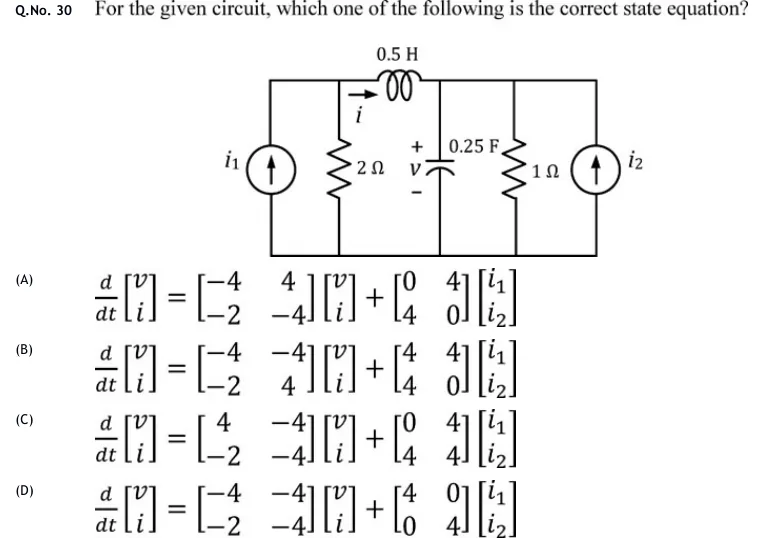
GATE 2020 EC question 30: Two-node circuit with a common bottom (ground) rail.Tap to open full size
Figure from the GATE 2020 EC paper. It is part of the question.
Figure description

Two-node circuit with a common bottom (ground) rail. Left top node: an independent current source i_1 (arrow pointing up, injecting current into the left top node) and a 2 Ω resistor, both connected between the left top node and ground. The left top node connects to the right top node through a series inductor of 0.5 H in the top rail; the inductor current i is marked with an arrow flowing left to right. Right top node: a 0.25 F capacitor with voltage v (+ at top, - at bottom), a 1 Ω resistor, and an independent current source i_2 (arrow pointing up, injecting current into the right top node), all connected between the right top node and ground.

  1. (A)

  2. (B)

  3. (C)

  4. (D)

Answer and solution

ANSWER

The state equation is , which is option (A).

Official answer: ASource: Official answer key, GATE 2020 EC (IIT Delhi)

  1. Take the energy-storage variables as the states: the capacitor voltage and the inductor current . Call the voltage of the left top node (the node shared by , the resistor and the inductor's left end) , measured from the bottom rail.

  2. KCL at the left node: enters, while the current and the inductor current leave.

  3. KVL around the loop formed by the branch, the inductor and the capacitor gives the inductor voltage (positive at its left end, the direction of ) as :

  4. KCL at the right top node: and enter; the capacitor current and the current leave.

  5. Assemble in the order with inputs :

  6. Check against the options. has no term () because reaches the capacitor node only through the inductor. has no term () because is in parallel with the capacitor, so it changes , not directly. The matrix appears in (A) and (B), but only (A) also has . The answer is (A).

KEY IDEA

To get a circuit's state equations, write KVL across each inductor to find and KCL at each capacitor node to find . Then remove every non-state quantity (here the left node voltage ) using the resistor and source relations. The signs of the diagonal entries (both negative for a passive RLC network) and where the zeros sit in are quick checks that rule out most options.

WATCH OUT FOR

Treating as if it equals and forgetting that the inductor current also flows out of the left node. That drops the term in . The other common error is getting the sign of the coupling terms wrong: current charges the capacitor, so has , while opposes the inductor current, so has . Flipping either sign leads to (B), (C) or (D).

From the GATE 2020 EC paper. Every question of this paper · Download the full paper · All 16 State space questions, with notes

More State space questions