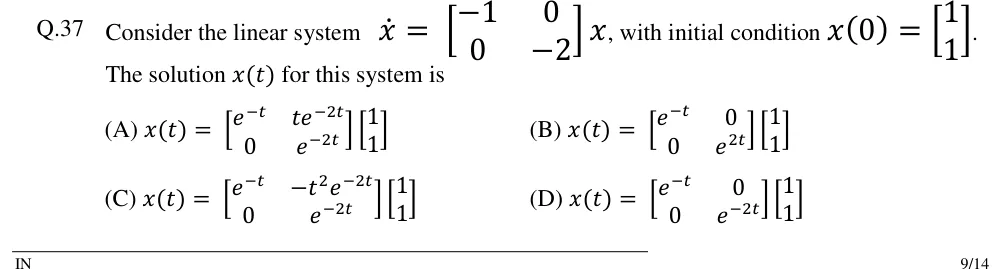
Consider the linear system , with initial condition . The solution for this system is
- (A)
- (B)
- (C)
- (D)

Consider the linear system , with initial condition . The solution for this system is
ANSWER
The answer is (D): .
Official answer: DSource: Official answer key, GATE 2018 IN (IIT Guwahati)
For the unforced system the solution is , where is the state transition matrix.
Here is diagonal, so every power of it is diagonal: . Summing the series term by term gives This is the same as saying the two states are decoupled: and .
Check by Laplace transform: , so and
So . This is option (D).
Why the others are wrong. (A) and (C) have a non-zero top-right entry. Step 2 shows that of a diagonal has no off-diagonal entries at all. A term like would need a Jordan block at , which means a repeated eigenvalue and a non-zero off-diagonal entry in . This has neither. (B) has , but the diagonal entries of are with and , so it would need an eigenvalue at .
A quick check by substitution. All four matrices equal at , so cannot tell them apart. Putting each candidate into does. For (A), gives . For (C), gives . For (B), gives . Only (D) satisfies both state equations and the initial condition. Because the solution is unique, the answer is (D).
KEY IDEA
For a diagonal , is diagonal with entries , because every power of a diagonal matrix is diagonal. Each state decays on its own, , and there are no cross terms.
WATCH OUT FOR
Using to eliminate options. Here every option equals at , including (C), whose term vanishes at , so that check eliminates nothing. The other mistake is misreading as , which is option (B). The mode for an eigenvalue at is .
From the GATE 2018 IN paper. Every question of this paper · Download the full paper · All 16 State space questions, with notes