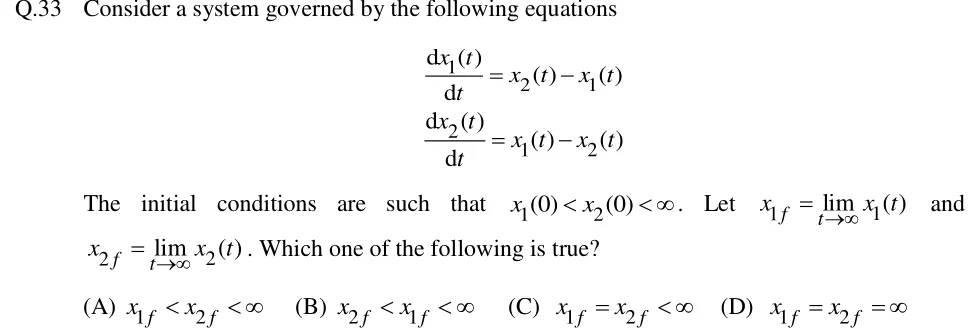
Consider a system governed by the following equations
The initial conditions are such that . Let and . Which one of the following is true?
- (A)
- (B)
- (C)
- (D)

Consider a system governed by the following equations
The initial conditions are such that . Let and . Which one of the following is true?
ANSWER
Both states settle at the same finite value, the average of the two initial values: . The answer is (C).
Official answer: CSource: Official answer key, GATE 2018 EE (IIT Guwahati)
Write the equations in state-space form: with and .
Eigenvalues: , so . Neither eigenvalue has a positive real part, and is a simple (non-repeated) root, so it contributes only a constant term. No state can grow without bound, which rules out (D).
Conserved quantity: adding the two equations gives , so for all . This is the mode.
Difference mode: let . Then , so . This is the mode.
Since , the gap stays positive for every finite but decays to zero, so . That rules out (A) and (B).
Solving the sum and the difference together gives the final values: This is finite because both initial values are finite.
So , which is option (C).
KEY IDEA
Break the system into its modes. The sum is conserved (the mode) and the difference decays as (the mode). The states therefore meet at the average of their initial values. The system is marginally stable, not asymptotically stable: it stays bounded but does not return to zero.
WATCH OUT FOR
Reading as instability and choosing (D). A simple eigenvalue at the origin gives a constant mode, not a growing one; only a repeated eigenvalue at zero (with a Jordan block) would give a term that grows like . The other mistake is assuming the ordering survives to the limit and choosing (A). The gap stays positive for every finite but goes to zero as .
From the GATE 2018 EE paper. Every question of this paper · Download the full paper · All 16 State space questions, with notes