
IAE Academy

GATE 2024 EC Q.13: solution and answer

GATE 2024 · ECQ.13 · 1 mark · MCQ

In the feedback control system shown in the figure below .

, , and are the Laplace transforms of , , and , respectively. If the input is a unit step function, then __________.
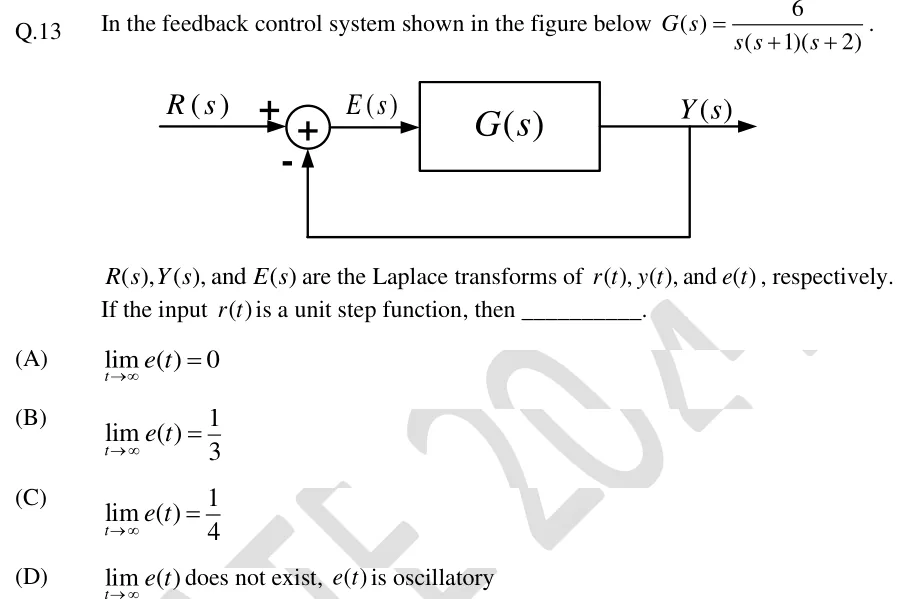
GATE 2024 EC question 13: Unity negative feedback loop.Tap to open full size
Figure from the GATE 2024 EC paper. It is part of the question.
Figure description

Unity negative feedback loop. Input R(s) enters a summing junction on its '+' terminal. The junction output E(s) feeds a block G(s), whose output is Y(s). Y(s) is taken off and fed back directly (gain 1, no block) to the summing junction's '-' terminal.

  1. (A)

  2. (B)

  3. (C)

  4. (D)

    does not exist, is oscillatory

Answer and solution

ANSWER

(D) The limit of e(t) as t goes to infinity does not exist, because e(t) oscillates. The closed-loop poles are s = -3 and s = ±j√2, so the error keeps an undamped sinusoid at √2 rad/s.

Official answer: DSource: Official answer key, GATE 2024 EC (IISc Bengaluru)

  1. Check that the closed loop is stable before using the final value theorem. With unity negative feedback the characteristic equation is , so :

  2. Routh array. Row : . Row : . Row : . The whole row is zero, which means some roots sit symmetrically about the origin. The first-column entries that exist (, ) do not change sign, so no root lies in the right half-plane.

  3. Take the auxiliary polynomial from the row: . Factoring confirms it: . The closed-loop poles are and , so the system is marginally stable.

  4. For unity feedback the error transform is

  5. has poles at , on the -axis. The final value theorem needs every pole of to be in the open left half-plane, so it cannot be used here. The numerator does not cancel these poles: at it equals .

  6. Partial fractions: so

  7. The exponential term dies out. The sinusoid at never decays, and its amplitude is . So keeps oscillating and does not exist. This is option (D).

KEY IDEA

The final value theorem only applies when every pole of is in the open left half-plane. So check closed-loop stability first. Here , which puts a pair of poles on the -axis at . The loop is marginally stable, so the error ends up as a steady sinusoid instead of settling to a limit.

WATCH OUT FOR

The common mistake is to apply the final value theorem without checking stability. Blindly, , which gives the trap option (B). A second trap: noticing is type 1 and writing for a step, which gives option (A). Both results assume a stable closed loop, and this loop is not asymptotically stable.

From the GATE 2024 EC paper. Every question of this paper · Download the full paper · All 22 Time response questions, with notes

More Time response questions