
IAE Academy

GATE 2024 EE Q.22: solution and answer

GATE 2024 · EEQ.22 · 1 mark · MCQ

Consider the cascaded system as shown in the figure. Neglecting the faster component of the transient response, which one of the following options is a first-order pole-only approximation such that the steady-state values of the unit step responses of the original and the approximated systems are same?
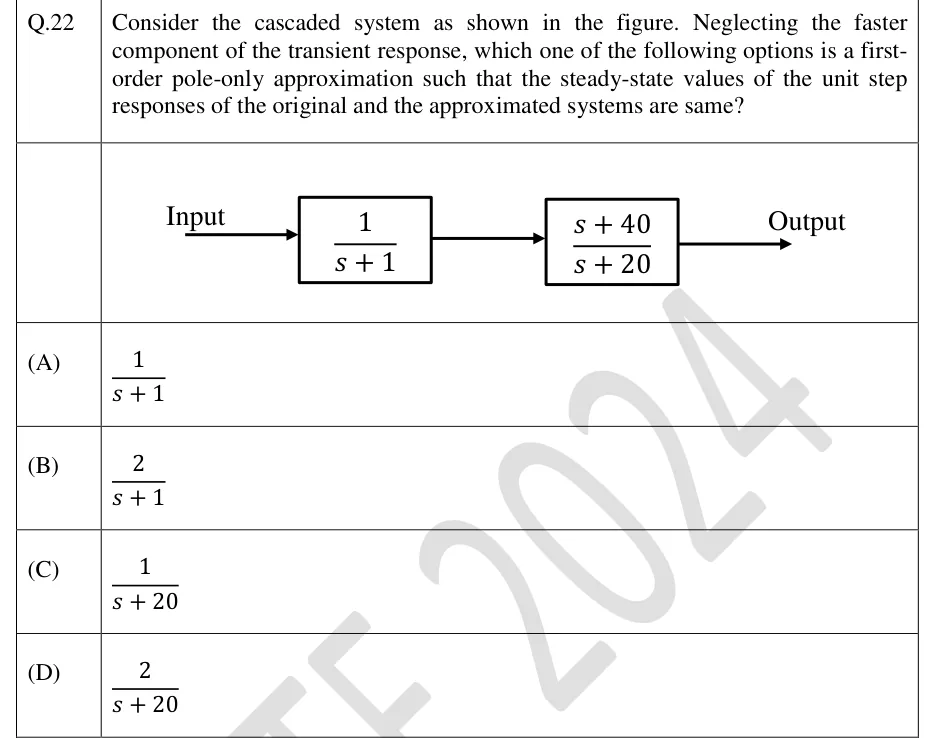
GATE 2024 EE question 22: Two blocks in cascade (series), no feedback.Tap to open full size
Figure from the GATE 2024 EE paper. It is part of the question.
Figure description

Two blocks in cascade (series), no feedback. An arrow labelled "Input" enters the first block (1)/(s+1); its output arrow goes into the second block (s+40)/(s+20); the output arrow of the second block is labelled "Output".

  1. (A)

  2. (B)

  3. (C)

  4. (D)

Answer and solution

ANSWER

The first-order pole-only approximation is , option (B). It keeps the dominant pole at , and its DC gain is 2, the same as the original system's .

Official answer: BSource: Official answer key, GATE 2024 EE (IISc Bengaluru)

  1. Blocks in series multiply, so the overall transfer function is

  2. The poles are at and . The pole at produces an term, which decays 20 times faster than the term (time constant against ). So is the dominant pole and the one to keep. The zero at is even further from the origin, and a pole-only model drops it as well.

  3. The approximation must therefore have the form . That rules out (C) and (D), which keep the fast pole and drop the slow one.

  4. Final value theorem for a unit step input: . Matching the steady-state values is the same as matching the DC gains.

  5. DC gain of the original system:

  6. DC gain of the approximation: . Setting gives which is option (B).

KEY IDEA

To reduce the order, keep the dominant pole (the one closest to the origin, here ) and drop the far pole and zero. Then pick the gain so the DC gains match, because by the final value theorem the unit-step steady state equals .

WATCH OUT FOR

There are three common traps. (1) Dropping the second block entirely and choosing (A) . This ignores the block's DC gain of and halves the steady-state value. (2) Keeping the pole at because it 'looks bigger', which gives (C) or (D). The pole to keep is the slow one closest to the origin, not the fast one. (3) Expanding in partial fractions, , and simply deleting the fast term. That leaves , whose DC gain of does not equal 2. The question asks for the steady states to match, so the gain has to be reset to .

From the GATE 2024 EE paper. Every question of this paper · Download the full paper · All 22 Time response questions, with notes

More Time response questions