
IAE Academy

GATE 2025 IN Q.59: solution and answer

GATE 2025 · INQ.59 · 2 marks · NAT

A feedback control system is shown in the figure.

The maximum allowable value of such that the output , due to any step disturbance signal , becomes zero at steady-state, is ________ (in integer).
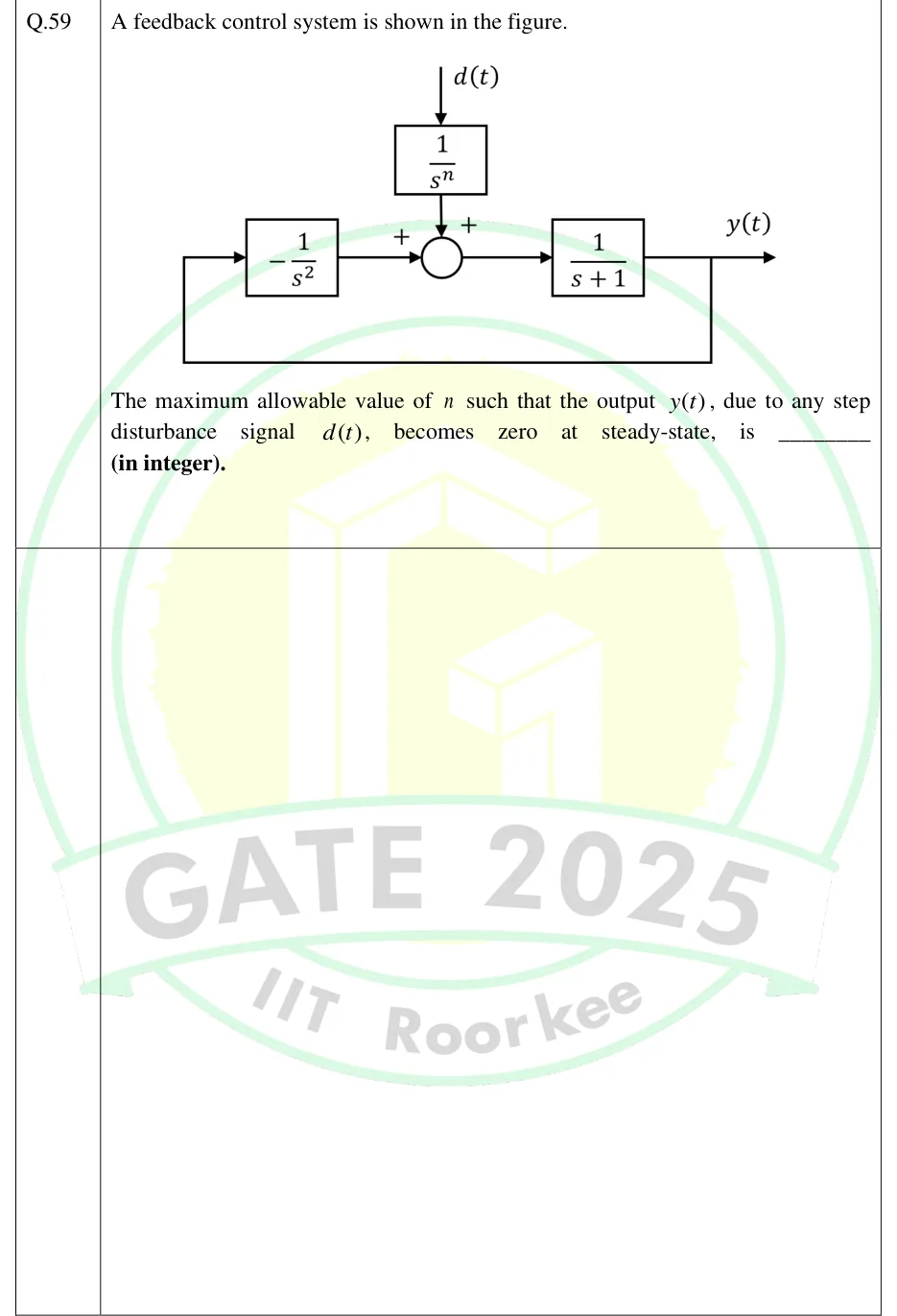
GATE 2025 IN question 59: Block diagram with one summing junction, both inputs marked +.Tap to open full size
Figure from the GATE 2025 IN paper. It is part of the question.
Figure description

Block diagram with one summing junction, both inputs marked +. The disturbance d(t) enters from the top through a block 1/s^n and goes into the junction's top input (+). The junction output passes through a forward block 1/(s+1) to give the output y(t). y(t) is picked off and fed back along a path below the diagram to the left side, where it enters a feedback block -1/s^2 (the minus sign is inside the block). That block's output goes into the junction's left input (+). There is no separate reference input.

Answer and solution

ANSWER

Applying the final value theorem formally, as the question intends, gives n = 1. Strictly, though, the closed loop (characteristic polynomial s^3 + s^2 + 1) has two right-half-plane poles, so y(t) grows without bound for every n and the condition cannot be met.

Official answer: marks to all candidatesSource: Official answer key, GATE 2025 IN (IIT Roorkee)

  1. Loop equation. The junction adds and , and its output passes through : The block feeding a input is ordinary negative feedback with .

  2. Disturbance-to-output transfer function. Collect the terms and multiply numerator and denominator by :

  3. Check stability before using the final value theorem. The characteristic polynomial is . Its coefficient is zero, so it fails the necessary condition for stability. Routh array: The first column changes sign twice, so there are two right-half-plane poles. The roots are and .

  4. What this means for . A step disturbance () gives The numerator is just a power of , so it can never cancel the poles at . So always contains a term that grows like with a nonzero coefficient. Strictly, grows without bound for every , and no value of makes it settle to zero. The question is flawed as printed.

  5. The method the question intends (final value theorem applied formally). because the denominator tends to . This limit is zero only if , that is .

  6. Test the boundary values formally. : . : . : . Every gives zero, so the largest allowed integer is .

  7. Conclusion. The intended answer, from applying the final value theorem formally, is . Strictly speaking, the closed loop is unstable, so the theorem does not apply and no satisfies the condition. The official key is MTA, so neither reading can lose marks.

KEY IDEA

Rejecting a step disturbance needs the disturbance-to-output transfer function to have at least one zero at the origin. Here the loop's feedback puts in the numerator of , and the disturbance path's removes of those zeros. That leaves , and a step (one more ) is rejected only if . A second rule matters just as much: the final value theorem only holds for a stable closed loop, so do a Routh check first. Here it fails, because has no term.

WATCH OUT FOR

(1) Using the final value theorem without checking stability. The characteristic polynomial has a missing coefficient, so the loop is unstable and the theorem's result is only formal. (2) Answering by asking only for a finite steady state () rather than a zero one (). (3) Reading the block going into a junction as positive feedback. That gives , which is also unstable, so it changes the algebra but not the formal answer.

From the GATE 2025 IN paper. Every question of this paper · Download the full paper · All 22 Time response questions, with notes

More Time response questions