IAE Academy

GATE 2018 EE Q.9: solution and answer

GATE 2018 · EEQ.9 · 1 mark · MCQ

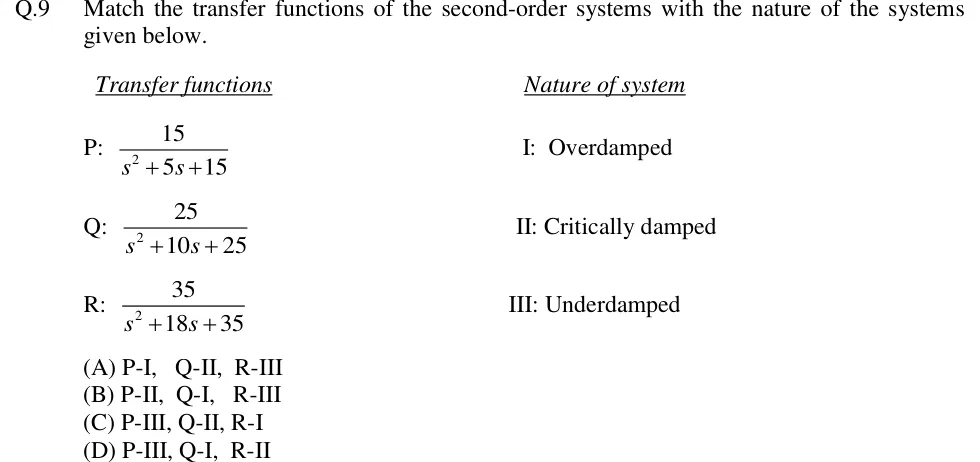
Match the transfer functions of the second-order systems with the nature of the systems given below.

Transfer functions

P:

Q:

R:

Nature of system

I: Overdamped

II: Critically damped

III: Underdamped

  1. (A)

    P-I, Q-II, R-III

  2. (B)

    P-II, Q-I, R-III

  3. (C)

    P-III, Q-II, R-I

  4. (D)

    P-III, Q-I, R-II

See the question in the paper

Answer and solution

ANSWER

P is underdamped (), Q is critically damped () and R is overdamped (). The matching is P-III, Q-II, R-I, which is option (C).

Official answer: CSource: Official answer key, GATE 2018 EE (IIT Guwahati)

  1. Compare each denominator with the standard form . This gives and .

  2. Classification rule: is underdamped, is critically damped and is overdamped. For a denominator the same test can be run on the discriminant : negative, zero or positive respectively.

  3. P: , so . Check: the discriminant is , so the poles are complex, . Underdamped (III).

  4. Q: , so and . There is a repeated real pole at . Critically damped (II).

  5. R: , so . Check: the discriminant is , giving two distinct real poles and . Overdamped (I).

  6. So the matching is P-III, Q-II, R-I, which is option (C).

KEY IDEA

The damping ratio of a second-order system comes from its denominator alone: for , . Equivalently, compare with . If the poles are complex (underdamped), if they are repeated (critically damped), and if they are real and distinct (overdamped). The numerator plays no part.

WATCH OUT FOR

Taking to be the coefficient of divided by , forgetting the division by . That gives , and , which would wrongly call all three systems overdamped. A second mistake is to rank the systems by the size of the coefficient alone. R has the largest coefficient, but you only know it is overdamped once you check .

From the GATE 2018 EE paper. Every question of this paper · Download the full paper · All 22 Time response questions, with notes

More Time response questions