IAE Academy

GATE 2026 EE Q.13: solution and answer

GATE 2026 · EEQ.13 · 1 mark · MCQ

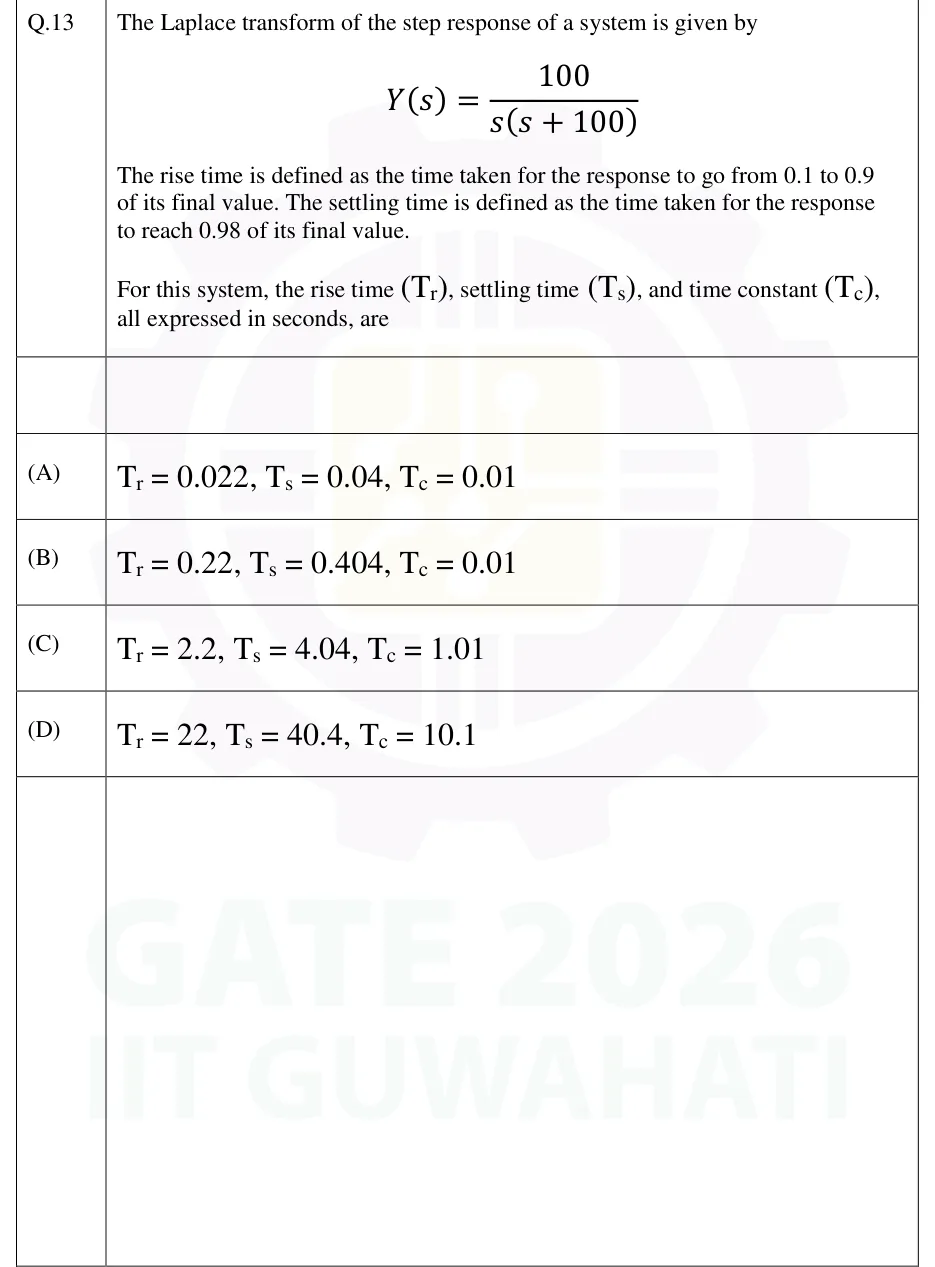
The Laplace transform of the step response of a system is given by

The rise time is defined as the time taken for the response to go from 0.1 to 0.9 of its final value. The settling time is defined as the time taken for the response to reach 0.98 of its final value.

For this system, the rise time , settling time , and time constant , all expressed in seconds, are

  1. (A)

  2. (B)

  3. (C)

  4. (D)

See the question in the paper

Answer and solution

ANSWER

The answer is (A): , , .

Official answer: ASource: Official answer key, GATE 2026 EE (IIT Guwahati)

  1. Remove the unit-step factor to get the transfer function: . This is a first-order system with DC gain 1.

  2. Read the time constant off the standard form : .

  3. Inverse Laplace by partial fractions: , so and the final value is .

  4. Rise time from 10% to 90%: gives , and gives . So and .

  5. Settling time to 98%: gives , so . This is the usual rule for the 2% band.

  6. Option (A) is the only one with all three values right: , , . Option (B) has the correct , but its and are ten times too large. Options (C) and (D) get itself wrong.

KEY IDEA

Remove the step factor and what is left, with , is a first-order system. Every time-domain figure is then a fixed multiple of : the 10–90% rise time is , and the 2% settling time is .

WATCH OUT FOR

Reading as 100 s from the pole at , which makes every value 10,000 times too large. The time constant is the reciprocal of the pole magnitude. A second slip is taking the rise time as (from 0 to 90%) and not from 10% to 90%. A third is using or the second-order formula for settling time, when this is a first-order response.

From the GATE 2026 EE paper. Every question of this paper · Download the full paper · All 22 Time response questions, with notes

More Time response questions