IAE Academy

GATE 2026 DA Q.18: solution and answer

GATE 2026 · DAQ.18 · 1 mark · MCQ

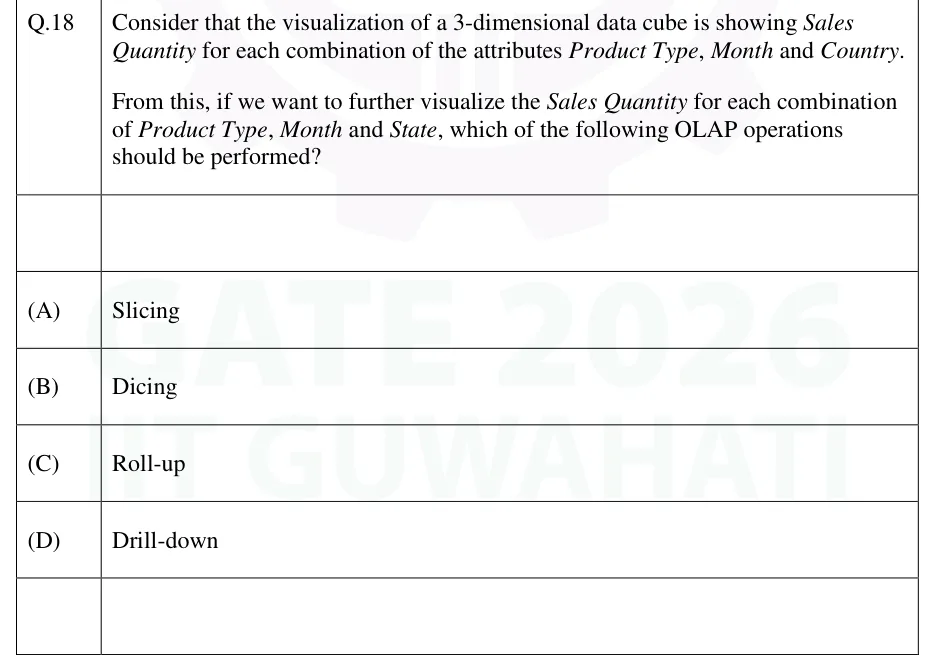
Consider that the visualization of a 3-dimensional data cube is showing Sales Quantity for each combination of the attributes Product Type, Month and Country.

From this, if we want to further visualize the Sales Quantity for each combination of Product Type, Month and State, which of the following OLAP operations should be performed?

  1. (A)

    Slicing

  2. (B)

    Dicing

  3. (C)

    Roll-up

  4. (D)

    Drill-down

See the question in the paper

Answer and solution

ANSWER

The operation is drill-down, option (D).

Official answer: DSource: Official answer key, GATE 2026 DA (IIT Guwahati)

  1. The cube keeps the same three dimensions: Product Type, Month and a location attribute. Only the level of the location dimension changes, from Country to State.

  2. In the location hierarchy , State is a finer level than Country, because each country contains many states.

  3. Moving from a coarser level to a finer level of detail along a dimension hierarchy is drill-down. The reverse, moving to a coarser level, is roll-up.

  4. Slicing fixes one dimension to a single value and so produces a cube with one dimension fewer. Dicing selects a sub-cube by restricting values on two or more dimensions. Neither changes the level of granularity of a dimension.

  5. Going from Country to State gives more detailed data, so the operation is drill-down: option (D).

KEY IDEA

Changing the level of a dimension's hierarchy is drill-down (to a finer level) or roll-up (to a coarser level). Slicing and dicing only select part of the cube and keep the level of detail.

WATCH OUT FOR

Picking dicing or slicing because the question says 'for each combination of' attributes. These operations only restrict values. They do not change the level of detail. Another slip is reversing the direction and choosing roll-up, but State is finer than Country, so the move is down the hierarchy.

From the GATE 2026 DA paper. Every question of this paper · Download the full paper · All 3 Data warehousing questions, with notes

More Data warehousing questions