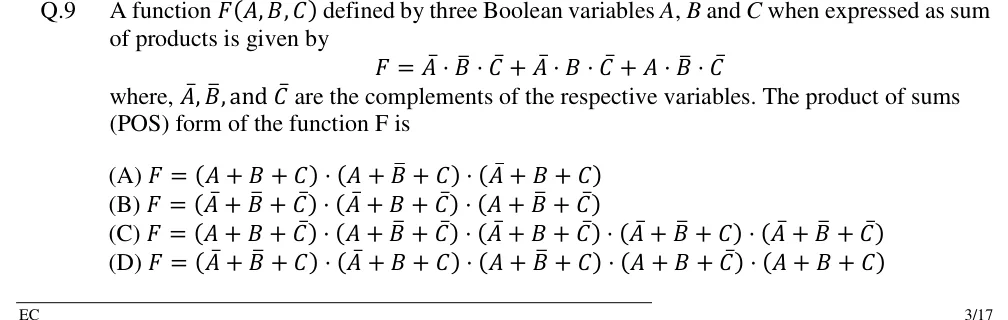
A function defined by three Boolean variables , and when expressed as sum of products is given by
where, , , and are the complements of the respective variables. The product of sums (POS) form of the function F is
- (A)
- (B)
- (C)
- (D)

A function defined by three Boolean variables , and when expressed as sum of products is given by
where, , , and are the complements of the respective variables. The product of sums (POS) form of the function F is
ANSWER
(C) , which is .
Official answer: CSource: Official answer key, GATE 2018 EC (IIT Guwahati)
Complements are written with throughout. Turn each product term into its minterm by reading an uncomplemented variable as 1 and a complemented one as 0: , , .
So . is 1 on exactly these three input combinations and 0 on the other five: .
The canonical POS is the product of the maxterms at which : .
Write each maxterm by reading a 0 as the plain variable and a 1 as its complement (the opposite of the minterm rule): , , , , .
This is option (C), with the factors in the same order.
Check the others. Every factor in every option contains all three variables, so each factor is a single maxterm, and a product of maxterms is 0 exactly at those maxterm numbers. (A) is , which is 0 at , exactly where should be 1. (B) is , which is 0 only at 3, 5 and 7. It is 1 at and , where . (D) is , which is 0 at , where . So only (C) works.
Quick algebraic check. Simplify the SOP: .
Now simplify option (C) with the adjacency rule , reusing where needed (allowed because ). . . . Then , so option (C) , the same as . The answer is (C).
KEY IDEA
For a function of variables, the minterms and maxterms split the input numbers between them. If , then its canonical POS is over every number not in . Here , so the POS is . For a maxterm, a 0 bit gives the plain variable and a 1 bit gives its complement.
WATCH OUT FOR
The usual mistake is to keep the same indices and write , which is option (A). Its factors are 0 exactly where should be 1. The other is writing each maxterm with the minterm literal rule (a 1 bit as the plain variable). That turns into the wrong-looking option (D) and is a quick way to lose the mark.
From the GATE 2018 EC paper. Every question of this paper · Download the full paper · All 22 Boolean logic questions, with notes