
IAE Academy

GATE 2018 EE Q.14: solution and answer

GATE 2018 · EEQ.14 · 1 mark · MCQ

In the logic circuit shown in the figure, Y is given by
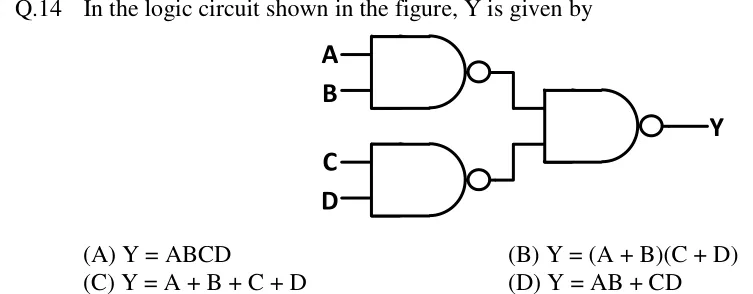
GATE 2018 EE question 14: Three two-input NAND gates, each drawn as an AND shape with an output bubble.Tap to open full size
Figure from the GATE 2018 EE paper. It is part of the question.
Figure description

Three two-input NAND gates, each drawn as an AND shape with an output bubble. Gate 1 takes inputs A (top) and B (bottom). Gate 2 takes inputs C (top) and D (bottom). The output of Gate 1 feeds the upper input of Gate 3 and the output of Gate 2 feeds its lower input. Gate 3 is also a NAND gate (AND shape with an output bubble), and its output is labelled Y.

  1. (A)

    Y = ABCD

  2. (B)

    Y = (A + B)(C + D)

  3. (C)

    Y = A + B + C + D

  4. (D)

    Y = AB + CD

Answer and solution

ANSWER

, which is option (D).

Official answer: DSource: Official answer key, GATE 2018 EE (IIT Guwahati)

  1. All three gates are two-input NAND gates: each is an AND body with a bubble on its output. Complement is written with an overline, .

  2. First-level outputs: the upper gate gives and the lower gate gives .

  3. The output gate is a NAND of and :

  4. By De Morgan's theorem, , with and :

  5. Double complementation, , gives This is the standard NAND-NAND form of a sum of products.

  6. Check with , : and , so , and agrees. Option (A) gives and option (B) gives , so both are ruled out.

  7. Check with , : and , so , and agrees. Option (C) gives , so it is ruled out. Option (D) is correct.

KEY IDEA

A two-level NAND-NAND circuit carries out an AND-OR (sum-of-products) function. By De Morgan's theorem, the output gate's NAND turns into an OR of the complemented inputs, and those complements cancel the bubbles of the first-level gates. So each first-level NAND gives one product term, and the output is the OR of those terms: .

WATCH OUT FOR

Treating each bubble as a separate inversion of the whole circuit and ending up with , or applying De Morgan to the inner NANDs as well, which gives -type terms and leads to option (B) or (C). Only the output NAND needs De Morgan. Its complements cancel the first-level bubbles, so the inner products and come through unchanged.

From the GATE 2018 EE paper. Every question of this paper · Download the full paper · All 22 Boolean logic questions, with notes

More Boolean logic questions