
IAE Academy

GATE 2026 IN Q.47: solution and answer

GATE 2026 · INQ.47 · 2 marks · MCQ

The initial state of in the digital circuit shown below is 1011.

The new value of after two rising edges of the clock (CLK) will be ______.
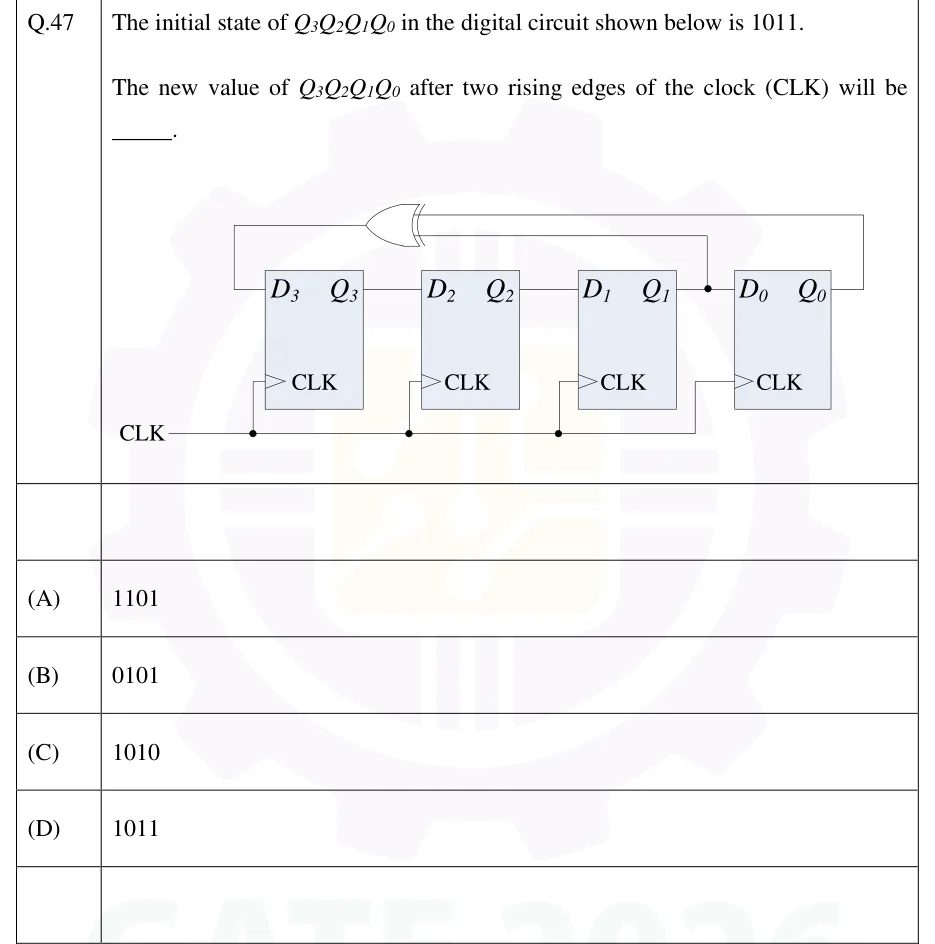
GATE 2026 IN question 47: Four positive-edge-triggered D flip-flops drawn left to right: FF3 (D_3, Q_3), FF2 (D_2, Q_2), FF1 (D_1, Q_1), FF0 (D_0…Tap to open full size
Figure from the GATE 2026 IN paper. It is part of the question.
Figure description

Four positive-edge-triggered D flip-flops drawn left to right: FF3 (D_3, Q_3), FF2 (D_2, Q_2), FF1 (D_1, Q_1), FF0 (D_0, Q_0). All four CLK inputs (plain triangle, no bubble) are tied to one common CLK line. Shift chain: Q_3 feeds D_2, Q_2 feeds D_1, Q_1 feeds D_0. A two-input XOR gate sits above the chain, drawn facing left. One XOR input is taken from a junction dot on the Q_1 to D_0 wire; the other XOR input is a feedback wire from Q_0, which runs up and back over the top of the circuit. The XOR output runs left and down into D_3. So D_3 = Q_1 XOR Q_0, D_2 = Q_3, D_1 = Q_2, D_0 = Q_1.

  1. (A)

    1101

  2. (B)

    0101

  3. (C)

    1010

  4. (D)

    1011

Answer and solution

ANSWER

After two rising edges the state goes , so . The answer is option (C).

Official answer: CSource: Official answer key, GATE 2026 IN (IIT Guwahati)

  1. Read the next-state equations off the circuit. For a D flip-flop, , so: The circuit is a right-shift register. Its serial input is the XOR of (taken from the junction dot on the wire) and (the feedback wire that runs back over the top).

  2. All four flip-flops share one clock, so the circuit is synchronous. On each rising edge, every is computed from the state held before that edge, and all four outputs change together.

  3. First rising edge, starting from (so ): , , , . New state: .

  4. Second rising edge, starting from (so ): , , , . New state: .

  5. After two rising edges, . This is option (C).

KEY IDEA

In a synchronous circuit, write for every flip-flop. Then work out every from the present state, update all flip-flops together on each clock edge, and repeat once per edge. Here the circuit is a right-shift register with XOR feedback: , , , .

WATCH OUT FOR

The most common slip is stopping after one clock edge. That gives , which is option (B). A second mistake is updating the flip-flops one at a time, so that an already-changed feeds the next within the same edge. A third is reading the XOR gate as an XNOR: the first edge then gives , which is option (A). A fourth is shifting in the wrong direction. Each wire goes from to , so the bits move from towards .

From the GATE 2026 IN paper. Every question of this paper · Download the full paper · All 30 Sequential questions, with notes

More Sequential questions