IAE Academy

GATE 2020 EE Q.28: solution and answer

GATE 2020 · EEQ.28 · 2 marks · MCQ

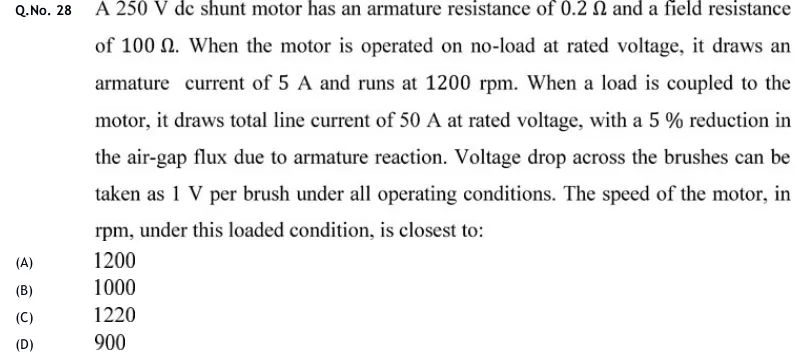
A 250 V dc shunt motor has an armature resistance of and a field resistance of . When the motor is operated on no-load at rated voltage, it draws an armature current of 5 A and runs at 1200 rpm. When a load is coupled to the motor, it draws total line current of 50 A at rated voltage, with a 5% reduction in the air-gap flux due to armature reaction. Voltage drop across the brushes can be taken as 1 V per brush under all operating conditions. The speed of the motor, in rpm, under this loaded condition, is closest to:

  1. (A)

    1200

  2. (B)

    1000

  3. (C)

    1220

  4. (D)

    900

See the question in the paper

Answer and solution

ANSWER

The loaded speed is closest to 1220 rpm — option C.

Official answer: CSource: Official answer key, GATE 2020 EE (IIT Delhi)

  1. Field current is fixed by the rated voltage and field resistance: (unchanged at no-load and under load, since the shunt field sees rated voltage throughout).

  2. No-load condition: armature current (given directly). Back EMF: .

  3. Loaded condition: total line current , so armature current .

  4. Back EMF under load: .

  5. Flux under load is reduced by armature reaction: .

  6. Since : .

  7. Computing: , and .

  8. , matching option (C).

KEY IDEA

For a dc shunt motor, back EMF , and speed is proportional to (since ). Field current stays fixed (rated voltage across a fixed field resistance), so armature current at each condition is found by subtracting field current from line current (no-load) or total line current (loaded).

WATCH OUT FOR

Using the given no-load armature current directly (correct) but then forgetting to subtract the field current from the loaded total line current to get loaded armature current — using instead of 47.5 A. Also common: forgetting the 2 V total brush drop (1 V/brush × 2 brushes), or applying the flux reduction the wrong way (multiplying instead of dividing by 0.95 in the speed ratio).

From the GATE 2020 EE paper. Every question of this paper · Download the full paper · All 8 DC machines questions, with notes

More DC machines questions