
IAE Academy

GATE 2026 EE Q.21: solution and answer

GATE 2026 · EEQ.21 · 1 mark · MCQ

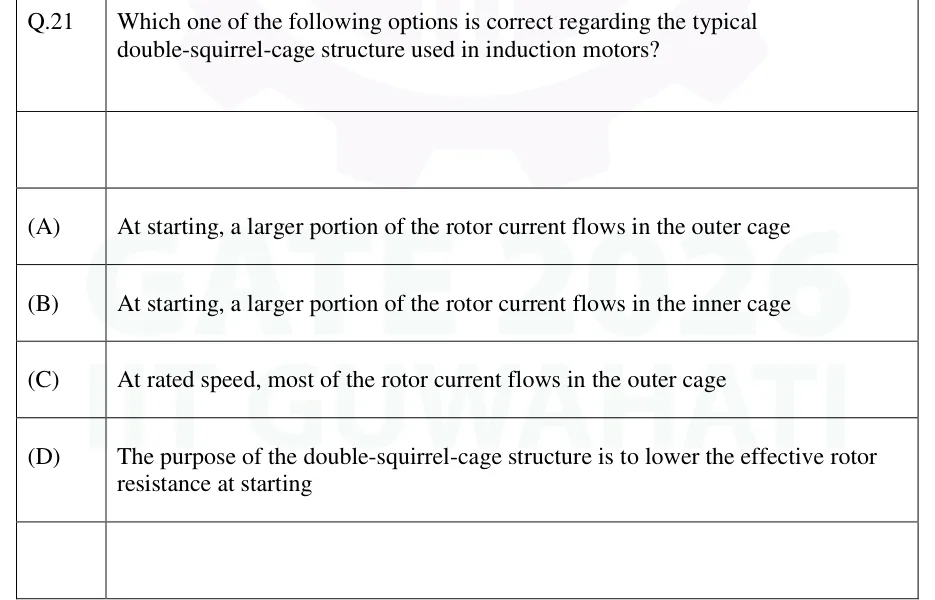
Which one of the following options is correct regarding the typical double-squirrel-cage structure used in induction motors?

  1. (A)

    At starting, a larger portion of the rotor current flows in the outer cage

  2. (B)

    At starting, a larger portion of the rotor current flows in the inner cage

  3. (C)

    At rated speed, most of the rotor current flows in the outer cage

  4. (D)

    The purpose of the double-squirrel-cage structure is to lower the effective rotor resistance at starting
See the question in the paper

Answer and solution

ANSWER

Correct answer: (A) — At starting, a larger portion of the rotor current flows in the outer cage of the double-squirrel-cage rotor.

Official answer: ASource: Official answer key, GATE 2026 EE (IIT Guwahati)

  1. Double-cage rotor construction: outer cage has small-cross-section bars near the air gap, giving high resistance and low leakage reactance (fewer flux linkages).

  2. Inner cage has large-cross-section bars deep in the slots, giving low resistance and high leakage reactance (strongly linked by slot leakage flux).

  3. Rotor branch reactance at slip is (the standstill, supply-frequency reactance scaled by slip). At starting, , so both and are at their maximum values.

  4. At starting, , so the inner-cage impedance is much larger than the outer-cage impedance. Current is therefore forced predominantly into the low-impedance outer cage — this is option (A).

  5. This redistribution raises the effective rotor resistance at starting (current flows mainly through the high- outer cage), which is exactly what produces high starting torque, like an external rotor-resistance starter — so option (D), which claims the structure lowers effective rotor resistance at starting, is false.

  6. At rated (near-synchronous) speed, is small, so and both shrink toward zero; the branches become resistance-dominated and current divides inversely with resistance, concentrating in the low-resistance inner cage — so option (C) (most current in the outer cage at rated speed) is false, and option (B) (larger portion in the inner cage at starting) is false since it is the opposite of step 4.

  7. Hence only (A) is consistent with the physics.

KEY IDEA

In a double-squirrel-cage rotor, the outer cage (small bars near the air gap) has high resistance and low leakage reactance, while the inner cage (large bars deep in the slot) has low resistance and high leakage reactance. Since rotor reactance scales with slip (), at starting () the reactances are at their supply-frequency maximum, so the high-reactance inner cage is effectively "choked off" and current is forced into the low-reactance outer cage — giving high effective rotor resistance and hence high starting torque, exactly like an external rotor-resistance starter. Near synchronous speed, slip is small, both reactances collapse, and the division of current is governed by resistance alone, so current concentrates in the low-resistance inner cage — giving low running losses and good efficiency.

WATCH OUT FOR

Confusing which cage dominates at which condition — assuming the low-resistance (inner) cage always carries most of the current (true only near rated speed, not at starting), or believing the purpose of the double cage is to reduce rotor resistance at starting rather than to raise it for better starting torque.

From the GATE 2026 EE paper. Every question of this paper · Download the full paper · All 17 Induction machines questions, with notes

More Induction machines questions