IAE Academy

GATE 2020 EE Q.33: solution and answer

GATE 2020 · EEQ.33 · 2 marks · MCQ

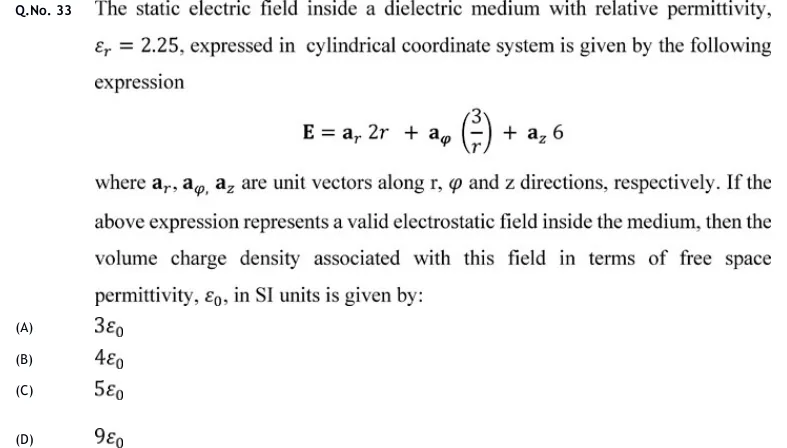
The static electric field inside a dielectric medium with relative permittivity, , expressed in cylindrical coordinate system is given by the following expression

where are unit vectors along , and directions, respectively. If the above expression represents a valid electrostatic field inside the medium, then the volume charge density associated with this field in terms of free space permittivity, , in SI units is given by:

  1. (A)

  2. (B)

  3. (C)

  4. (D)

See the question in the paper

Answer and solution

ANSWER

The volume charge density is , option (D).

Official answer: DSource: Official answer key, GATE 2020 EE (IIT Delhi)

  1. Use Gauss's law in point form. In a linear dielectric , so . The medium is uniform, so comes out of the divergence. Here , but the answer is asked for in terms of .

  2. Divergence in cylindrical coordinates: with , , .

  3. Radial term: , so .

  4. Azimuthal term: does not depend on , so it contributes . Axial term: is constant, so it contributes . Hence .

  5. Check that the field is a valid electrostatic field, i.e. . In cylindrical coordinates: -component ; -component ; -component . So the field is curl-free (for ), as the question states.

  6. Volume charge density: which is option (D).

KEY IDEA

Free charge comes from the divergence of , not of : in a uniform linear dielectric, . In cylindrical coordinates the radial term is , and a -component that depends only on adds nothing to the divergence.

WATCH OUT FOR

Using and leaving out gives (option B), which is the total (free plus bound) charge density, not the free charge. Another slip is to take the radial term as and forget the form, which gives , an answer that is not among the options.

From the GATE 2020 EE paper. Every question of this paper · Download the full paper · All 23 Electrostatics questions, with notes

More Electrostatics questions