
IAE Academy

GATE 2026 EE Q.63: solution and answer

GATE 2026 · EEQ.63 · 2 marks · NAT

A uniform spherical volume charge distribution of radius 2 m, centered at the origin, has a strength of . A point charge of strength is moved from to in Cartesian coordinate system. The relative permittivity of the medium is 1 and the coordinate values are in meters.

The work done during the process is ______

(Round off to two decimal places)
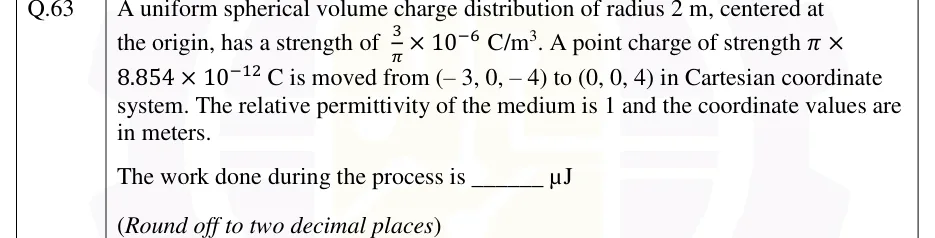
See the question in the paper

Answer and solution

ANSWER

The work done is 0.40 μJ.

Official answer: 0.38 to 0.42Source: Official answer key, GATE 2026 EE (IIT Guwahati)

  1. Locate the end points. Start : . End : . Both lie outside the charged sphere of radius .

  2. Total charge of the sphere.

  3. Potential outside the sphere. Gauss's law over a concentric sphere of radius gives , the same as a point charge at the origin. Integrating from infinity, for , with and .

  4. Work done by the external agent is . The electrostatic field is conservative, so this depends only on the end points and not on the path:

  5. Use the given value of q. , so .

  6. Compute.

  7. Check the sign. The work is positive: the positive point charge is pushed from to , closer to the positively charged sphere, against the repulsion.

KEY IDEA

Outside a uniformly charged sphere, the field and potential are those of a point charge at the centre. Electrostatic work depends only on the end points, , so only the two radial distances matter (5 m and 4 m). The point charge is given as so that exactly.

WATCH OUT FOR

Three common mistakes: (1) using the -coordinates or the straight-line distance between the points, 5 m apart, instead of each point's distance from the origin; (2) using the interior potential formula when both points are outside the sphere (, ); (3) writing , which gives (the work done by the field) instead of the work done by the external agent in moving the charge.

From the GATE 2026 EE paper. Every question of this paper · Download the full paper · All 23 Electrostatics questions, with notes

More Electrostatics questions