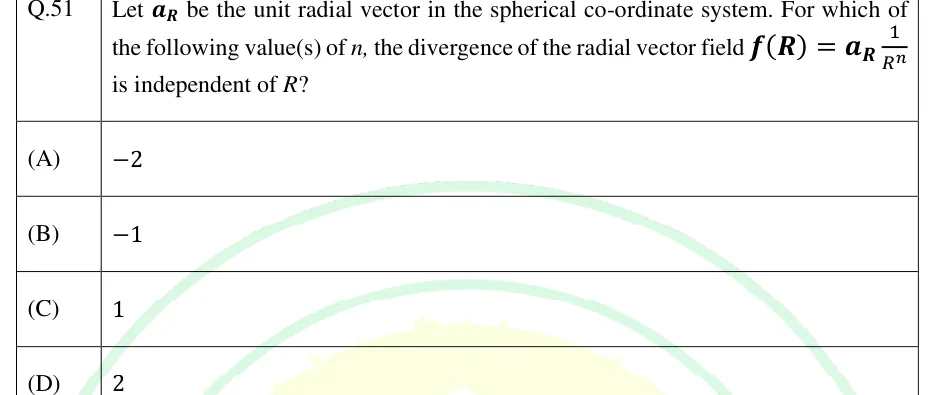
Let be the unit radial vector in the spherical co-ordinate system. For which of the following value(s) of , the divergence of the radial vector field is independent of ?
- (A)
- (B)
- (C)
- (D)

Let be the unit radial vector in the spherical co-ordinate system. For which of the following value(s) of , the divergence of the radial vector field is independent of ?
ANSWER
Options (B) and (D) are correct. With , gives the constant 3 and gives 0 everywhere except .
Official answer: B, DSource: Official answer key, GATE 2025 EE (IIT Roorkee)
The field has only a radial component, , and it does not depend on or . So only the radial term of the spherical divergence survives:
Substitute: , so .
Divide by : This is independent of only when the power of is zero or the coefficient is zero.
Case 1, the power of is zero: . Then and , a constant. So option (B) is correct.
Case 2, the coefficient is zero: . Then (the inverse-square field of a point charge) and for every . Zero is also independent of , so option (D) is correct.
Check the others: gives , and gives . Both depend on , so (A) and (C) are wrong. Answer: (B) and (D).
KEY IDEA
For a purely radial field in spherical coordinates, . With this gives . That expression can lose its -dependence in two ways: the power of becomes zero (), or the coefficient becomes zero (, the inverse-square field, which has zero divergence).
WATCH OUT FOR
Setting only the power of to zero and marking just (B). Students forget that a divergence of zero is also independent of , so they miss , the inverse-square (Coulomb) field. A second trap is using the Cartesian-style derivative without the factor. That gives and wrongly picks and .
From the GATE 2025 EE paper. Every question of this paper · Download the full paper · All 23 Electrostatics questions, with notes