
IAE Academy

GATE 2022 IN Q.57: solution and answer

GATE 2022 · INQ.57 · 2 marks · NAT

A conducting semi-circular loop of radius , with its diameter centered at the origin, rotates in the - plane about the origin with a constant angular velocity, , as shown. A magnetic field of magnitude and normal to - plane exists in the region as shown. If the loop has a resistance of , and negligible inductance, the peak-to-peak current (in milliamperes) in the loop is ________ (round off to one decimal place)
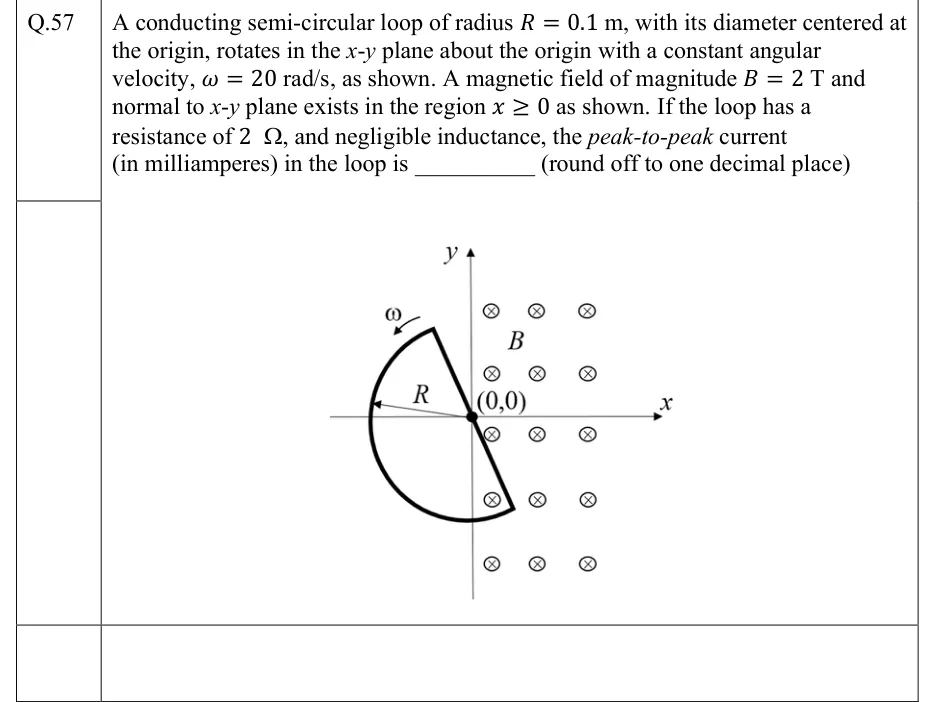
GATE 2022 IN question 57: Standard x-y axes with the origin marked (0,0) by a dot.Tap to open full size
Figure from the GATE 2022 IN paper. It is part of the question.
Figure description

Standard x-y axes with the origin marked (0,0) by a dot. A thick-outlined semicircular (half-disc) conducting loop has its straight diameter passing through the origin, tilted slightly from the y-axis: its upper end lies above the origin just left of the y-axis (x < 0) and its lower end lies below the origin just right of the y-axis (x > 0). The curved arc of radius R bulges to the left (into the x < 0 region); a horizontal arrow from the origin to the arc on the negative x side is labelled R. A curved arrow near the top of the arc labelled omega shows counter-clockwise rotation about the origin. The region x >= 0 is filled with a 5-row by 3-column grid of cross-in-circle symbols (field into the page) labelled B; no field is drawn for x < 0. In the position shown, only a small sector of the half-disc, just below the origin between the negative y-axis and the lower end of the diameter, lies inside the field region.

Answer and solution

ANSWER

The peak-to-peak current is 200.0 mA. The current is a square wave that switches between +100 mA and -100 mA every half-turn.

Official answer: 200.0Source: Official answer key, GATE 2022 IN (IIT Kharagpur)

  1. Flux linked. Only the part of the half-disc lying in links flux. The diameter is centred at the origin, so the half-disc is a sector of angle with its vertex at the origin. The field region is a half-plane bounded by a line through that same origin, so it is also a sector of angle about the origin. Two sectors with the same vertex overlap in a sector, whose angle is the overlap of their angular ranges. So

  2. How the overlap changes. The half-disc spans an angle of , and so does the field half-plane. As the loop turns at , the overlap angle grows linearly from to over half a turn, then falls linearly back to over the next half turn. Its rate is always the rotation rate: . So is a triangular wave in time, not a sinusoid.

  3. Faraday's law. The magnitude is the same at every instant. Only its sign changes, at the moments when reaches or .

  4. Ohm's law (inductance is negligible, so the current follows the emf at once):

  5. Lenz's law gives the sign. While the overlap grows (more flux into the page), the induced current makes a field out of the page, so it flows counter-clockwise as drawn. While the overlap shrinks, it flows clockwise. So is a square wave that switches between and every half-turn, i.e. every .

  6. Peak-to-peak current:

KEY IDEA

The half-disc and the field region are both sectors of angle centred on the pivot, so their overlap is always a sector. Its area rises and falls linearly at the rate . That makes the flux a triangular wave, so the emf has a constant magnitude and flips sign every half-turn. The current is a square wave, and its peak-to-peak value is twice the magnitude.

WATCH OUT FOR

There are three common mistakes. (1) Treating this like a coil turning in a uniform field and assuming a sinusoidal emf. Here the flux is a triangular wave and the emf is a square wave. (2) Reporting the magnitude, 100 mA, and forgetting that the current reverses when the overlap starts to shrink. The peak-to-peak value is 200 mA. (3) Deciding the current is DC because the emf magnitude never changes, and answering 0. It is also easy to use the whole semicircle's area in place of the rate of change of the overlap sector, .

From the GATE 2022 IN paper. Every question of this paper · Download the full paper · All 5 Maxwell's equations questions, with notes

More Maxwell's equations questions