Maxwell's equations, Faraday's law, boundary conditions and the Poynting vector
Maxwell's four equations tie the electric and magnetic fields to their sources and to each other. Faraday's law (a changing magnetic flux induces an emf) and the displacement current (a changing electric flux acts like a current) are what make time-varying fields and waves possible. The working skills for this topic are finding the emf in stationary and moving loops, checking whether a given field can satisfy Maxwell's equations, carrying fields across an interface with the boundary conditions, and computing power flow from the Poynting vector.
5 previous-year questions · 5 solved · 5 practice questions
Faraday's law, Lenz's law and induced emf
Conventions used throughout these notes
SI units. ε0=8.854×10⁻¹² F/m, μ0=4π×10−7 H/m, c=1/μ0ε0≈3×108 m/s, η0=μ0/ε0≈120π≈377Ω.
Unit vectors are written a^x,a^y,a^z (and a^ρ,a^ϕ in cylindrical coordinates).
Right-hand rule: the positive sense of circulation dl round a closed path C and the positive direction of dS on any surface bounded by C are related by the right hand (fingers along dl, thumb along dS).
Time-harmonic fields are phasors with ejωt:E(r,t)=Re[Es(r)ejωt], so ∂/∂t→jω. Phasor magnitudes are peak values unless stated otherwise.
A wave travelling in +z carries the phasor factor e−jβz (instantaneous form cos(ωt−βz)).
At an interface between media 1 and 2, the unit normal a^n points from medium 2 into medium 1.
Faraday's law says that an emf appears round any closed path whenever the magnetic flux linking that path changes with time. The flux can change in two ways: the field changes while the path stays still (transformer emf), or the path moves or deforms through a magnetic field (motional emf). Both can happen at once, and the total emf is their sum.
FARADAY'S LAW (FLUX RULE)
Vemf=−dtdΨ=−NdtdΦ,Φ=∫SB⋅dS
Ψ=NΦ is the flux linkage of N tightly wound turns. Holds for any closed circuit of thin wire, stationary or moving, including a bar sliding on rails. Where the current path through a moving conductor is not a definite wire (a rotating disc), compute the emf from the u×B integral below instead. A positive emf drives current in the sense that is right-handed about the dS used to compute Φ.
Conductor moving with velocity u through B; only the moving segments contribute. Between the ends a and b of an open-circuited rod, Vb−Va=∫ab(u×B)⋅dl: the end towards which u×B points is positive.
TOTAL EMF, MOVING PATH IN A TIME-VARYING FIELD
Vemf=−∫S∂t∂B⋅dS+∮C(u×B)⋅dl
For a thin-wire circuit this equals −dΦ/dt computed with both the field and the area changing; useful as a check or when only one part is asked for.
FARADAY'S LAW, POINT FORM
∇×E=−∂t∂B
Stokes' theorem applied to the transformer emf; holds at every point. In static fields ∇×E=0 (E is conservative); with a time-varying B it is not.
COIL ROTATING IN A UNIFORM STATIC FIELD
Φ=BAcosωt⇒e=NBAωsinωt,emax=NBAω
N-turn coil of area A rotating at ω rad/s about an axis perpendicular to B, with the coil plane perpendicular to B at t=0.
Stationary N-turn coil, every turn linked by the same flux of peak value Φm at frequency f (ω=2πf). The peak emf is 2πfNΦm, and the emf lags the flux by 90∘.
Coils fixed in place in a linear magnetic medium. Φ is the flux that a coil's own current i sets up through each of its N turns; Φ21 is the flux produced by i1 through each of the N2 turns of coil 2, and e2 is the emf induced in coil 2 by a changing i1. The minus sign is Lenz's law. Treated as a circuit element with the passive sign convention, the voltage across an inductor is v=Ldi/dt.
LONG STRAIGHT WIRE AND A COPLANAR RECTANGULAR LOOP
Infinitely long straight wire carrying I in a non-magnetic medium; single-turn rectangular loop in the same plane, with its two sides of length h parallel to the wire at distances d and d+w from it. A stationary loop and a slowly varying I give ∣Vemf∣=M∣dI/dt∣. With a constant I and the loop moving directly away at speed u,∣Vemf∣=2πμ0Ihu(d1−d+w1), the difference of the BLu emfs of the near and far sides.
ROD ROTATING ABOUT ONE END (FARADAY DISC)
V=∫0LωrBdr=21BωL2
Rod of length L rotating at ω in a plane perpendicular to a uniform static B, pivoted at one end; also the emf between axle and rim of a disc of radius L.
INDUCED E OF A UNIFORM, TIME-VARYING B IN A CIRCULAR REGION
Eϕ=−2rdtdB(r≤a),Eϕ=−2ra2dtdB(r≥a)
B=B(t)a^z uniform inside radius a and zero outside (as in a long solenoid), so by symmetry E is purely azimuthal. With dl along a^ϕ and dS along a^z,∮E⋅dl=Eϕ(2πr)=−(area of the field region enclosed)dB/dt. The induced E exists even where B=0.
FORCE ON A CURRENT-CARRYING CONDUCTOR
F=I∫dl×B,F=BIL(straight conductor perpendicular to B)
Gives the retarding force on a sliding bar carrying induced current. For a bar moving at constant velocity through a static field (self-inductance neglected), the mechanical power Fu supplied equals the electrical power I2R dissipated.
The minus sign is Lenz's law: the induced emf drives a current whose own magnetic field opposes the change of flux that produced it. If the flux through a loop is increasing, the induced current circulates so that its field inside the loop points against the applied field; if the flux is decreasing, the induced field points along it. A plus sign would violate energy conservation, since a small flux change would then feed itself without limit.
Transformer emf
Motional emf
Cause
B changes with time; path fixed
Path moves or deforms in B
Expression
−∫S(∂B/∂t)⋅dS
∮C(u×B)⋅dl
Exists in a static B?
No
Yes
Where the emf is generated
Induced (non-conservative) E all round the path
Only in the moving segments
Typical arrangement
Transformer, fixed coil in an AC field
Generator, sliding bar, rotating disc
WORKED EXAMPLE
Two parallel conducting rails lie along x at y=0 and y=0.5 m and are joined at x=0. A conducting bar parallel to y slides on them with position x=2t m (so u=2 m/s and the bar is at x=0 at t=0). The field is B=0.1cos(10t)a^z T. Find the emf round the loop at t=0.1 s, taking the positive sense as counter-clockwise viewed from +z, and split it into transformer and motional parts.
▸ Solution
Take dS=dxdya^z; by the right-hand rule the positive circulation is then counter-clockwise viewed from +z.
At t=0.1 s, 10t=1 rad: cos1=0.5403 and sin1=0.8415, so Vemf=−0.1(0.5403−0.8415)=+0.0301 V.
Transformer part, with the area at that instant =0.5×0.2=0.1 m²: −∂t∂B×0.1=−(−0.1×10sin1)(0.1)=+0.0841 V.
Motional part: on the bar the positive sense is dl=dya^y, and u×B=2a^x×Ba^z=−2Ba^y, so Vm=−2B(0.5)=−B=−0.1cos1=−0.0540 V.
Check: 0.0841−0.0540=0.0301 V, the same as −dΦ/dt.
Lenz check: at this instant B>0 but Φ is decreasing (the field falls faster than the area grows), so the induced current flows counter-clockwise, making a +z field inside the loop that opposes the loss of flux.
Answer:Vemf≈30.1 mV, counter-clockwise viewed from +z; transformer part +84.1 mV, motional part −54.0 mV.
EXAM TIP
A loop that translates (does not rotate or deform) through a uniform static field has zero net emf: the u×B contributions of opposite sides cancel. A net emf needs the flux to change: a non-uniform field, a changing area, rotation, or a time-varying B.
EXAM TIP
In (u×B)⋅dl, a velocity component along the rod and a field component along the velocity both contribute nothing. Resolve first, then multiply only the mutually perpendicular parts.
EXAM TIP
A stationary loop in a static field has no emf however strong the field is: with neither the field nor the loop changing, dΦ/dt=0.
Displacement current and the Ampère–Maxwell law
Ampère's circuital law of magnetostatics, ∇×H=J, cannot hold for time-varying fields. The divergence of a curl is zero, so it would force ∇⋅J=0, which contradicts charge conservation wherever the charge density is changing. Maxwell added the displacement current density∂D/∂t; with Gauss's law, the divergence of the new right-hand side is zero by the continuity equation.
The standard picture is a capacitor being charged by a current I. A surface that cuts the connecting wire is crossed by conduction current I; a surface bounded by the same loop but passing between the plates is crossed by no charge at all. The displacement current through the second surface, dtd∫SD⋅dS, equals I exactly, so both surfaces give the same ∮H⋅dl.
CONTINUITY EQUATION (CHARGE CONSERVATION)
∇⋅J=−∂t∂ρv,∮SJ⋅dS=−dtdQenc
Always true. For steady currents ∇⋅J=0, the field form of KCL.
DISPLACEMENT CURRENT
Jd=∂t∂D,Id=∫S∂t∂D⋅dS
A/m²; exists wherever D changes with time, including in vacuum. Phasor form in a linear medium: Jds=jωεEs.
AMPÈRE–MAXWELL LAW, POINT FORM
∇×H=J+∂t∂D
J is the free (conduction or convection) current density; in a conductor J=σE.
DISPLACEMENT CURRENT IN A PARALLEL-PLATE CAPACITOR
Id=εAdtd(dv)=Cdtdv,C=dεA
Plate area A, gap d, uniform field E=v/d (fringing neglected); equals the conduction current in the leads.
CONDUCTION TO DISPLACEMENT CURRENT RATIO (LOSS TANGENT)
∣Jd∣∣Jc∣=ωεσ
Time-harmonic field in a medium with conductivity σ and real permittivity ε:Jc=σEs and Jd=jωεEs are 90∘ apart, with Jd leading.
RELAXATION TIME OF FREE CHARGE IN A CONDUCTOR
ρv(t)=ρv0e−t/τ,τ=σε
Homogeneous conductor; from the continuity equation with J=σE and ∇⋅E=ρv/ε. Excess charge inside decays in a few τ and appears on the surface.
Condition
Medium behaves as
Dominant current
σ/(ωε)≫1
Good conductor
Conduction
σ/(ωε)≈1
Quasi-conductor (lossy dielectric)
Both comparable
σ/(ωε)≪1
Good (low-loss) dielectric
Displacement
EXAM TIP
Whether a material counts as a conductor depends on frequency. The two current densities are equal in magnitude at f=σ/(2πε); well below this frequency the material behaves as a conductor, well above it as a dielectric.
EXAM TIP
Displacement current carries no charge, but it produces a magnetic field exactly as a conduction current does. That is the term that lets a changing E create H in empty space, and so lets waves propagate.
Maxwell's equations: point form, integral form and meaning
Four equations, together with the constitutive relations and the Lorentz force, describe every classical electromagnetic effect. The point (differential) form holds at each point where the fields are differentiable. The integral form holds over any closed surface or closed path, and is the one to use for problems with symmetry and for deriving boundary conditions. The two are linked by the divergence theorem, ∮SA⋅dS=∫v∇⋅Adv, and Stokes' theorem, ∮CA⋅dl=∫S(∇×A)⋅dS.
MAXWELL'S EQUATIONS, POINT FORM
∇⋅D∇⋅B∇×E∇×H=ρv=0=−∂t∂B=J+∂t∂D
General time-varying fields; ρv and J are free charge and free current densities.
Stationary surfaces and paths. In the last two lines S is any surface bounded by C, with dS right-handed about dl, and Ienc=∫SJ⋅dS.
Equation
Name
What it says
∇⋅D=ρv
Gauss's law
Electric flux lines begin on positive and end on negative free charge; the net outward flux of D through a closed surface equals the free charge enclosed.
∇⋅B=0
Gauss's law for magnetism
There are no isolated magnetic charges; B lines close on themselves, so the net flux of B through any closed surface is zero.
∇×E=−∂B/∂t
Faraday's law
A time-varying magnetic field produces a circulating, non-conservative electric field.
∇×H=J+∂D/∂t
Ampère–Maxwell law
Conduction current and a time-varying electric field both produce a circulating magnetic field.
CONSTITUTIVE RELATIONS
D=εE=ε0εrE,B=μH=μ0μrH,J=σE
Linear, isotropic, homogeneous media. In general D=ε0E+P and B=μ0(H+M).
LORENTZ FORCE
F=q(E+u×B)
Force on a point charge q moving with velocity u; the magnetic part does no work because it is perpendicular to u.
MAXWELL'S EQUATIONS, PHASOR (TIME-HARMONIC) FORM
∇⋅Ds∇⋅Bs∇×Es∇×Hs=ρvs=0=−jωμHs=(σ+jωε)Es
Fields varying as ejωt in a linear medium. The last line assumes the only current is conduction current σEs (no impressed source current).
Testing whether a given field can exist in a source-free region
Check the divergences: in a homogeneous source-free region ∇⋅E=0 and ∇⋅H=0. A magnetic field with ∇⋅B=0 anywhere is ruled out at once.
From ∇×E=−μ∂H/∂t (phasor: Hs=−∇×Es/(jωμ)) find H, dropping any time-independent constant of integration.
Substitute into ∇×H=σE+ε∂E/∂t. It must hold for all t and all positions; for a uniform plane wave in a lossless medium this fixes β=ωμε.
If any step fails identically, the pair (E,H) cannot exist in that region.
EXAM TIP
The two divergence equations keep exactly the same form for time-varying fields as in statics; only the two curl equations gain time-derivative terms. Setting ∂/∂t=0 recovers electrostatics (∇×E=0) and magnetostatics (∇×H=J), which are then uncoupled.
EXAM TIP
Taking the divergence of the Ampère–Maxwell law and using Gauss's law gives the continuity equation. So charge conservation is contained in two of Maxwell's equations: the Ampère–Maxwell law and Gauss's law for D.
EXAM TIP
With time-varying fields ∮E⋅dl=0 round a path that links changing flux, so the voltage between two points depends on the path taken. Circuit KVL holds only in the lumped approximation, where the changing flux is confined inside the inductors.
Boundary conditions
Fields can jump at the interface between two media. Applying the integral forms to a thin pillbox (for the normal components) and to a thin rectangular loop straddling the interface (for the tangential components), and shrinking their thickness to zero, gives the boundary conditions. Only the surface charge density ρs (C/m²) and the surface current density K (A/m) survive the limit; the ∂/∂t terms vanish because the area enclosed by the loop goes to zero while the fields stay finite.
Steady (DC) current crossing the interface between two media of finite conductivity: ∇⋅J=0 makes normal J continuous, and E1t=E2t with J=σE gives the tangential condition. Jn is taken along a^n (from 2 into 1) and θ from the normal. The surface charge ρs=D1n−D2n is zero only if ε1/σ1=ε2/σ2.
SURFACE OF A PERFECT ELECTRIC CONDUCTOR
E1t=0,B1n=0,D1n=ρs,a^n×H1=K
Medium 2 is a perfect conductor (σ→∞), inside which time-varying E,D,B,H are all zero; a^n points out of the conductor. At the surface E is purely normal and H purely tangential.
Component
General interface
No ρs, no K
At a perfect conductor, time-varying fields (medium 1 side)
Tangential E
Continuous
Continuous
0
Normal D
Jumps by ρs
Continuous
D1n=ρs
Normal E
ε1E1n−ε2E2n=ρs
ε1E1n=ε2E2n (jumps)
E1n=ρs/ε1
Normal B
Continuous
Continuous
0
Tangential H
Jumps: a^n×(H1−H2)=K
Continuous
a^n×H1=K
Normal H
μ1H1n=μ2H2n
μ1H1n=μ2H2n (jumps)
0
Procedure for an interface problem
Identify the interface and choose a^n pointing from medium 2 into medium 1 (for a tilted plane f(x,y,z)= constant, a^n=±∇f/∣∇f∣, with the sign that points into medium 1).
Split the known field into its normal part (E⋅a^n)a^n and its tangential part E−(E⋅a^n)a^n.
Copy the tangential E across unchanged (and the tangential H, if K=0).
Scale the normal component: ε1E1n−ε2E2n=ρs, or μ1H1n=μ2H2n.
Recombine, then find whatever is asked: D=εE, the angle from the normal via tanθ=Et/En, or the energy density 21εE2.
WORKED EXAMPLE
The plane z=0 separates medium 1 (z>0,εr1=5) from medium 2 (z<0,εr2=2). Both are perfect dielectrics and there is no free surface charge. Just below the interface, E2=5a^x−2a^y+10a^z V/m. Find E1 and D1 just above the interface, and the angles E1 and E2 make with the normal.
▸ Solution
The normal from medium 2 into medium 1 is a^n=a^z. Tangential part of E2:5a^x−2a^y; normal part: E2n=10 V/m.
Tangential E is continuous: E1t=5a^x−2a^y V/m.
Normal D is continuous (ρs=0):εr1E1n=εr2E2n, so E1n=52×10=4 V/m.
θ2=tan−1(5.385/10)=28.3∘ and θ1=tan−1(5.385/4)=53.4∘.
Check: tanθ1/tanθ2=10/4=2.5=εr1/εr2. The field is farther from the normal in the higher-permittivity medium, as expected.
Answer:E1=5a^x−2a^y+4a^z V/m; D1=ε0(25a^x−10a^y+20a^z) C/m²; θ1≈53.4∘,θ2≈28.3∘ from the normal.
EXAM TIP
Sign trap: if a^n is taken from medium 1 into medium 2 instead, every right-hand side (ρs and K) changes sign. Draw the normal before writing any equation. On a conductor surface, a^n in a^n×H=K points out of the conductor.
EXAM TIP
A true surface current K exists only on a perfect conductor (or an idealised current sheet). Between two media of finite conductivity, tangential H is continuous even when volume currents flow in both.
EXAM TIP
In electrostatics E = 0 inside any conductor, so Et=0 and Dn=ρs hold at every conductor surface. For time-varying fields the perfect-conductor conditions are exact only as σ→∞, and a good approximation for a good conductor.
The wave equation and time-harmonic fields
In a source-free region of a linear, homogeneous, isotropic medium (ρv=0, and the only current is conduction current σE), take the curl of Faraday's law, use ∇×∇×E=∇(∇⋅E)−∇2E with ∇⋅E=0, and substitute the Ampère–Maxwell law. The result is a wave equation: a changing E sustains H and a changing H sustains E. In a lossless medium the pair travels at speed 1/με; in vacuum that is 1/μ0ε0≈3×108 m/s, the speed of light. In a lossy medium the wave is attenuated and its phase velocity is ω/β.
WAVE EQUATION (TIME DOMAIN)
∇2E=μσ∂t∂E+με∂t2∂2E
Source-free, linear, homogeneous, isotropic medium; H obeys the same equation. Lossless (σ=0):∇2E=με∂2E/∂t2.
HELMHOLTZ (PHASOR WAVE) EQUATION
∇2Es−γ2Es=0,γ2=jωμ(σ+jωε)
Time-harmonic fields (ejωt) in the same medium; the same equation holds for Hs.
PROPAGATION CONSTANT AND INTRINSIC IMPEDANCE
γ=α+jβ=jωμ(σ+jωε),η=σ+jωεjωμ=∣η∣∠θη
α (Np/m) is the attenuation constant and β (rad/m) the phase constant; take the root with α,β≥0, and the root of η with a non-negative real part. tan2θη=σ/(ωε), so θη=0 in a lossless medium and 0∘<θη<45∘ in a lossy one (approaching 45∘ in a good conductor); H lags E in time by θη.
E0 real. A wave travelling in −z has e+γz and cos(ωt+βz); its amplitude E0e+αz decreases as it travels towards −z.
E AND H OF A UNIFORM PLANE WAVE
Hs=η1a^k×Es,Es=−ηa^k×Hs
Wave travelling along the unit vector a^k in a homogeneous medium: E,H and a^k are mutually perpendicular, and E×H points along a^k. Example: E along a^x, travel along a^z gives H along a^y.
PHASOR AND INSTANTANEOUS FIELD
E(r,t)=Re[Es(r)ejωt],∂t∂↔jω,∂t2∂2↔−ω2
Sinusoidal steady state at a single frequency; e.g. Es=E0e−jβzejϕa^x (E0 real) corresponds to E0cos(ωt−βz+ϕ)a^x.
A phasor carries amplitude and phase but no time. Only linear operations (addition, differentiation, curl) may be done directly on phasors. For a product such as power, either return to the time domain first or use the 21Re[⋅] rule of the next section.
EXAM TIP
Reading a wave: in cos(ωt−βz) the wave travels in +z (the ωt and βz terms have opposite signs); β is the coefficient of z and vp=ω/β. For a non-magnetic lossless medium, εr=βc/ω.
EXAM TIP
To get H from a given E, use Faraday's law directly, Hs=−∇×Es/(jωμ), or the plane-wave shortcut Hs=a^k×Es/η. Both must give the same direction; if they do not, the direction of travel has been misread.
The Poynting vector and power flow
The Poynting vectorS=E×H (W/m²) is the power flow per unit area, and its direction is the direction of energy flow. Poynting's theorem is energy conservation for the fields: in a region with no impressed sources, the power flowing in through a closed surface equals the rate of increase of the electric and magnetic energy stored inside plus the power dissipated as heat.
POYNTING VECTOR (INSTANTANEOUS)
S(r,t)=E(r,t)×H(r,t)(W/m2)
Uses the real time-domain fields, never the phasors.
POYNTING'S THEOREM (INTEGRAL FORM)
∮S(E×H)⋅dS=−dtd∫v(21εE2+21μH2)dv−∫vσE2dv
Fixed volume v bounded by the closed surface S (outward dS), linear non-dispersive medium, and the only current inside is conduction current σE. The left side is the total power leaving through S; so net power flowing in = rate of rise of stored energy + ohmic loss. With an impressed source current Js inside, the power it supplies, −∫vJs⋅Edv, is added to the right side.
POYNTING'S THEOREM (POINT FORM)
∇⋅S=−∂t∂(21εE2+21μH2)−J⋅E
Same statement per unit volume; J is the total current density, and J⋅E=σE2 when it is only conduction current.
Linear medium: instantaneous values, then time averages for time-harmonic fields with peak phasors. For a single uniform plane wave in a lossless medium we=wm at every instant, because H=E/η.
TIME-AVERAGE POYNTING VECTOR
Savg=T1∫0TSdt=21Re[Es×Hs∗]
Time-harmonic fields with peak-value phasors; with rms phasors drop the 21. Since only the real part is kept, Re[Es×Hs∗]=Re[Es∗×Hs], but one of the two must be conjugated.
AVERAGE POWER DENSITY OF A PLANE WAVE, LOSSLESS MEDIUM
Savg=2ηE02a^k=21ηH02a^k
E0 and H0=E0/η are peak amplitudes; in free space η=η0≈120πΩ. For a wave along z of any polarisation, replace E02 by ∣Es∣2=∣Exs∣2+∣Eys∣2. Equivalently Savg=vp⟨we+wm⟩=vp⋅21εE02: the stored energy is carried along at vp.
AVERAGE POWER DENSITY OF A PLANE WAVE, LOSSY MEDIUM
Savg=2∣η∣E02e−2αzcosθηa^z
Wave E0e−αzcos(ωt−βz)a^x with η=∣η∣∠θη, so H=(E0/∣η∣)e−αzcos(ωt−βz−θη)a^y. Power decays as e−2αz, twice the exponent of the field.
TOTAL POWER THROUGH A SURFACE
Pavg=∫SSavg⋅dS=SavgA(uniform, normal to a flat area A)
If the area is tilted by angle ψ between its normal and Savg, multiply by cosψ.
WORKED EXAMPLE
In free space, a uniform plane wave has Es=(6a^x+j8a^y)e−jβz V/m. Find Hs, the time-average Poynting vector, and the range over which the instantaneous power density varies. Take η0=120πΩ.
▸ Solution
Travel is along a^k=a^z. Using a^z×a^x=a^y and a^z×a^y=−a^x: Hs=η01a^z×Es=η01(−j8a^x+6a^y)e−jβz A/m.
Savg=21Re[⋅]=120π50a^z=0.1326a^z W/m². This is ∣Es∣2/(2η0) with ∣Es∣2=36+64=100.
Time domain, with ψ=ωt−βz:E=6cosψa^x−8sinψa^y and H=η01(8sinψa^x+6cosψa^y).
S=E×H=η01(36cos2ψ+64sin2ψ)a^z, which varies between 36/η0=0.0955 and 64/η0=0.1698 W/m² and averages to 50/η0, confirming step 4.
Answer:Hs=(−j8a^x+6a^y)e−jβz/(120π) A/m; Savg≈0.133a^z W/m²; the instantaneous power density varies between about 0.096 and 0.170 W/m².
EXAM TIP
Never multiply two phasors and call it power. Use 21Re[Es×Hs∗], or multiply the real time-domain fields and then average.
EXAM TIP
For a linearly polarised lossless plane wave, S=(E02/η)cos2(ωt−βz): it pulses between 0 and E02/η at twice the wave frequency, and its average is half the peak. Check that a question's 'peak power density' and 'average power density' are not being confused.
EXAM TIP
For a straight DC wire of resistance R carrying I,E at the surface is along the wire and H circles it, so S points radially inward and its total inflow over the surface is VI=I2R. The energy dissipated in the wire enters through the surrounding field. Likewise, for a coaxial line carrying DC between perfect conductors, integrating S over the annular dielectric gives exactly VI.
EXAM TIP
The direction of E×H is a quick check on the direction of travel: a^x×a^y=a^z, a^y×a^z=a^x, a^z×a^x=a^y. If E is along a^y and the wave travels in +z, then H must be along −a^x.
PREVIOUS-YEAR QUESTIONS
5 questions from the EC, EE and IN papers
Try each question first, then open the answer. We placed each question under a topic ourselves; the exam paper does not label topics.
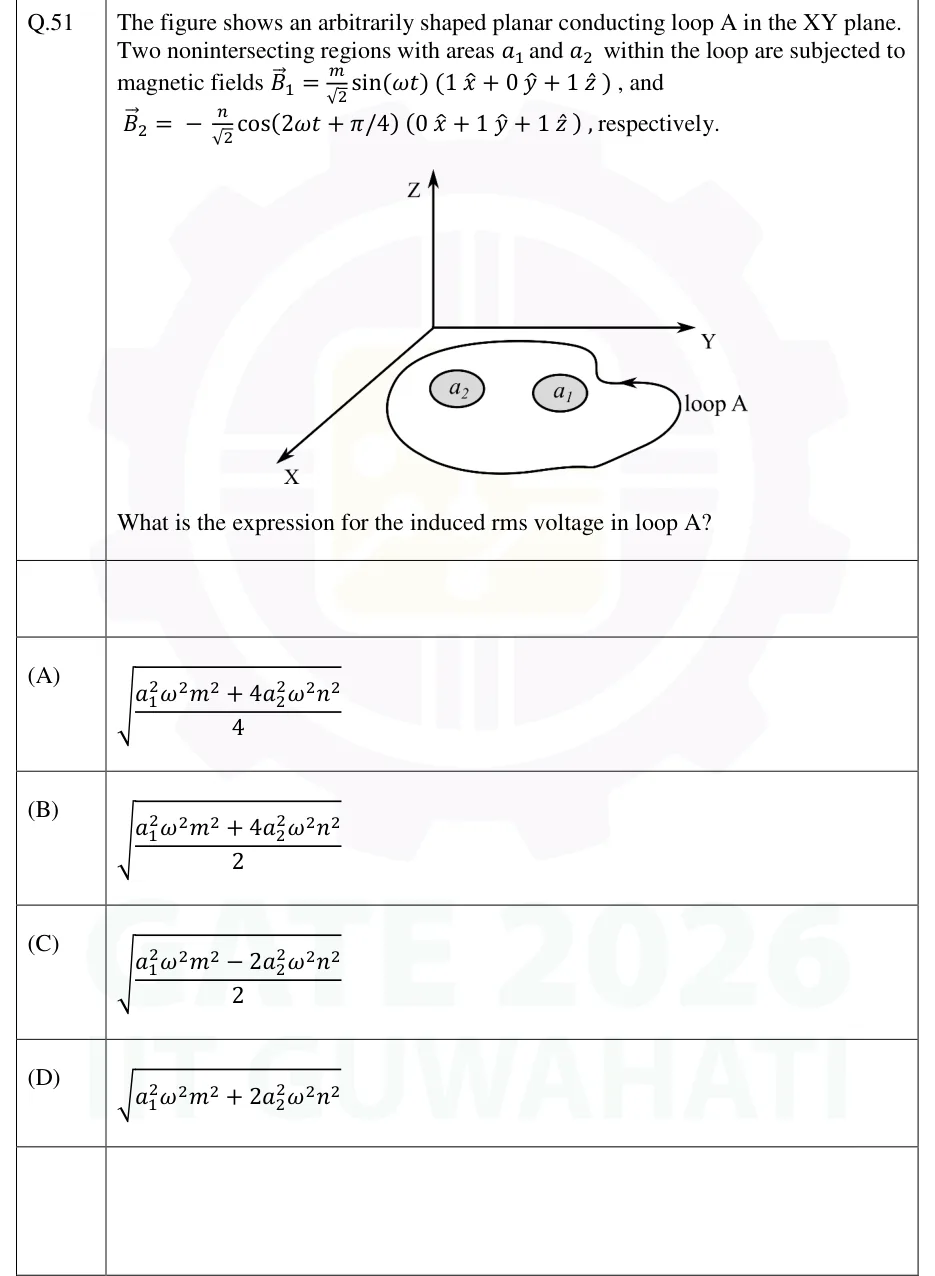
The figure shows an arbitrarily shaped planar conducting loop A in the XY plane. Two nonintersecting regions with areas a1 and a2 within the loop are subjected to magnetic fields B1=2msin(ωt)(1x^+0y^+1z^), and B2=−2ncos(2ωt+π/4)(0x^+1y^+1z^), respectively.
What is the expression for the induced rms voltage in loop A?
Tap to open full sizeFigure from the GATE 2026 EE paper. It is part of the question.Figure description
A 3-D axis sketch with Z pointing up, Y pointing right and X pointing down-left toward the viewer, all meeting at the origin. An irregular closed curve labelled 'loop A' lies in the XY plane below the Y axis. It has a notch at the top right and a lobe extending to the right. An arrowhead on the upper edge of that right-hand lobe points left, toward the notch, and shows the direction of traversal. Inside the loop are two small, separate, grey-shaded elliptical patches side by side: a_2 on the left, nearer the X axis, and a_1 to its right. The patches do not overlap.
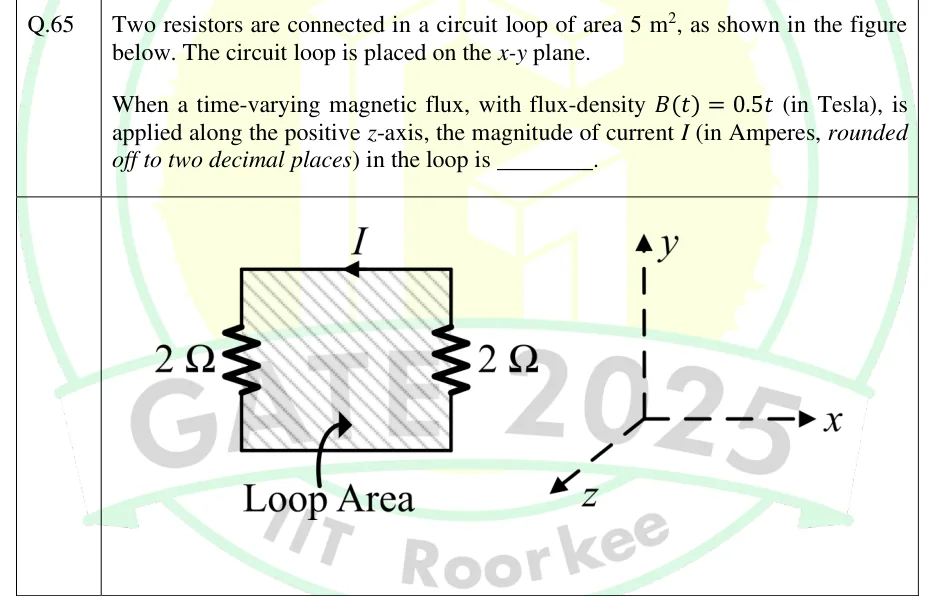
Two resistors are connected in a circuit loop of area 5m2, as shown in the figure below. The circuit loop is placed on the x-y plane.
When a time-varying magnetic flux, with flux-density B(t)=0.5t (in Tesla), is applied along the positive z-axis, the magnitude of current I (in Amperes, rounded off to two decimal places) in the loop is ________.
Tap to open full sizeFigure from the GATE 2025 EC paper. It is part of the question.Figure description
A single rectangular conducting loop (hatched interior labelled 'Loop Area', with an arrow pointing into the hatched region) lies in the x-y plane. The left vertical side contains a 2 Ω resistor and the right vertical side contains a 2 Ω resistor, so the two resistors are in series around the loop. The top side carries an arrow labelled I pointing to the left (right-to-left along the top wire). The bottom side is a plain wire. To the right, coordinate axes are drawn: y pointing up, x pointing right, and z drawn diagonally down-left (out of the page toward the viewer, right-handed system).
Inductance of a coil is measured as 10 mH, using an LCR meter, when no other objects are present near the coil. The LCR meter uses a sinusoidal excitation at 10 kHz. If a pure copper sheet is brought near the coil, the same LCR meter will read ____________.
(A)
less than 10 mH
(B)
10 mH
(C)
more than 10 mH
(D)
less than 10 mH initially and then stabilizes to more than 10 mH
In a circuit, there is a series connection of an ideal resistor and an ideal capacitor. The conduction current (in Amperes) through the resistor is 2sin(t+π/2). The displacement current (in Amperes) through the capacitor is ________.
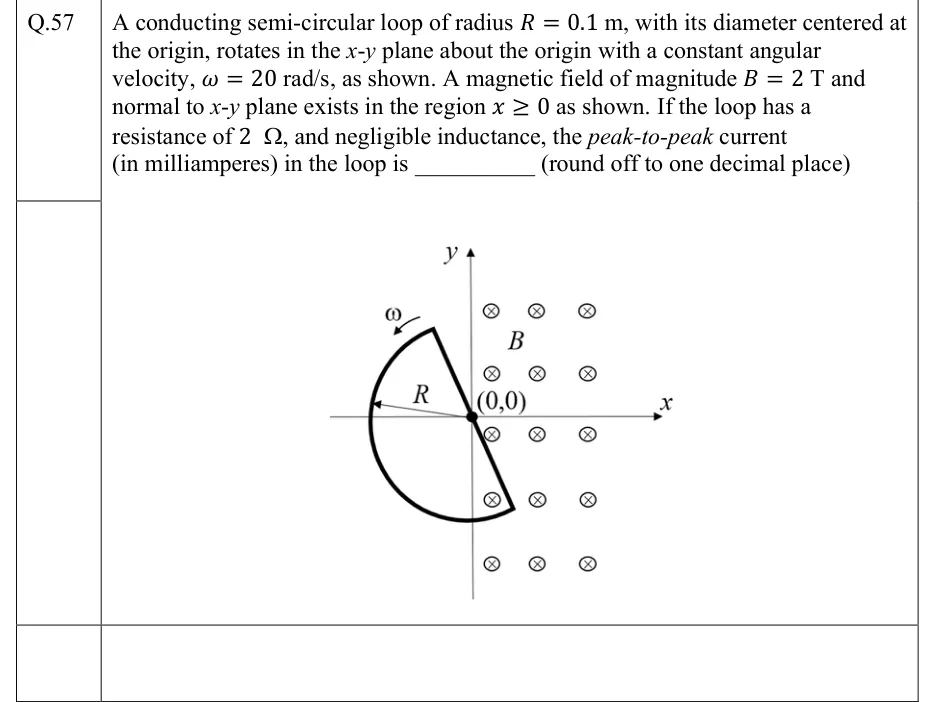
A conducting semi-circular loop of radius R=0.1m, with its diameter centered at the origin, rotates in the x-y plane about the origin with a constant angular velocity, ω=20rad/s, as shown. A magnetic field of magnitude B=2T and normal to x-y plane exists in the region x≥0 as shown. If the loop has a resistance of 2Ω, and negligible inductance, the peak-to-peak current (in milliamperes) in the loop is ________ (round off to one decimal place)
Tap to open full sizeFigure from the GATE 2022 IN paper. It is part of the question.Figure description
Standard x-y axes with the origin marked (0,0) by a dot. A thick-outlined semicircular (half-disc) conducting loop has its straight diameter passing through the origin, tilted slightly from the y-axis: its upper end lies above the origin just left of the y-axis (x < 0) and its lower end lies below the origin just right of the y-axis (x > 0). The curved arc of radius R bulges to the left (into the x < 0 region); a horizontal arrow from the origin to the arc on the negative x side is labelled R. A curved arrow near the top of the arc labelled omega shows counter-clockwise rotation about the origin. The region x >= 0 is filled with a 5-row by 3-column grid of cross-in-circle symbols (field into the page) labelled B; no field is drawn for x < 0. In the position shown, only a small sector of the half-disc, just below the origin between the negative y-axis and the lower end of the diameter, lies inside the field region.
With k a non-zero constant and x,y,z in metres, which one of the following can represent a magnetic flux density B?
(A)
k(xa^x+ya^y)
(B)
k(ya^x+xa^y)
(C)
k(xa^x−2ya^y+2za^z)
(D)
k(za^x+ya^y)
▸ Answer and solution
Answer: (B)
Any magnetic flux density must satisfy ∇⋅B=0 everywhere.
A: ∇⋅B=k(1+1)=2k=0.
B: ∇⋅B=k(∂x∂y+∂y∂x)=0.
C: ∇⋅B=k(1−2+2)=k=0.
D: ∇⋅B=k(∂x∂z+∂y∂y)=k=0.
Only B is divergence-free.
PRACTICE 21 mark · NAT
Sea water has conductivity σ=4 S/m, relative permittivity εr=81 and μr=1. Take ε0=8.854×10⁻¹² F/m. For a time-harmonic field at f=1 MHz, the ratio of the amplitude of the conduction current density to the amplitude of the displacement current density is ______ (rounded off to the nearest integer).
Ratio =4/(4.506×10−3)≈887.7≈888, so conduction current dominates at this frequency.
PRACTICE 32 marks · NAT
Two parallel conducting rails lie along x at y=0 and y=0.4 m and are connected at x=0 through a resistor of 2Ω. A conducting bar of resistance 1Ω, parallel to y, slides on the rails with constant velocity 5a^x m/s. The rails themselves have negligible resistance, and the static magnetic field is B=0.3xa^z T (x in metres). Neglecting friction and self-inductance, the magnitude of the external force (in N) needed to keep the bar moving at constant velocity at the instant it is at x=2 m is ______ (rounded off to three decimal places).
▸ Answer and solution
Answer:0.096 (accepted range ±0.002)
Flux through the circuit when the bar is at x:Φ=∫0x0.3x′(0.4)dx′=0.06x2 Wb.
∣Vemf∣=dtdΦ=0.12xdtdx=0.12×2×5=1.2 V (equivalently B(x)Lu=0.6×0.4×5).
Current: I=1.2/(2+1)=0.4 A.
Magnetic force on the bar, which by Lenz's law opposes the motion: F=B(x)IL=0.6×0.4×0.4=0.096 N. The external force must equal this.
Check: mechanical power Fu=0.096×5=0.48 W equals I2Rtotal=0.16×3=0.48 W.
PRACTICE 42 marks · MSQ
The region z<0 is a perfect electric conductor and z>0 is free space. A time-harmonic field exists in the free-space region, and at z=0+ its magnetic field is H=10cos(ωt)a^x A/m. Which of the following statements is/are correct?
(A)
The surface current density on the conductor is K=10cos(ωt)a^y A/m.
(B)
The surface current density on the conductor is K=−10cos(ωt)a^y A/m.
(C)
The normal component of B at z=0+ is zero.
(D)
The tangential electric field at z=0+ has amplitude 3770 V/m.
▸ Answer and solution
Answer: (A), (C)
The unit normal points out of the conductor into free space: a^n=a^z. Inside the perfect conductor the time-varying fields are zero.
K=a^n×H=a^z×10cos(ωt)a^x=10cos(ωt)a^y A/m, so A is correct and B (the sign that results from using a^n=−a^z) is wrong.
Normal B is continuous and is zero inside the conductor, so Bz(0+)=0: C is correct (consistent with the given H having no z component).
Tangential E is continuous and is zero inside the conductor, so Et(0+)=0, not η0×10: D is wrong.
PRACTICE 52 marks · NAT
A uniform plane wave in a lossless, non-magnetic dielectric has E=60cos(2π×108t−34πz)a^x V/m, with z in metres. Take c=3×10⁸ m/s and η0=120πΩ. The time-average power (in W) crossing a flat circular disc of radius 0.5 m lying in a plane z= constant is ______ (rounded off to one decimal place).
▸ Answer and solution
Answer:7.5 (accepted range ±0.1)
β=ωεr/c, so εr=ωβc=2π×108(4π/3)(3×108)=2 and εr=4.
η=η0/εr=60πΩ.
Savg=2ηE02=120π3600=π30≈9.549 W/m², directed along +a^z, normal to the disc.

 Tap to open full size