
IAE Academy

GATE 2023 IN Q.12: solution and answer

GATE 2023 · INQ.12 · 1 mark · MCQ

Inductance of a coil is measured as 10 mH, using an LCR meter, when no other objects are present near the coil. The LCR meter uses a sinusoidal excitation at 10 kHz. If a pure copper sheet is brought near the coil, the same LCR meter will read ____________.

  1. (A)

    less than 10 mH

  2. (B)

    10 mH

  3. (C)

    more than 10 mH

  4. (D)

    less than 10 mH initially and then stabilizes to more than 10 mH
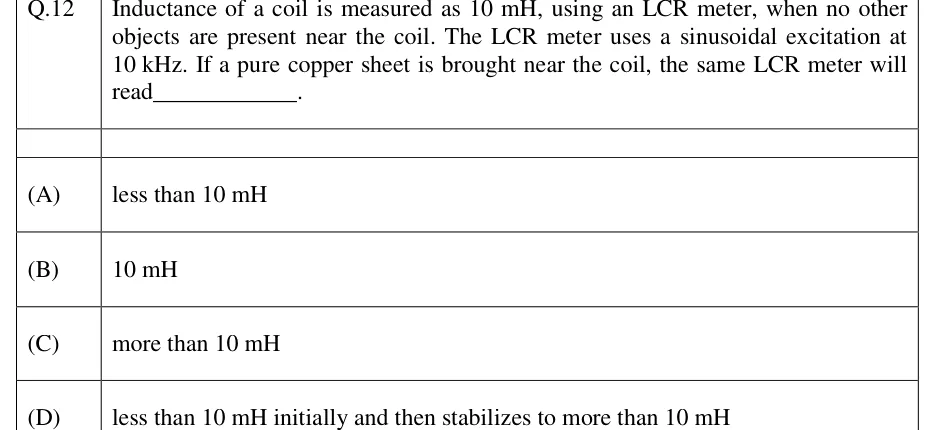
See the question in the paper

Answer and solution

ANSWER

With the copper sheet nearby, the LCR meter reads less than 10 mH. The answer is option (A).

Official answer: ASource: Official answer key, GATE 2023 IN (IIT Kanpur)

  1. Faraday's law: the coil's alternating field at passes through the copper sheet and induces an emf in it. Copper is a very good conductor (), so large eddy currents circulate in the sheet.

  2. Lenz's law: these eddy currents set up a flux that opposes the coil's own flux. For the same coil current, less net flux links the coil, so goes down.

  3. Copper is not magnetic: (it is very slightly diamagnetic), so the sheet gives the flux no easier path and nothing pushes up. A ferromagnetic sheet such as iron would have the opposite effect.

  4. Circuit model (coil = primary, sheet = shorted one-turn secondary): the coil's input impedance is Rationalising the last term gives So the sheet lowers the effective inductance and raises the effective resistance, because it absorbs eddy-current loss.

  5. Check that 10 kHz is high enough: the skin depth is with , giving . A typical sheet is thicker than this, so it blocks most of the flux (, and approaches ). The drop in is therefore large enough to see.

  6. The LCR meter reports the reactive part of the impedance as an inductance, so it reads less than 10 mH. The reading drops as soon as the sheet is in place and stays there, because nothing makes it recover later. That rules out option (D). Answer: (A).

KEY IDEA

A non-magnetic conductor near an AC coil behaves like a shorted secondary winding. Its eddy currents oppose the coil's flux (Lenz's law) and reflect a negative reactance into the coil, . The measured inductance falls and the measured resistance rises. Only a magnetic material () would raise .

WATCH OUT FOR

Many students pick (C) because they assume any metal near a coil increases its inductance, as an iron core does. Copper has , so it adds no magnetic path, and its eddy currents cancel part of the flux. Option (D) is also wrong: the reduction is a steady-state AC effect with no later rise above 10 mH.

From the GATE 2023 IN paper. Every question of this paper · Download the full paper · All 5 Maxwell's equations questions, with notes

More Maxwell's equations questions