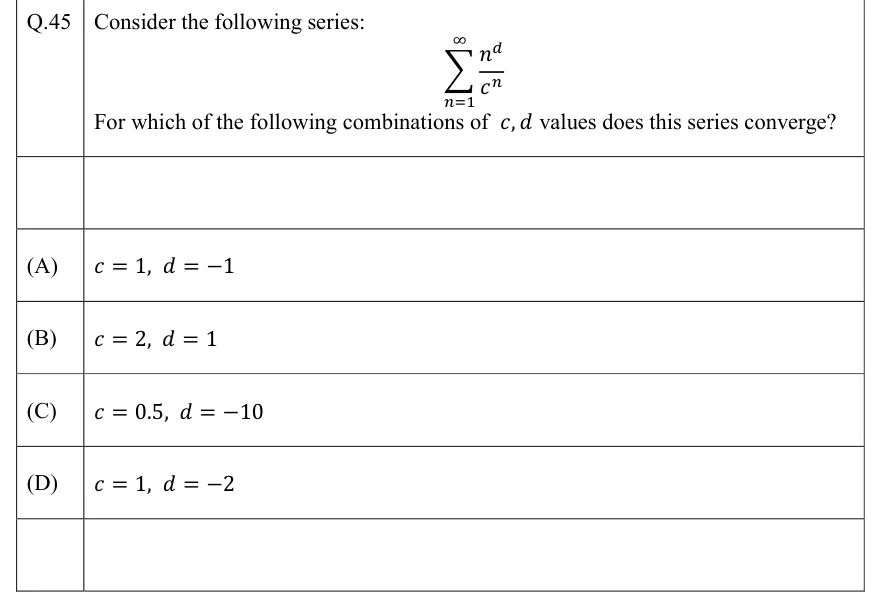
Consider the following series:
For which of the following combinations of values does this series converge?
- (A)
- (B)
- (C)
- (D)

Consider the following series:
For which of the following combinations of values does this series converge?
ANSWER
The series converges for (B) and (D) .
Official answer: B, DSource: Official answer key, GATE 2022 EC (IIT Kharagpur)
Let . Every option has , so every term is positive. Apply the ratio test: for any value of , because .
So the series converges if (the limit is less than ) and diverges if (the limit is greater than ), for every . A power can never outgrow an exponential , and can never hold one back.
When the ratio test gives a limit of exactly , so it tells us nothing. The series becomes , a p-series with . It converges if and only if , that is, .
(A) : is the harmonic series (), which diverges.
(B) : has ratio limit , so it converges. (Its sum is .)
(C) : , and the ratio limit is . The terms do not even go to zero (the -th term test), so the series diverges.
(D) : is a p-series with , so it converges.
The series converges for (B) and (D).
KEY IDEA
For , the ratio test gives whatever is. The exponential decides: the series converges for and diverges for . Only at does matter, where the series is the p-series , which converges only when .
WATCH OUT FOR
Picking (A) because . Terms going to zero is necessary but not sufficient, and the harmonic series () diverges. The other trap is picking (C) because the power looks strongly decaying. With the factor grows exponentially and swamps any power of , so the terms blow up.
From the GATE 2022 EC paper. Every question of this paper · Download the full paper · All 39 Calculus questions, with notes