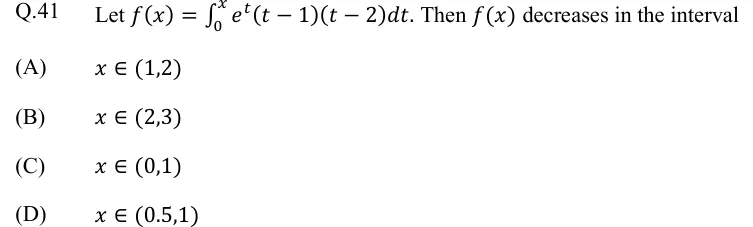
Let . Then decreases in the interval
- (A)
- (B)
- (C)
- (D)

Let . Then decreases in the interval
ANSWER
only for , so decreases on . Option (A).
Official answer: ASource: Official answer key, GATE 2022 EE (IIT Kharagpur)
The integrand is continuous for all , so by the Fundamental Theorem of Calculus (Leibniz rule with a constant lower limit and upper limit ):
A differentiable function is decreasing on an interval where . Since for every real , the sign of is the sign of .
Sign chart of , which has roots and : for both factors are negative, so the product is positive; for the factors have opposite signs, so the product is negative; for both factors are positive, so the product is positive.
Hence exactly on , so decreases on .
Check the other options: on we have , and on and its sub-interval we have ; in all three , so increases there. The answer is (A).
KEY IDEA
If with continuous, then . So is increasing or decreasing according to the sign of the integrand at . You never need to evaluate the integral.
WATCH OUT FOR
Integrating by parts to find explicitly wastes time and invites sign errors. A second trap is reading the sign of backwards. The quadratic opens upward, so it is negative between its roots, not outside them. That backwards reading picks (B) or (C) instead.
From the GATE 2022 EE paper. Every question of this paper · Download the full paper · All 39 Calculus questions, with notes