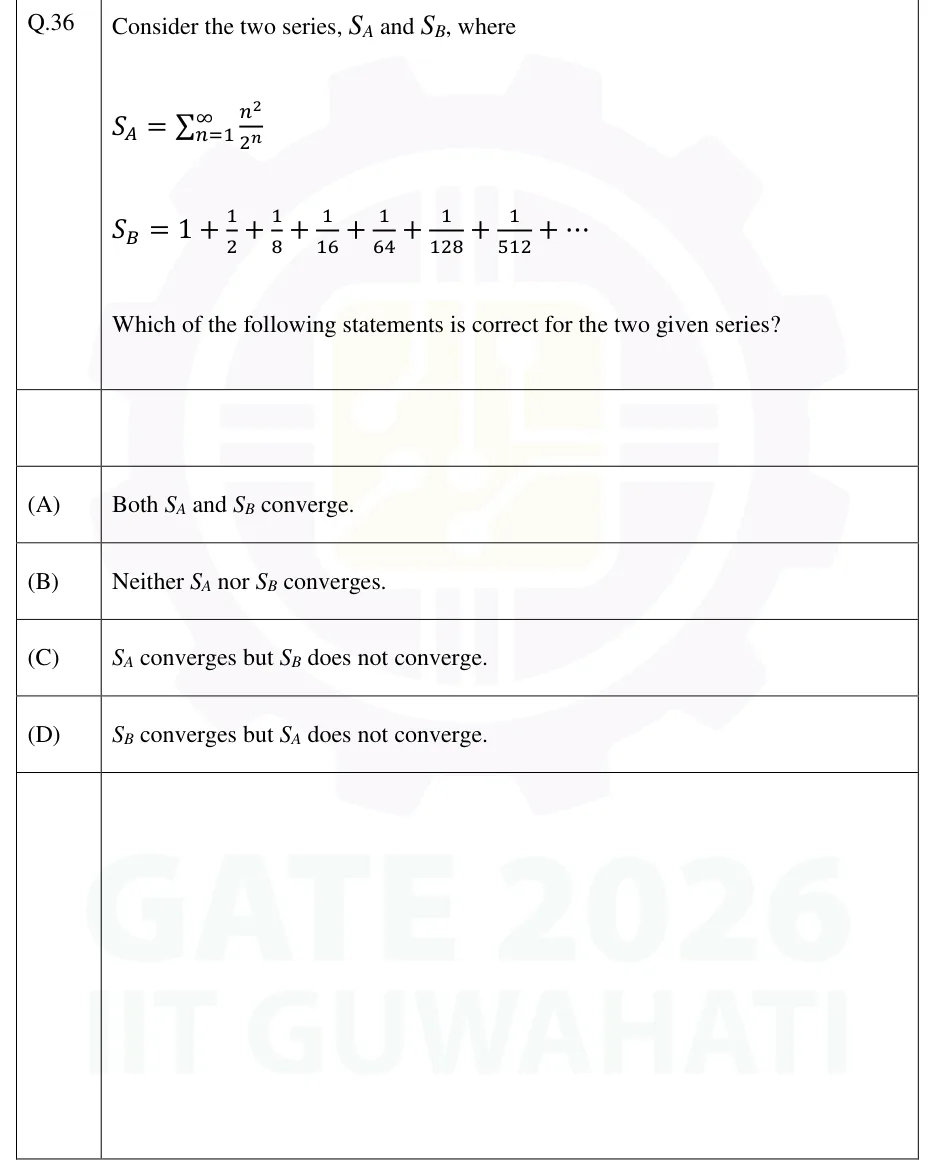
Consider the two series, and , where
Which of the following statements is correct for the two given series?
- (A)
Both and converge.
- (B)
Neither nor converges.
- (C)
converges but does not converge.
- (D)
converges but does not converge.

Consider the two series, and , where
Which of the following statements is correct for the two given series?
Both and converge.
Neither nor converges.
converges but does not converge.
converges but does not converge.
ANSWER
(A) Both and converge (, ).
Official answer: ASource: Official answer key, GATE 2026 EC (IIT Guwahati)
, ratio test. With : so converges.
Check with the standard sum for . At : which is finite.
, spot the pattern. The terms are : powers of in pairs, with every third power () left out.
Comparison test. Every term of is positive, and the terms are distinct terms of the geometric series . So the partial sums of increase and never exceed . A bounded increasing sequence converges, so converges.
Exact value (a check, not needed for the answer): since all terms are positive, grouping consecutive pairs does not change the sum. The -th pair () is , so
Both series converge, so option (A) is correct.
KEY IDEA
An exponential in the denominator beats any power of in the numerator: for with the ratio test gives the limit , so the series converges. A series of positive terms, each a distinct term of a convergent geometric series, has bounded increasing partial sums and therefore converges, however irregular the pattern of left-out terms.
WATCH OUT FOR
Two traps. First, seeing in the numerator of and deciding the terms grow, when grows much faster and the terms tend to . Second, deciding that is not geometric because of the gaps ( are missing) and so it cannot be judged. Leaving out positive terms from a convergent geometric series can only make the sum smaller, so it still converges.
From the GATE 2026 EC paper. Every question of this paper · Download the full paper · All 39 Calculus questions, with notes