
IAE Academy

GATE 2026 EC Q.61: solution and answer

GATE 2026 · ECQ.61 · 2 marks · NAT

Consider the square region in the - plane as shown with the dark shading in the Figure. The value of is ____. (rounded off to two decimal places)
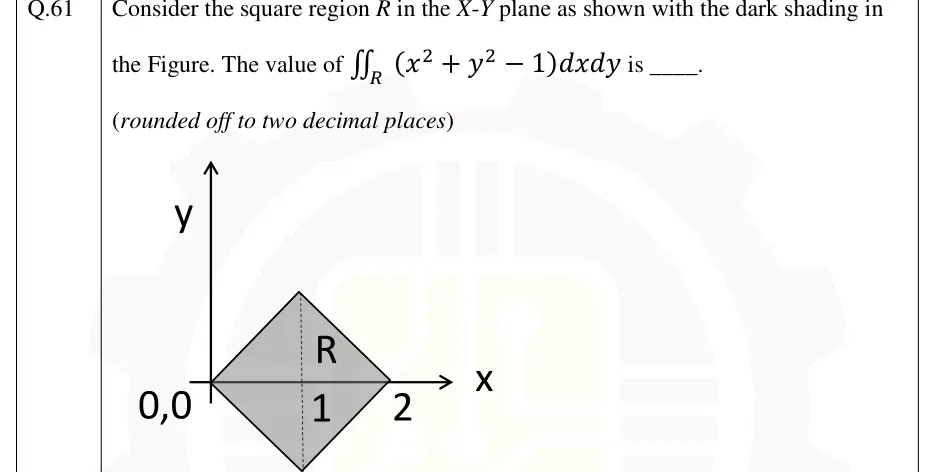
GATE 2026 EC question 61: A vertical axis with an upward arrow labelled y and a horizontal axis with a rightward arrow labelled X;Tap to open full size
Figure from the GATE 2026 EC paper. It is part of the question.
Figure description

A vertical axis with an upward arrow labelled y and a horizontal axis with a rightward arrow labelled X; the origin is labelled 0,0. A dark-shaded square R stands on one corner (a diamond). Its left corner is at the origin and its right corner is on the x-axis at the point labelled 2. A dotted vertical line, the square's other diagonal, joins the top corner to the bottom corner and crosses the x-axis at the point labelled 1. The top and bottom corners are not labelled; because R is a square with its horizontal diagonal from 0 to 2, they are (1,1) and (1,-1). The label R sits in the upper half just right of the dotted line. The label 1 sits just below the x-axis beside the dotted line, and 2 sits just below the x-axis at the right corner.

Answer and solution

ANSWER

.

Official answer: 0.60 to 0.70Source: Official answer key, GATE 2026 EC (IIT Guwahati)

  1. Read the region. The figure puts the left and right corners of on the -axis at and , so that diagonal has length and midpoint . In a square the diagonals are equal and are perpendicular bisectors of each other, so the dotted vertical diagonal through also has length . The other two corners are therefore and . The side is , the area is , and is the set .

  2. Move the origin to the centre with (a translation, so the Jacobian is ). Then .

  3. The region is symmetric under and is odd in , so .

  4. That leaves over the diamond . For a fixed with , runs from to , a width of .

  5. The diamond is unchanged when and are swapped, so as well.

  6. Check: is the polar moment of area of a square about its centre, which is and does not change when the square is rotated. Here , which agrees.

KEY IDEA

Put the origin at the centre of the square (). The integrand becomes . The odd term integrates to zero by symmetry, and the cancels against the from . What remains, , is the polar moment of a square about its centre, with , which gives .

WATCH OUT FOR

Taking the region as an axis-aligned square such as or . The figure shows a square standing on a corner, , with side and area , not side . A second slip is subtracting only for the constant term instead of . That gives instead of .

From the GATE 2026 EC paper. Every question of this paper · Download the full paper · All 39 Calculus questions, with notes

More Calculus questions