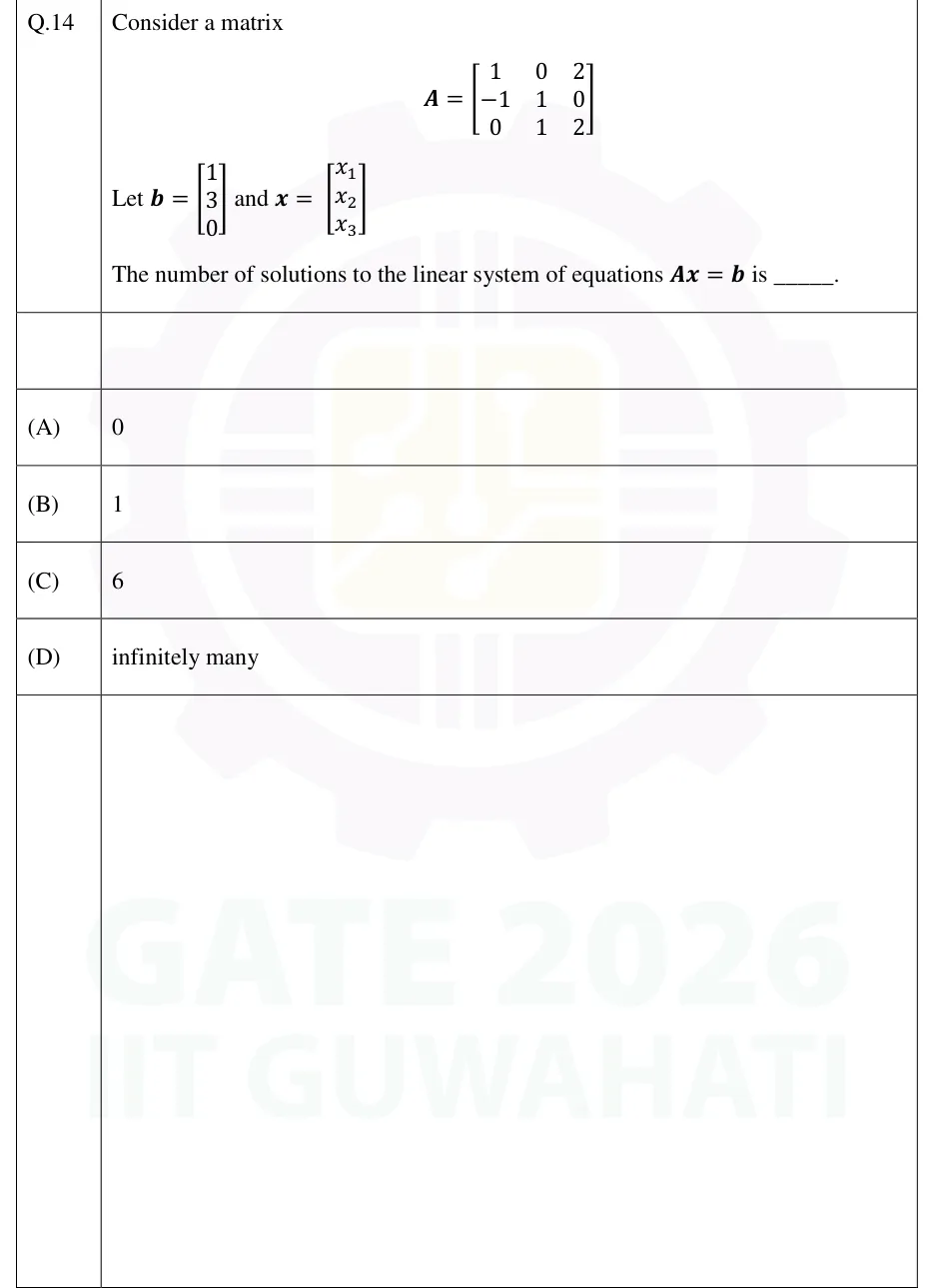
Consider a matrix
Let and
The number of solutions to the linear system of equations is ______.
- (A)
0
- (B)
1
- (C)
6
- (D)
infinitely many

Consider a matrix
Let and
The number of solutions to the linear system of equations is ______.
0
1
6
infinitely many
ANSWER
The system is inconsistent: but , so has no solution. Answer: (A) 0.
Official answer: ASource: Official answer key, GATE 2026 IN (IIT Guwahati)
Check whether is singular by expanding along the first row: So is singular and a unique solution is ruled out. The system has either no solution or infinitely many, and the rank test decides which.
Find the dependence among the rows: . Rows 1 and 2 are not multiples of each other, so .
Form the augmented matrix and apply the same row operation, :
The last row reads , which is impossible. Put another way, the system is consistent only if obeys the same dependence as the rows, , but here . The three rows of the reduced augmented matrix are independent, so . (Direct check: the first equation gives , and the second then gives . So for every candidate, while the third equation demands .)
Rank (Rouché–Capelli) test: , so the system is inconsistent. The number of solutions is , which is option (A).
KEY IDEA
When a square is singular (), has either no solution or infinitely many. It has infinitely many exactly when satisfies the same linear dependence as the rows of , i.e. when . Here but , so there are no solutions.
WATCH OUT FOR
Seeing and choosing "infinitely many" (D) straight away. A zero determinant only rules out a unique solution. You still have to check against the row dependence, and here . A sign slip in the cofactor can also make look nonzero, which leads to the wrong answer (B).
From the GATE 2026 IN paper. Every question of this paper · Download the full paper · All 46 Linear algebra questions, with notes