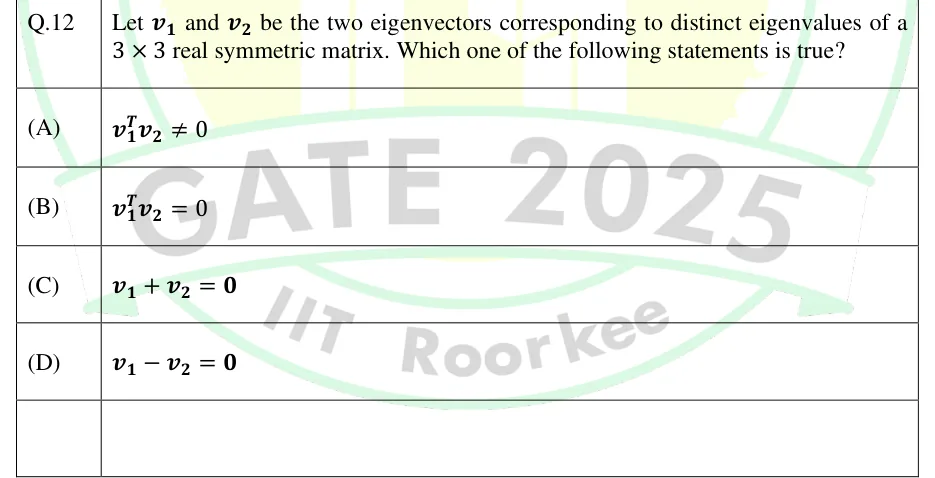
Let and be the two eigenvectors corresponding to distinct eigenvalues of a real symmetric matrix. Which one of the following statements is true?
- (A)
- (B)
- (C)
- (D)

Let and be the two eigenvectors corresponding to distinct eigenvalues of a real symmetric matrix. Which one of the following statements is true?
ANSWER
(B) . For a real symmetric matrix, eigenvectors that belong to distinct eigenvalues are orthogonal.
Official answer: BSource: Official answer key, GATE 2025 EE (IIT Roorkee)
Let be the real symmetric matrix (), with , and . Eigenvectors are nonzero by definition.
Premultiply the second equation by : .
Use symmetry: . So the same scalar is also .
Subtract the two results: Since , . The eigenvectors are orthogonal, so (B) is true and (A) is false.
(C) would give and (D) would give . In either case as well as , so . That is impossible, because and . (Also, would contradict the orthogonality just proved.) The answer is (B).
KEY IDEA
Write the scalar in two ways, once using and once using with . Subtracting gives , so the eigenvectors are orthogonal whenever .
WATCH OUT FOR
Confusing linear independence with orthogonality. Eigenvectors for distinct eigenvalues are linearly independent for ANY matrix, but they are orthogonal () only because this matrix is symmetric. A second mistake is choosing (C) or (D): eigenvectors of distinct eigenvalues can never be multiples of each other, so neither nor can hold.
From the GATE 2025 EE paper. Every question of this paper · Download the full paper · All 46 Linear algebra questions, with notes