GATE 2026 EC Q.26
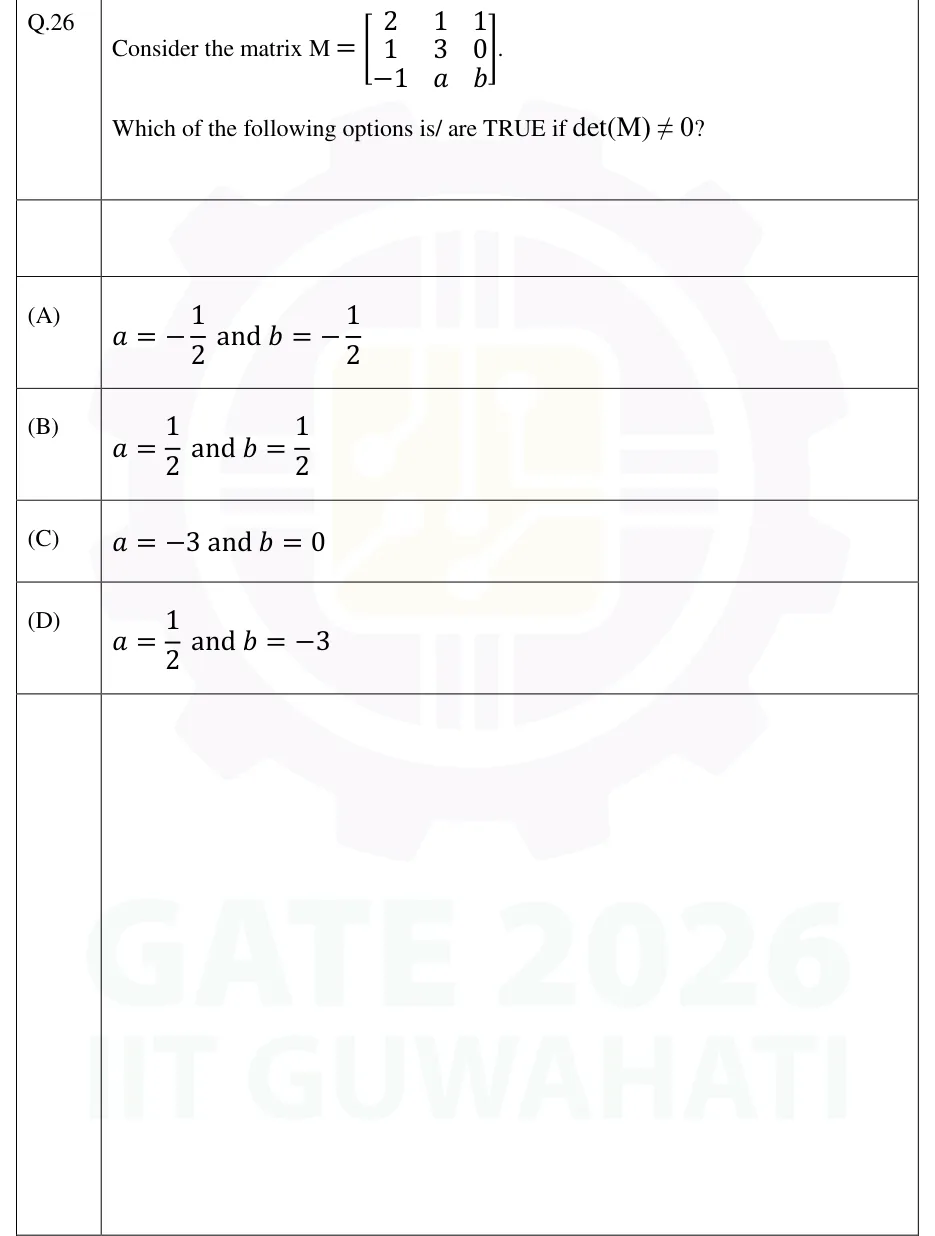
Consider the matrix .
Which of the following options is/ are TRUE if ?
- (A)
and
- (B)
and
- (C)
and
- (D)
and

GATE EC · EE · IN
Linear algebra is the study of matrices, the systems of linear equations they encode and the vector spaces they act on. Rank decides whether a system has no solution, exactly one or infinitely many, and eigenvalues and eigenvectors describe what a matrix does to directions in space. Typical problems in this topic are short computations (a determinant, a rank, the parameter value that makes a system consistent, an eigenvalue of or ) that become quick once the standard properties below are known; the same eigenvalue results return in state-space analysis.
46 previous-year questions · 45 solved · 6 practice questions
Conventions used in these notes. is the imaginary unit () and is the complex conjugate of . Subscripts such as (as in or ) are always indices, never the imaginary unit. For a matrix : is the transpose, the matrix of conjugates and the conjugate transpose (other texts write or ). and both mean the determinant, is the trace (the sum of the diagonal entries), or is the identity and is the zero matrix. Vectors are column vectors. Scalars are real unless a statement says complex.
An matrix can multiply an matrix , and is with . Multiplication is associative and distributive but not commutative: in general , and does not force or . A square matrix is non-singular (invertible) exactly when ; its inverse is unique and . The cofactor of is , where the minor is the determinant left after deleting row and column . The adjoint (adjugate) is the transpose of the matrix of cofactors.
REVERSAL LAWS
The order reverses for any number of factors, e.g. . The transpose and conjugate-transpose laws hold whenever is defined, square or not; the inverse laws need every factor square and non-singular.
MORE INVERSE RULES
non-singular, a scalar and a positive integer. A diagonal matrix with non-zero diagonal entries has inverse , and the inverse of a non-singular upper (lower) triangular matrix is again upper (lower) triangular.
INVERSE THROUGH THE ADJOINT
The first identity holds for every square matrix; the inverse formula needs .
INVERSE OF A 2 × 2 MATRIX
Swap the diagonal entries, change the sign of the off-diagonal entries, divide by the determinant. Valid only when .
Inverse by row reduction (Gauss–Jordan)
Write the matrix .
Apply elementary row operations only (never column operations) until the left block becomes . The right block is then .
If a row of zeros appears in the left block, and has no inverse.
TRACE PROPERTIES
holds whenever both products are defined, even for non-square and . The trace is unchanged by cyclic shifts, , but not by other reorderings: in general . In general .
SYMMETRIC PLUS SKEW-SYMMETRIC SPLIT
Every square matrix is, in exactly one way, a symmetric part plus a skew-symmetric part. Likewise splits a complex matrix into Hermitian and skew-Hermitian parts.
Properties of determinants (for an n × n matrix)
, so every row property below holds for columns too.
Interchanging two rows changes the sign of the determinant.
Multiplying one row by multiplies the determinant by . Hence , not .
Two equal or proportional rows, or a row of zeros, give .
Adding a multiple of one row to another row leaves the determinant unchanged. This is the operation to use when simplifying by hand.
If one row is a sum, the determinant splits: . In general .
Triangular (upper or lower) or diagonal matrix: the determinant is the product of the diagonal entries. Block-triangular: for square blocks and .
A skew-symmetric matrix of odd order has determinant , because .
The determinant equals the product of the eigenvalues (Section 5).
DETERMINANTS OF PRODUCTS, POWERS AND MULTIPLES
and are and is a scalar. holds for every positive integer (for every integer when is non-singular), and needs . even when .
ADJOINT IDENTITIES
For matrices with ; all four hold for singular matrices too. The first follows from taking determinants of , which gives . Consequently . Also , and for non-singular , .
Special matrices
Matrix | Defining property | Consequences worth remembering |
|---|---|---|
Symmetric | For real : eigenvalues real, eigenvectors of distinct eigenvalues orthogonal, always diagonalisable | |
Skew-symmetric | Diagonal entries ; for odd order; for real , eigenvalues or purely imaginary | |
Orthogonal (real) | ; ; columns (and rows) orthonormal; every eigenvalue has | |
Hermitian | Diagonal entries real; eigenvalues real; a real Hermitian matrix is symmetric | |
Skew-Hermitian | Diagonal entries or purely imaginary; eigenvalues or purely imaginary | |
Unitary | ; ; every eigenvalue has | |
Idempotent | Eigenvalues or ; ; is also idempotent | |
Nilpotent | for some positive integer (the least such is the index) | All eigenvalues ; and ; is invertible |
Involutory | ; eigenvalues ; | |
Triangular or diagonal | for (upper) or for (lower) | Determinant and eigenvalues read straight off the diagonal |
PRODUCTS DO NOT COMMUTE
, which equals only when . Likewise , not . The product of two symmetric matrices is symmetric exactly when they commute, because .
SCALAR MULTIPLES INSIDE A DETERMINANT
For a matrix with : , , and . Writing is the usual slip.
A vector space over the real numbers (or over the complex numbers) is a set in which vectors can be added and multiplied by scalars with the results staying in , and in which the usual rules hold: there is a zero vector, every vector has an additive inverse, , and the associative, commutative and distributive laws apply. , the set of all matrices and the set of polynomials of degree at most are all vector spaces. A subspace is a non-empty subset that is itself a vector space under the same operations.
Subspace test
A subset of is a subspace if and only if all three hold:
The zero vector of lies in . If it does not, stop: is not a subspace.
(closed under addition).
and any scalar (closed under scalar multiplication). The last two together are equivalent to for all scalars and all .
Typical verdicts: the solution set of a homogeneous system is a subspace (the null space of ); the solution set of with is not, since it misses the zero vector. In the subspaces are , lines through the origin, planes through the origin and itself. The intersection of two subspaces is always a subspace; their union is a subspace only when one of them contains the other.
The span of is the set of all linear combinations ; it is always a subspace. The vectors are linearly independent if forces , and linearly dependent otherwise, in which case at least one of them is a combination of the others. A basis of is a linearly independent set that spans . Every basis of a finite-dimensional space has the same number of vectors, the dimension .
INNER PRODUCT, LENGTH AND ORTHOGONALITY
For real vectors in . For complex vectors use and . A set of vectors is orthonormal if they are mutually orthogonal and each has length . In an orthonormal basis the coordinates of any are simply .
Tests for linear independence
Write the vectors as the rows (or the columns) of a matrix. They are independent if and only if its rank equals the number of vectors.
vectors in : independent if and only if the determinant they form is non-zero.
More than vectors in an -dimensional space are always dependent.
Any set that contains the zero vector is dependent.
Two vectors are dependent if and only if one is a scalar multiple of the other.
Non-zero, mutually orthogonal vectors are independent, and eigenvectors belonging to distinct eigenvalues are independent.
In an -dimensional space, any independent vectors form a basis, and any vectors that span the space form a basis.
GRAM–SCHMIDT ORTHOGONALISATION
Turns independent real vectors into mutually orthogonal vectors , and orthonormal vectors , spanning the same subspace. Each step subtracts from its projections on the vectors already built. Getting at some step means was a combination of the earlier vectors.
DIMENSION OF A SUM OF SUBSPACES
and are subspaces of a finite-dimensional space and is the set of all sums . Two distinct planes through the origin in meet in a line: .
Dimensions of common spaces
Space | Dimension | Basis or remark |
|---|---|---|
standard basis | ||
All real matrices | matrices with a single entry and the rest | |
symmetric matrices | choose the diagonal and the entries above it | |
skew-symmetric matrices | diagonal forced to ; choose the entries above it | |
upper (or lower) triangular matrices | same count as the symmetric matrices | |
diagonal matrices | one free entry per diagonal position | |
matrices with trace | one linear condition on entries | |
Polynomials of degree | ||
Null space of an matrix | rank-nullity theorem (Section 3) | |
over ; over | the field of scalars matters |
CHECK THE ZERO VECTOR FIRST
fails at once because is not in it. A condition that is not linear, such as , usually fails closure instead: and both satisfy , but their sum does not.
The rank of an matrix has four equivalent descriptions: the maximum number of linearly independent rows; the maximum number of linearly independent columns; the order of the largest square submatrix with a non-zero determinant (the largest non-vanishing minor); and the number of non-zero rows in any row echelon form of . Row rank always equals column rank, so . Elementary row or column operations do not change the rank. The zero matrix has rank ; every other matrix has rank at least .
Finding the rank by row reduction
Use elementary row operations (swap two rows, multiply a row by a non-zero constant, add a multiple of one row to another) to reach row echelon form: zero rows at the bottom, and the first non-zero entry (pivot) of each row to the right of the pivot in the row above.
Count the non-zero rows. That count is the rank.
Shortcut for a square matrix: if the rank is and no reduction is needed. If , look for a non-zero minor of order , and so on down.
A matrix whose rows are all multiples of one non-zero row has rank . Every rank-one matrix can be written as with non-zero column vectors and .
BOUNDS ON RANK
For an matrix. A square matrix has rank exactly when .
RANK OF A PRODUCT (SYLVESTER'S INEQUALITY ON THE LEFT)
is and is , so is the shared inner dimension. Multiplying by a non-singular matrix does not change the rank: for invertible and .
RANK OF A SUM
and of the same size.
RANK-NULLITY THEOREM
is the number of columns of (the number of unknowns in ), and is the dimension of the solution space of .
The four subspaces of a matrix. For a real matrix of rank : the column space (the set of all products ) is a subspace of of dimension ; the row space is a subspace of of dimension ; the null space (all with ) is a subspace of of dimension ; and the null space of is a subspace of of dimension . is consistent exactly when lies in the column space of . In the language of linear maps, from to has range equal to the column space and kernel equal to the null space, so rank-nullity reads . is one-to-one exactly when , and onto exactly when .
RANK OF THE GRAM MATRIX
For complex the same holds with in place of . So the matrix is invertible exactly when the columns of are independent.
RANK OF THE ADJOINT
For an matrix with . It follows from and the fact that every cofactor is a minor of order .
RANK IS NOT THE COUNT OF NON-ZERO EIGENVALUES
For a diagonalisable matrix (in particular any real symmetric matrix) the rank equals the number of non-zero eigenvalues counted with multiplicity. For other matrices the rank can be larger, never smaller: has rank but both eigenvalues are . (In general is the geometric multiplicity of the eigenvalue , which cannot exceed its algebraic multiplicity; see Section 5.) What always holds is that is singular exactly when is an eigenvalue.
Write equations in unknowns as , where is the coefficient matrix and is the augmented matrix ( with appended as an extra column). The system is consistent if it has at least one solution. Reduce to row echelon form: the rank of its first columns is , and the rank of the whole is , which is either or .
CONSISTENCY CONDITION (ROUCHÉ–CAPELLI THEOREM)
When consistent, the solution is unique if this common rank equals the number of unknowns , and has free parameters if the common rank is .
Rank test for AX = B in n unknowns
Ranks | Nature of the solution |
|---|---|
Inconsistent: no solution | |
Consistent: unique solution | |
Consistent: infinitely many solutions, with free parameters |
Homogeneous systems are always consistent, because the trivial solution satisfies them. Non-trivial solutions exist if and only if , and the solutions then form a subspace of dimension . For a square system this means . With fewer equations than unknowns (), , so non-trivial solutions always exist.
NON-TRIVIAL SOLUTIONS OF A SQUARE HOMOGENEOUS SYSTEM
is . The number of linearly independent solutions is .
Square systems. If , the system has exactly one solution, , for every . If , it has either no solution or infinitely many, never exactly one; the rank test decides which. More generally, a linear system has , or infinitely many solutions: if are two solutions, then is a solution for every scalar .
CRAMER'S RULE
is the determinant of with its -th column replaced by . Applies only to a square system with . If and some , the system is inconsistent.
WORKED EXAMPLE · CONSISTENCY WITH TWO PARAMETERS
For the system , , , find the values of and for which it has (i) a unique solution, (ii) no solution, (iii) infinitely many solutions, and write the solution in case (iii).
Augmented matrix: . and give the rows and .
gives the echelon form .
(i) If : , so there is a unique solution for every . (Check: , non-zero exactly when .)
(ii) If and : the last row reads , so and there is no solution.
(iii) If and : both ranks are , so there are infinitely many solutions with free parameter. Put . The second row, , gives , and the first gives .
Check in the third equation: for every .
Answer: Unique solution for (any ); no solution for , ; infinitely many for , , namely with real.
CRAMER'S RULE CANNOT CERTIFY INFINITELY MANY SOLUTIONS
When and every , the system may have infinitely many solutions or none: , , has (each determinant has two equal columns) and no solution. Settle the case with ranks.
COMPARE THE RANK WITH THE NUMBER OF UNKNOWNS
Uniqueness needs the common rank to equal the number of unknowns , not the number of equations. Four equations in three unknowns can still have a unique solution (both ranks ), and a homogeneous system with more unknowns than equations always has non-trivial solutions.
A scalar is an eigenvalue of the matrix if for some non-zero vector , called an eigenvector for . Rewritten as , a non-zero solution exists exactly when , the characteristic equation, which is a polynomial equation of degree . It has roots counted with multiplicity, possibly complex even when is real. The eigenvectors for are the non-zero solutions of ; together with the zero vector they form the eigenspace of .
Convention. An eigenvector is fixed only up to a non-zero scalar multiple: if is an eigenvector, so is for every , so and are the same answer. The zero vector is never an eigenvector, but can be an eigenvalue, and it is one exactly when is singular.
CHARACTERISTIC EQUATION OF A 2 × 2 MATRIX
For : , so . The eigenvalues are real whenever , in particular whenever is real symmetric.
CHARACTERISTIC EQUATION OF A 3 × 3 MATRIX
This is multiplied through by . is the sum of the three principal minors (the cofactors of the diagonal entries); it also equals .
SUM AND PRODUCT OF EIGENVALUES
Each eigenvalue is counted as often as its algebraic multiplicity, complex ones included. More generally for every positive integer ; for instance is the sum of the squares of the eigenvalues. A quick check on any eigenvalue calculation.
Eigenvalues of matrices built from A (eigenvalue λ, eigenvector X)
Matrix | Eigenvalue | Eigenvector | Condition |
|---|---|---|---|
any scalar | |||
any scalar | |||
a positive integer | |||
non-singular (so ) | |||
not an eigenvalue of | |||
non-singular | |||
any polynomial | |||
in general different | same characteristic polynomial as | ||
complex | |||
in general different | complex | ||
non-singular (similar matrices) | |||
and | the same eigenvalues for both, with the same multiplicities | in general different | and both ( and have the same characteristic polynomial) |
Eigenvalues of special matrices
Matrix | Eigenvalues |
|---|---|
Triangular or diagonal | the diagonal entries |
Block triangular , with and square | the eigenvalues of together with those of |
Real symmetric, or Hermitian | all real; eigenvectors of distinct eigenvalues are orthogonal |
Real skew-symmetric, or skew-Hermitian | or purely imaginary () |
Orthogonal, or unitary | modulus , ; the real ones are |
Idempotent () | or |
Nilpotent | all |
Involutory () | or |
Rank one, (, and non-zero) | once, and repeated times |
All entries equal to () | once, and repeated times |
Every row sums to the same number | is an eigenvalue, with eigenvector ; if instead every column sums to , is still an eigenvalue (apply the row rule to ), but that eigenvector need not work |
Any real matrix | non-real eigenvalues occur in conjugate pairs ; a real matrix of odd order has at least one real eigenvalue |
Algebraic and geometric multiplicity. The algebraic multiplicity (AM) of is its multiplicity as a root of the characteristic equation. The geometric multiplicity (GM) is the number of linearly independent eigenvectors for , that is, the dimension of its eigenspace.
GEOMETRIC MULTIPLICITY
An eigenvalue with AM (a simple root) always has GM . A repeated eigenvalue can have any GM from up to its AM.
WORKED EXAMPLE · EIGENVALUES, MULTIPLICITY AND A POLYNOMIAL IN A
Let . Find the eigenvalues of , an eigenvector for the largest one, the geometric multiplicity of the repeated eigenvalue, and the trace and determinant of .
Write , where is the matrix of all ones. has rank , so its eigenvalues are and .
Adding adds to each eigenvalue: has eigenvalues . Check: , and (direct expansion: ).
For : has rows , and . Each row sums to zero, so (or any non-zero multiple) is an eigenvector.
For : has rank , so GM , equal to its AM. The eigenspace is the plane , spanned for instance by and , and is diagonalisable.
With , has eigenvalues and (twice).
and .
Answer: Eigenvalues ; eigenvector for ; GM of is ; and .
DO NOT ROW-REDUCE BEFORE FINDING EIGENVALUES
Row operations preserve rank but change eigenvalues. has eigenvalues and ; after it becomes , with eigenvalues and . Solve on the original matrix.
SUMS AND PRODUCTS OF MATRICES
In general the eigenvalues of are not sums, and those of are not products, of the eigenvalues of and . The rules in the table work because , , and share the eigenvector of .
A MATRIX EQUATION LIMITS THE POSSIBLE EIGENVALUES
If for a polynomial , every eigenvalue satisfies (apply both sides to an eigenvector). From , each eigenvalue is or . The converse fails: which of those roots actually occur has to be decided separately.
ROTATION MATRICES
The orthogonal matrix has trace and determinant , so its eigenvalues are , of modulus . They are real only for or (in ).
An matrix is diagonalisable if for some non-singular and diagonal . This happens exactly when has linearly independent eigenvectors: the columns of are those eigenvectors, and the diagonal of lists the matching eigenvalues in the same order. Here and may be complex: a real matrix with non-real eigenvalues, such as a rotation, can be diagonalised only with complex and . Similar matrices () have the same characteristic polynomial, hence the same eigenvalues with the same multiplicities, the same trace and the same determinant; they also have the same rank, because multiplying by a non-singular matrix preserves rank. The converse fails: and share the characteristic polynomial but are not similar, since for every .
When is a matrix diagonalisable?
Necessary and sufficient: for every eigenvalue; equivalently, the GMs add up to .
Sufficient: distinct eigenvalues. This is not necessary: has a single repeated eigenvalue and is already diagonal.
Sufficient: real symmetric. The eigenvectors can then be chosen orthonormal, is orthogonal and (orthogonal diagonalisation). A Hermitian matrix is likewise unitarily diagonalisable, .
Fails whenever some GM AM. The standard case is : has AM , but , so GM .
A non-zero nilpotent matrix is never diagonalisable: its only eigenvalue is , so would force .
POWERS AND FUNCTIONS THROUGH DIAGONALISATION
acts entry by entry on the diagonal. is a polynomial, or a convergent power series such as the exponential: . For a real symmetric , take orthonormal eigenvectors as the columns of (normalise each one and, inside the eigenspace of a repeated eigenvalue, also make them orthogonal); then . Normalising alone is not enough when an eigenvalue repeats: and in the Section 5 example are not orthogonal.
Cayley–Hamilton theorem. Every square matrix satisfies its own characteristic equation. If the characteristic polynomial is , then , with the constant term read as . The theorem reduces any polynomial in to one of degree at most , and gives without cofactors.
CAYLEY–HAMILTON THEOREM
Using instead of only multiplies the polynomial by , which does not change the conclusion.
INVERSE FROM CAYLEY–HAMILTON
Multiply the Cayley–Hamilton identity by . Needs , that is, .
THE 2 × 2 CASE
For any matrix; the inverse needs .
HIGHER POWERS BY THE REMAINDER METHOD
Here is the characteristic polynomial (degree ), and the result follows because . With distinct eigenvalues, find the coefficients of from . For an eigenvalue of algebraic multiplicity , also match the first derivatives; for a double root this is .
The minimal polynomial of is the monic polynomial of least degree with . It divides the characteristic polynomial and has every eigenvalue as a root; is diagonalisable (over the complex numbers) exactly when has no repeated root. For it is , and for it is .
WORKED EXAMPLE · INVERSE AND A POWER BY CAYLEY–HAMILTON
For , use the Cayley–Hamilton theorem to find and .
and , so the characteristic equation is , with roots and .
Cayley–Hamilton: . Multiplying by gives , so .
Check: .
For , write . At : . At : . Subtracting, , so and .
Hence .
Check: , and .
Answer: and .
A REPEATED EIGENVALUE IS NOT A VERDICT
A repeated eigenvalue does not by itself make a matrix non-diagonalisable; compute . In the worked example of Section 5, is repeated and is still diagonalisable. By contrast, has with AM and GM , and is not.
CAYLEY–HAMILTON IS A MATRIX IDENTITY
The constant term becomes , not the scalar . And the theorem cannot be 'proved' by putting into : that gives the scalar , which is a different statement.
A quadratic form in is with real symmetric. The coefficient of is , and the coefficient of a cross term () is , so each off-diagonal entry is half the cross-term coefficient. For example, has . The orthogonal change of variables , with diagonalising , turns into a sum of squares.
CANONICAL (SUM-OF-SQUARES) FORM
is orthogonal, with orthonormal eigenvectors of as its columns. The rank of is the number of non-zero , and its index is the number of positive .
Definiteness of a quadratic form
with real symmetric; is the leading principal minor of order (the determinant of the top-left block of ).
Nature | Meaning | Eigenvalues of | Minor test |
|---|---|---|---|
Positive definite | for every | all | |
Negative definite | for every | all | (the sign of is that of ) |
Positive semi-definite (not definite) | for every , and for some | all , at least one | every principal minor and (the leading minors alone are not enough) |
Negative semi-definite (not definite) | for every , and for some | all , at least one | every principal minor of order is or has the sign of , and |
Indefinite | takes both signs | some and some | none of the above |
Consequences worth knowing. A positive definite matrix has every eigenvalue positive, so and is invertible; every diagonal entry is positive too (), but positive diagonal entries alone do not make a matrix positive definite. For any real matrix , the matrix is symmetric and positive semi-definite, because ; it is positive definite exactly when .
HALF THE CROSS TERM
In the matrix is ( off the diagonal, not ). Its eigenvalues are and , so is indefinite although every coefficient is positive: at , .
LEADING MINORS DO NOT SETTLE SEMI-DEFINITENESS
has leading minors and , both , yet is negative semi-definite. When a leading minor is zero, use the eigenvalues or all the principal minors.
Tensors (listed for IN). A tensor extends the idea of scalars, vectors and matrices to quantities with any number of indices. In three-dimensional Cartesian coordinates a tensor of order has components written with indices, each running over . (The order is also called the rank of the tensor, which has nothing to do with the rank of a matrix.) Order is a scalar ( component, the same in every frame), order a vector ( components ), order a quantity such as stress, strain or electrical conductivity ( components ). What makes a set of components a tensor is the rule by which they change when the axes are rotated: one direction-cosine factor per index.
Index notation
Summation convention: an index repeated in a single term is summed over and is called a dummy index: , and (the trace).
An index that appears once in a term is a free index. It must appear in every term of the equation, and the equation holds for each of its values: is three equations, one for each . No index may appear more than twice in one term.
Kronecker delta: if and otherwise. It replaces an index, , and in three dimensions.
Levi-Civita (permutation) symbol: if is an even permutation of , if it is odd, and if any two indices are equal. Then and .
Contraction (setting two indices equal and summing) lowers the order by : is a scalar and is a vector.
A second-order tensor splits into a symmetric part (, independent components) and an antisymmetric part (, independent components, zero diagonal): .
TRANSFORMATION LAW FOR CARTESIAN TENSORS
Under a rotation of axes, with the cosine of the angle between the new axis and the old axis . The matrix is orthogonal, . A third-order tensor picks up three factors: .
EPSILON-DELTA IDENTITY
Summed over . It turns a double cross product into dot products, e.g. .
PREVIOUS-YEAR QUESTIONS
Try each question first, then open the answer. One shows the official answer only. We placed each question under a topic ourselves; the exam paper does not label topics.
See these papers in full: GATE ECE 2026 · GATE ECE 2025 · GATE ECE 2024 · GATE ECE 2023 · GATE ECE 2022 · GATE ECE 2020 · GATE ECE 2018 · GATE EE 2026 · GATE EE 2025 · GATE EE 2024 · GATE EE 2023 · GATE EE 2022 · GATE EE 2020 · GATE EE 2018 · GATE IN 2026 · GATE IN 2025 · GATE IN 2024 · GATE IN 2023 · GATE IN 2022 · GATE IN 2020 · GATE IN 2018
Consider the matrix .
Which of the following options is/ are TRUE if ?
and
and
and
and
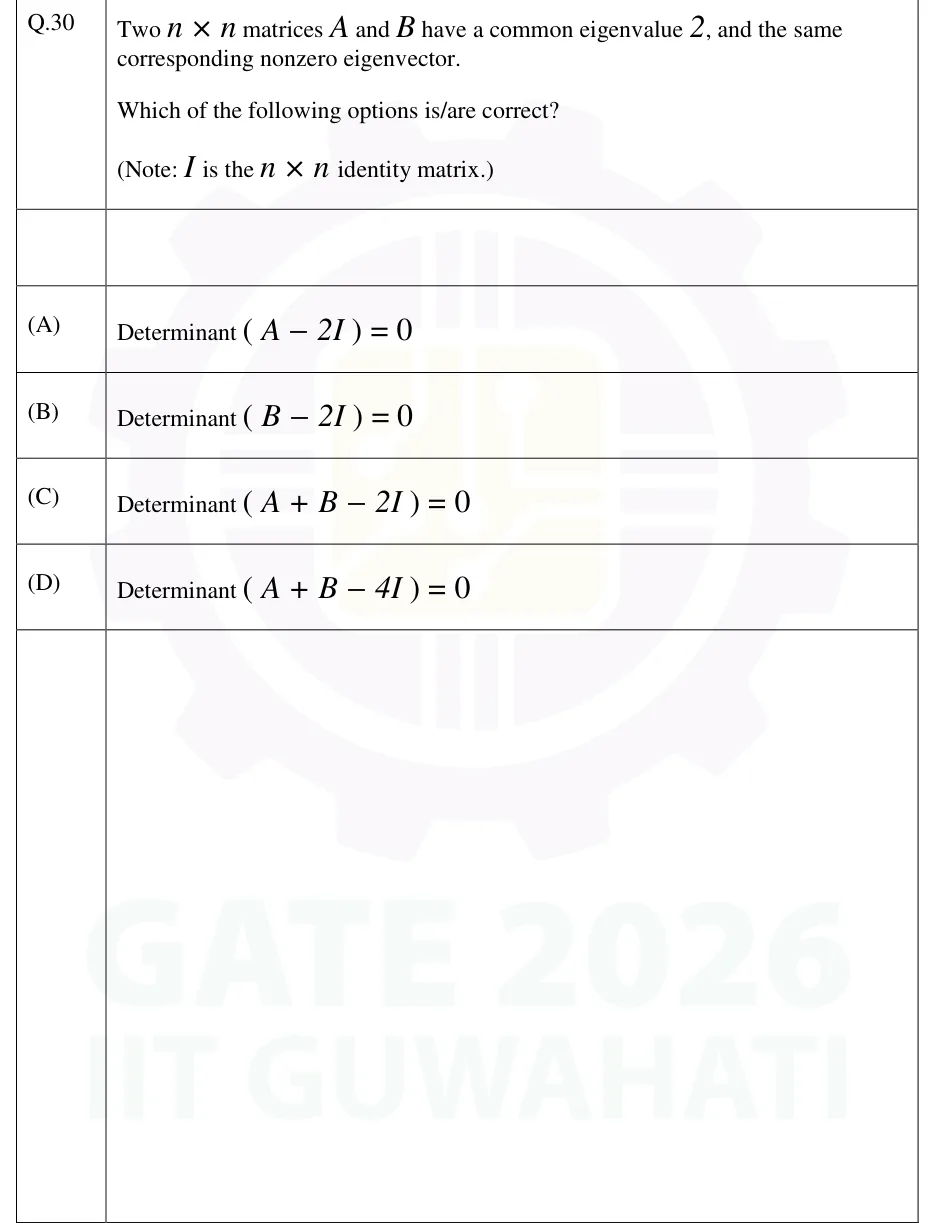
Two matrices and have a common eigenvalue , and the same corresponding nonzero eigenvector.
Which of the following options is/are correct?
(Note: is the identity matrix.)
Determinant
Determinant
Determinant
Determinant
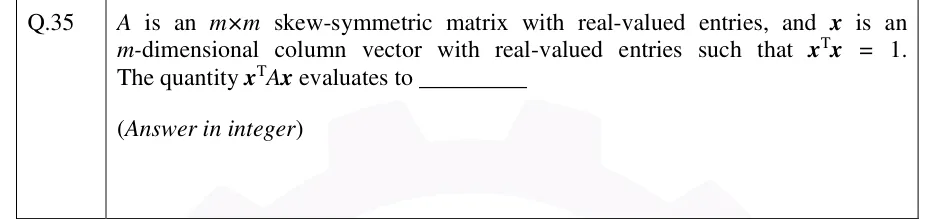
is an skew-symmetric matrix with real-valued entries, and is an -dimensional column vector with real-valued entries such that . The quantity evaluates to ________
(Answer in integer)
Which one of the following statements is ALWAYS correct about a collection of column vectors, each having real-valued entries?
If , then the column vectors must be linearly dependent
If , then the column vectors must be linearly independent
If , then the column vectors must be orthogonal
If , then the column vectors must be linearly independent
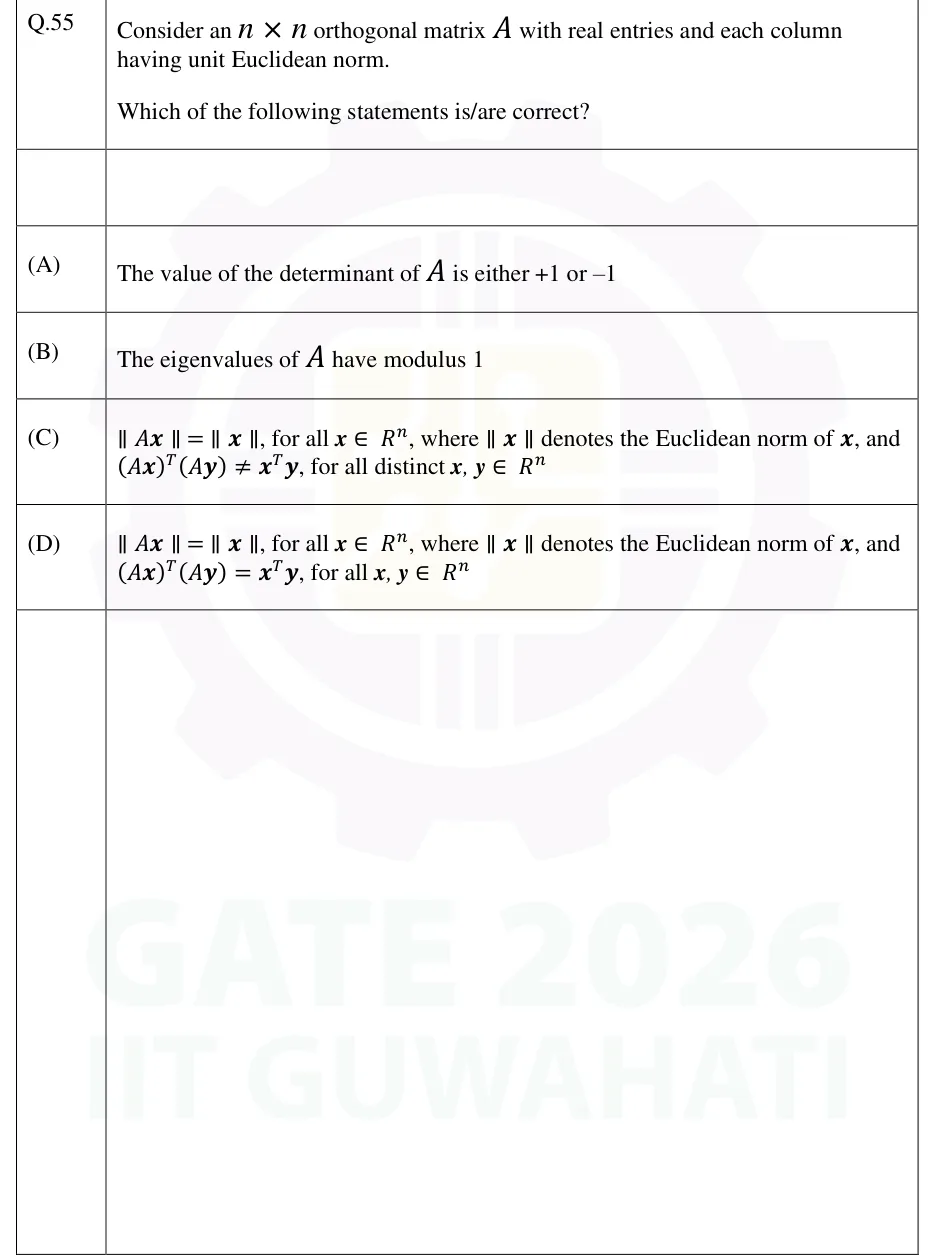
Consider an orthogonal matrix with real entries and each column having unit Euclidean norm.
Which of the following statements is/are correct?
The value of the determinant of is either or
The eigenvalues of have modulus 1
, for all , where denotes the Euclidean norm of , and , for all distinct
, for all , where denotes the Euclidean norm of , and , for all
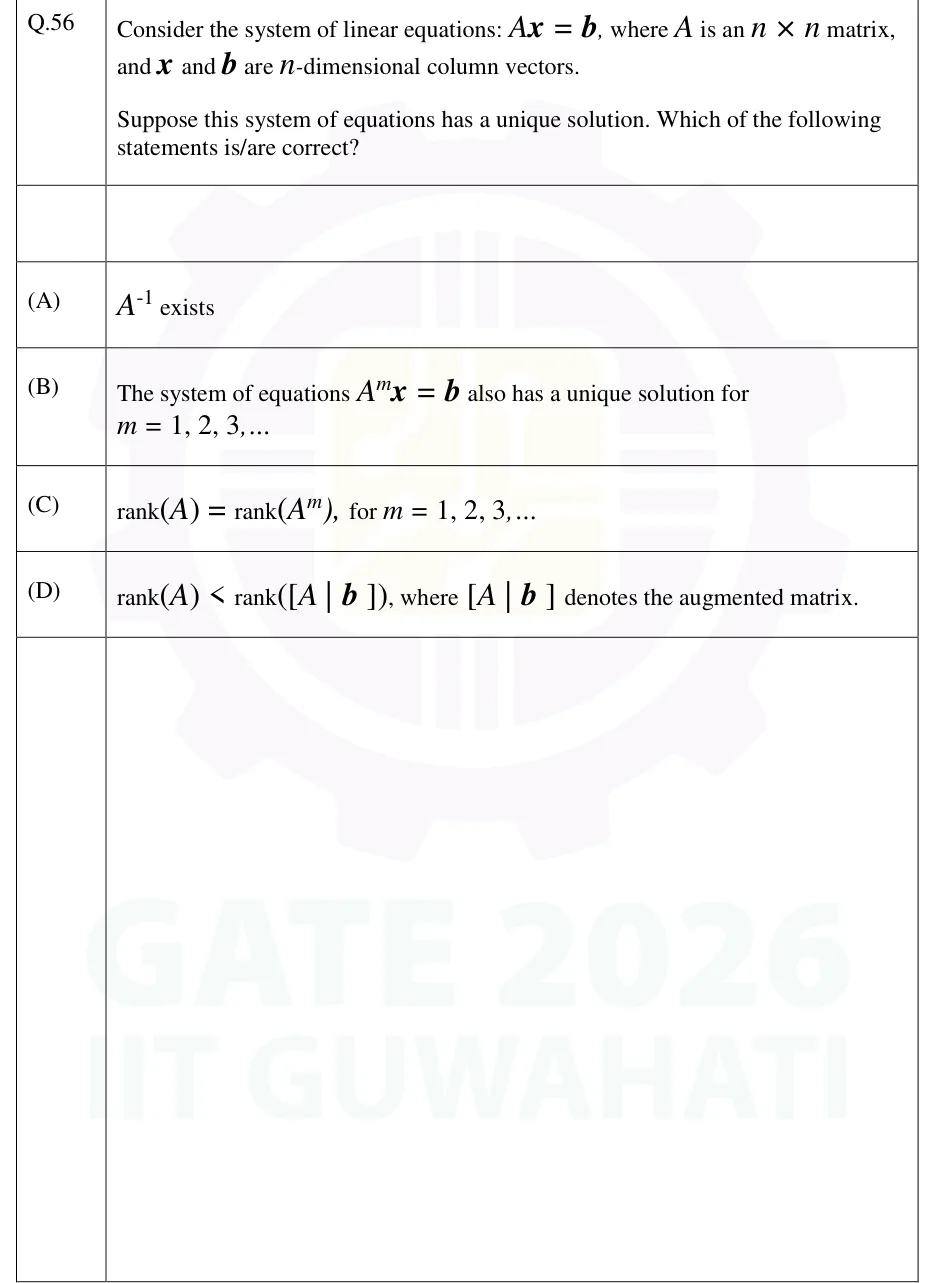
Consider the system of linear equations: , where is an matrix, and and are -dimensional column vectors.
Suppose this system of equations has a unique solution. Which of the following statements is/are correct?
exists
The system of equations also has a unique solution for
, for
, where denotes the augmented matrix.
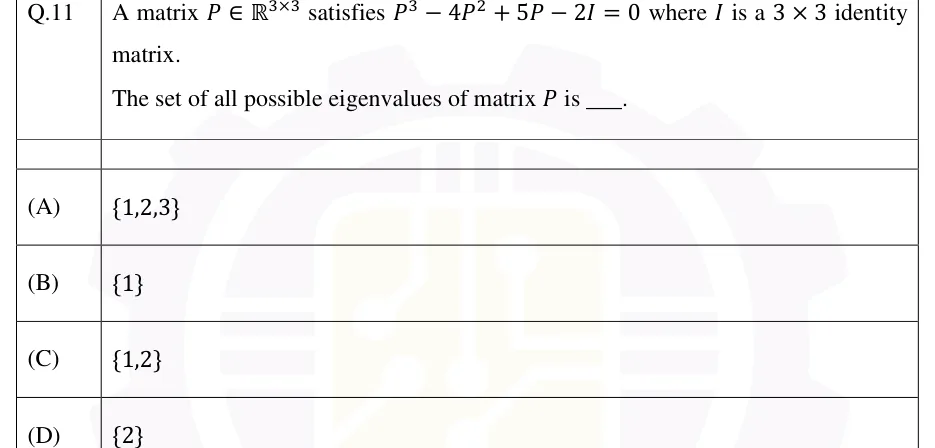
A matrix satisfies where is a identity matrix.
The set of all possible eigenvalues of matrix is ____.
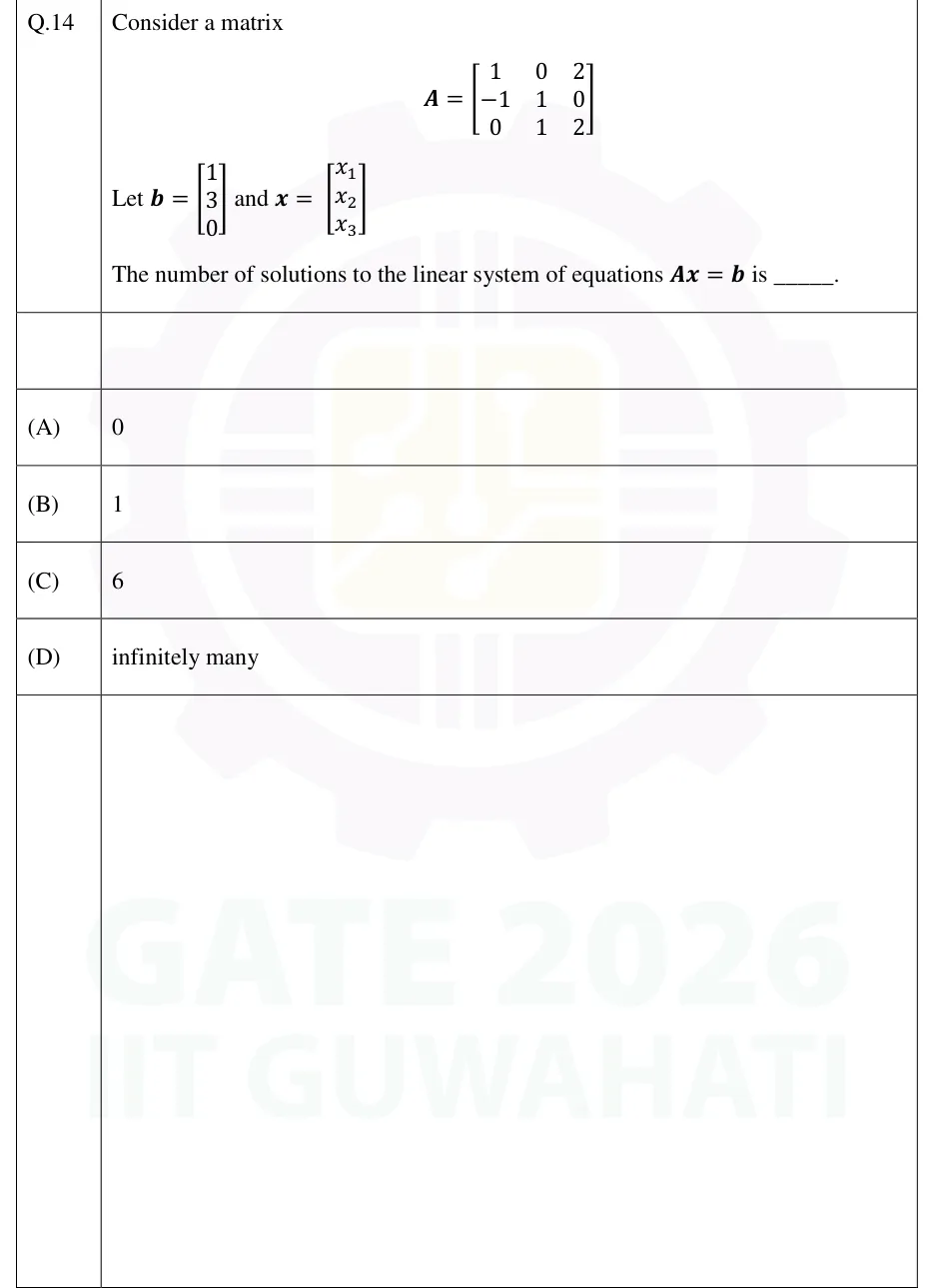
Consider a matrix
Let and
The number of solutions to the linear system of equations is ______.
0
1
6
infinitely many
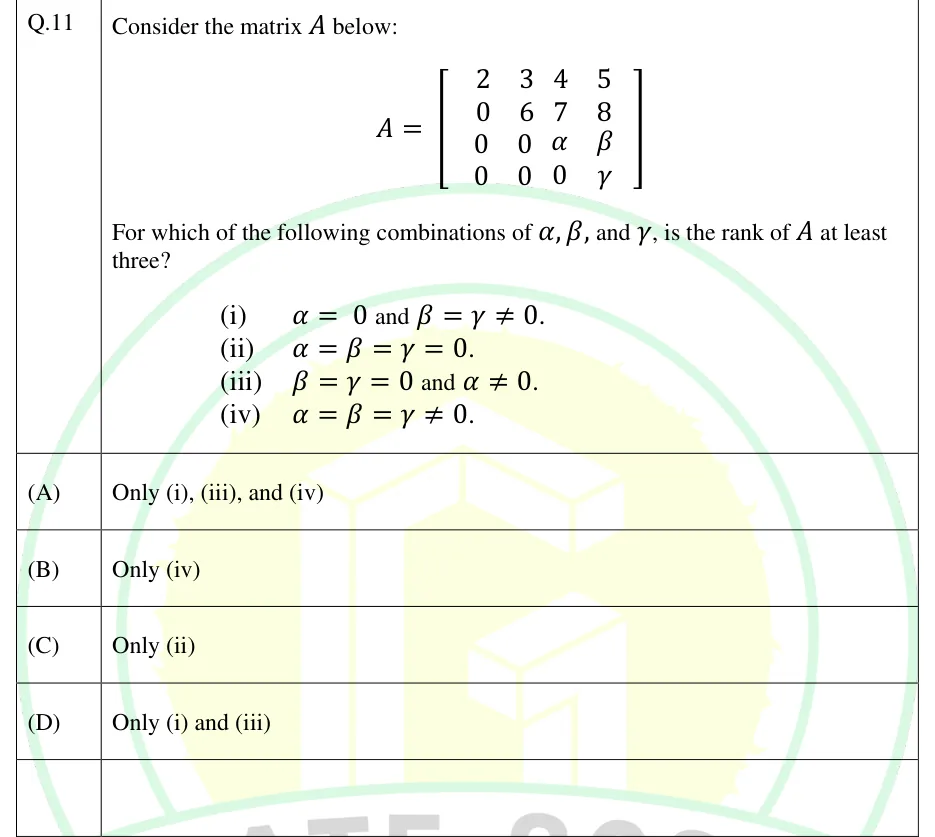
Consider the matrix below:
For which of the following combinations of , and , is the rank of at least three?
(i) and .
(ii) .
(iii) and .
(iv) .
Only (i), (iii), and (iv)
Only (iv)
Only (ii)
Only (i) and (iii)
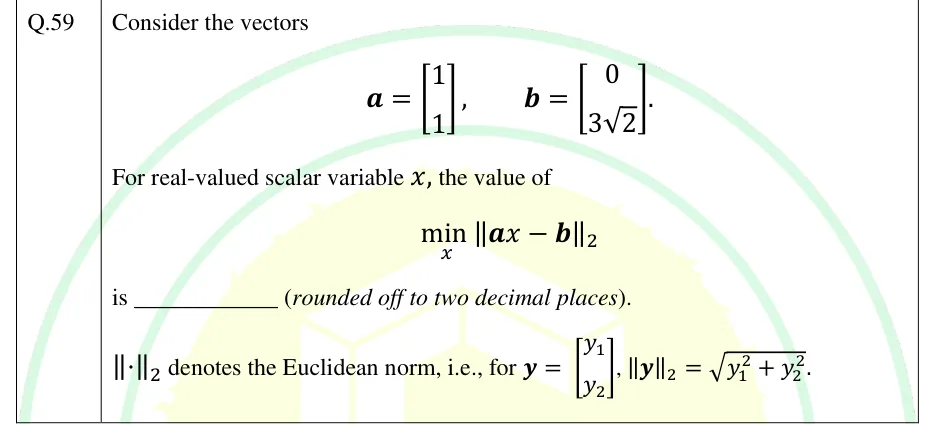
Consider the vectors
For real-valued scalar variable , the value of
is ________ (rounded off to two decimal places).
denotes the Euclidean norm, i.e., for , .
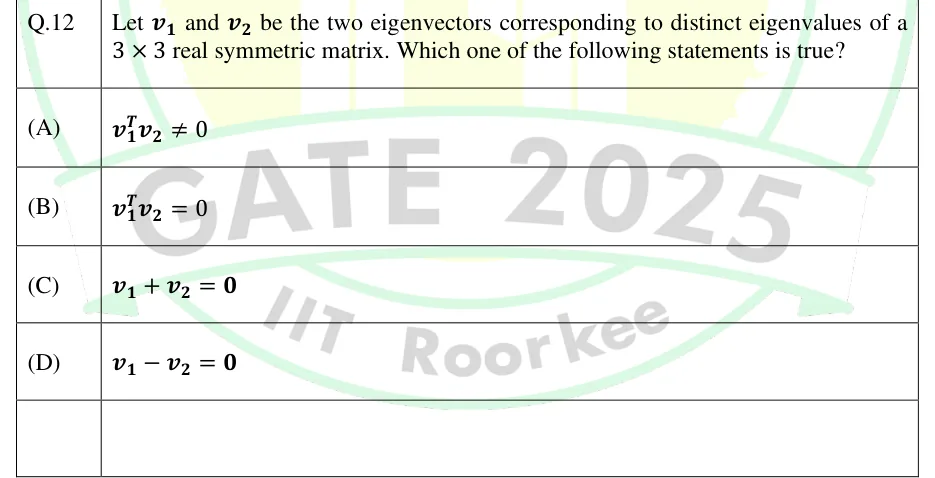
Let and be the two eigenvectors corresponding to distinct eigenvalues of a real symmetric matrix. Which one of the following statements is true?
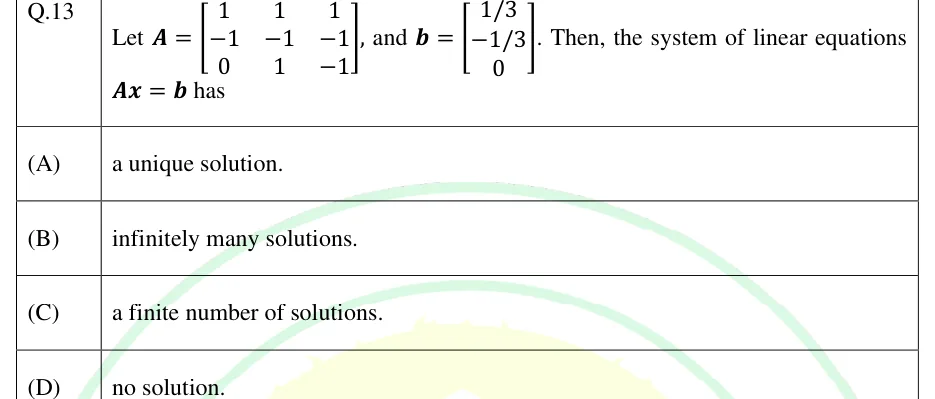
Let , and . Then, the system of linear equations has
a unique solution.
infinitely many solutions.
a finite number of solutions.
no solution.
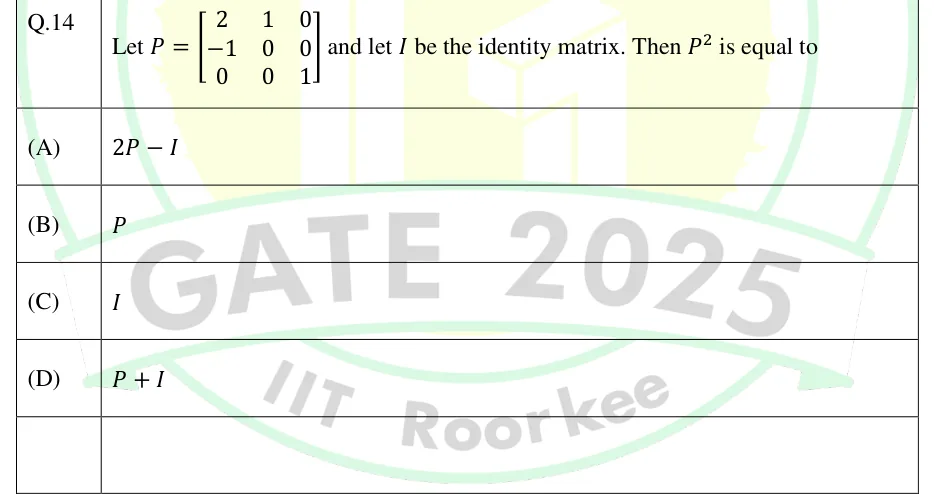
Let and let be the identity matrix. Then is equal to
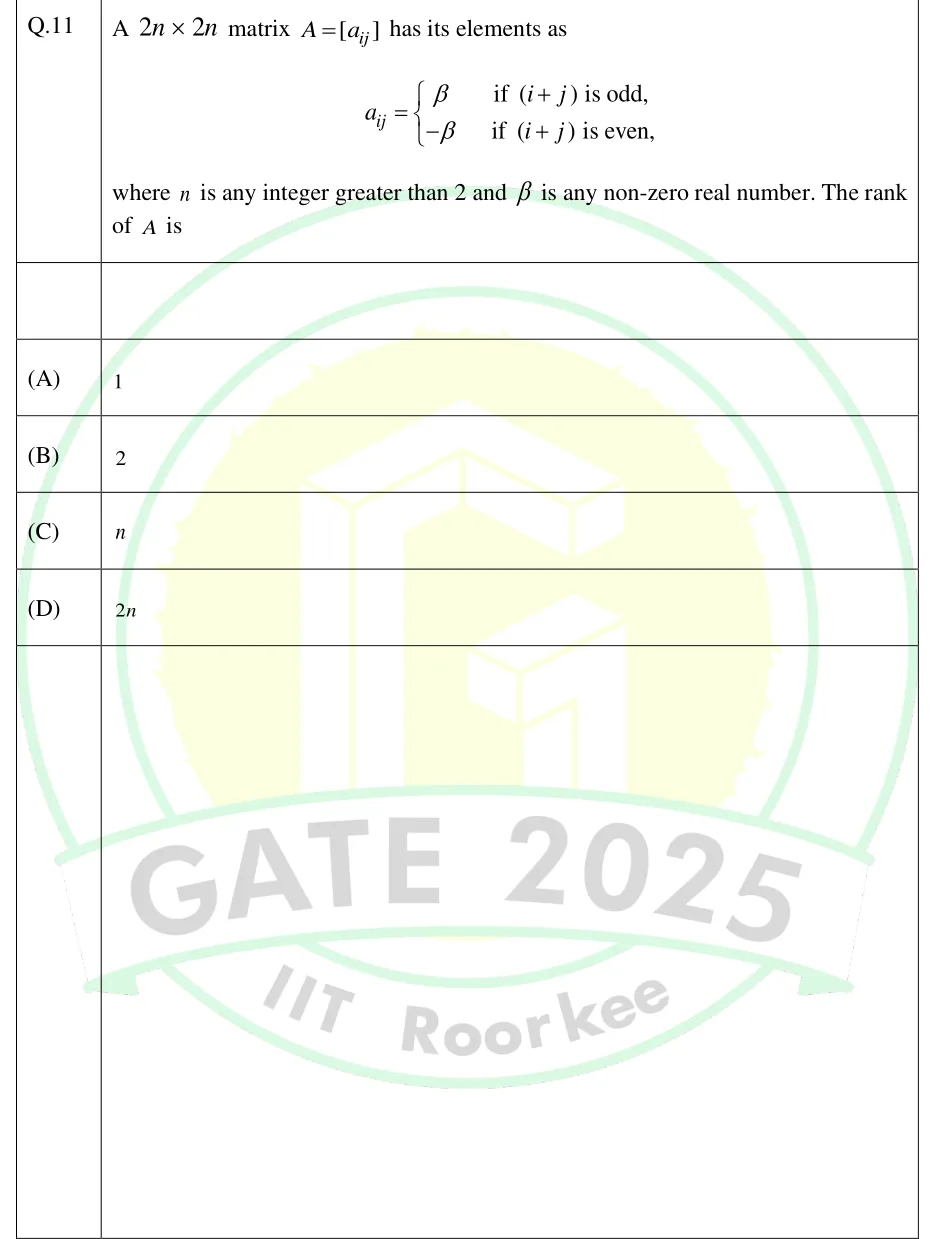
A matrix has its elements as
where is any integer greater than 2 and is any non-zero real number. The rank of is
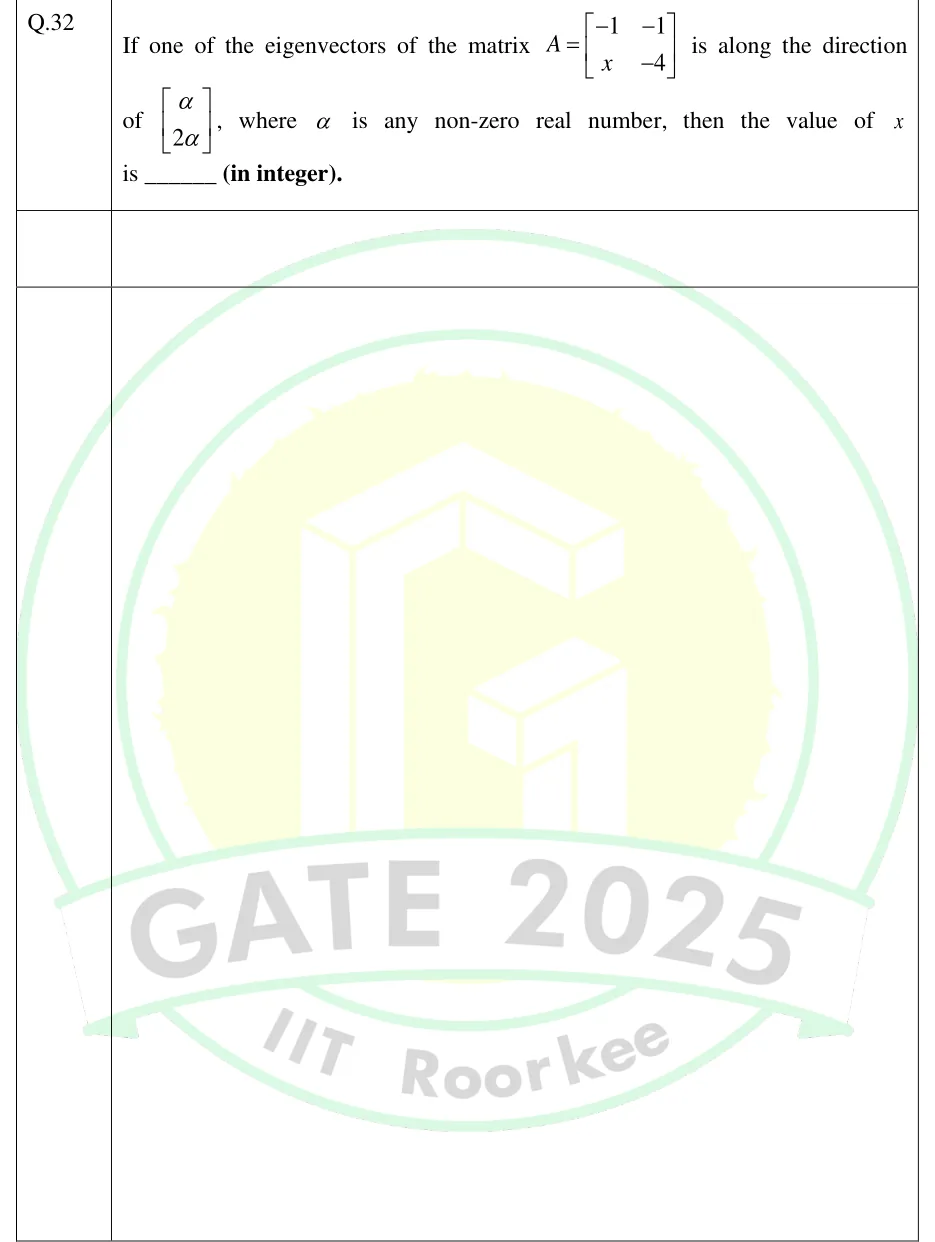
If one of the eigenvectors of the matrix is along the direction of , where is any non-zero real number, then the value of is ______ (in integer).
Let and denote the set of real numbers and the three dimensional vector space over it, respectively. The value of for which the set of vectors
does not form a basis of is ______.
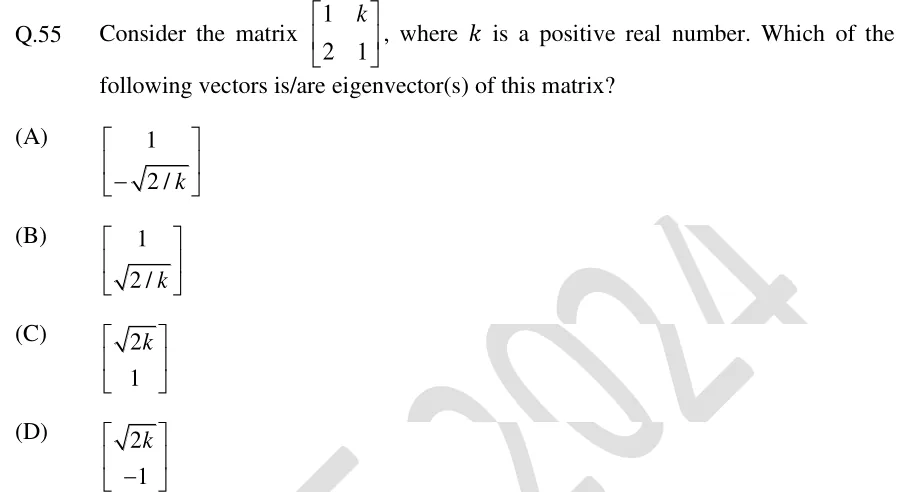
Consider the matrix , where is a positive real number. Which of the following vectors is/are eigenvector(s) of this matrix?
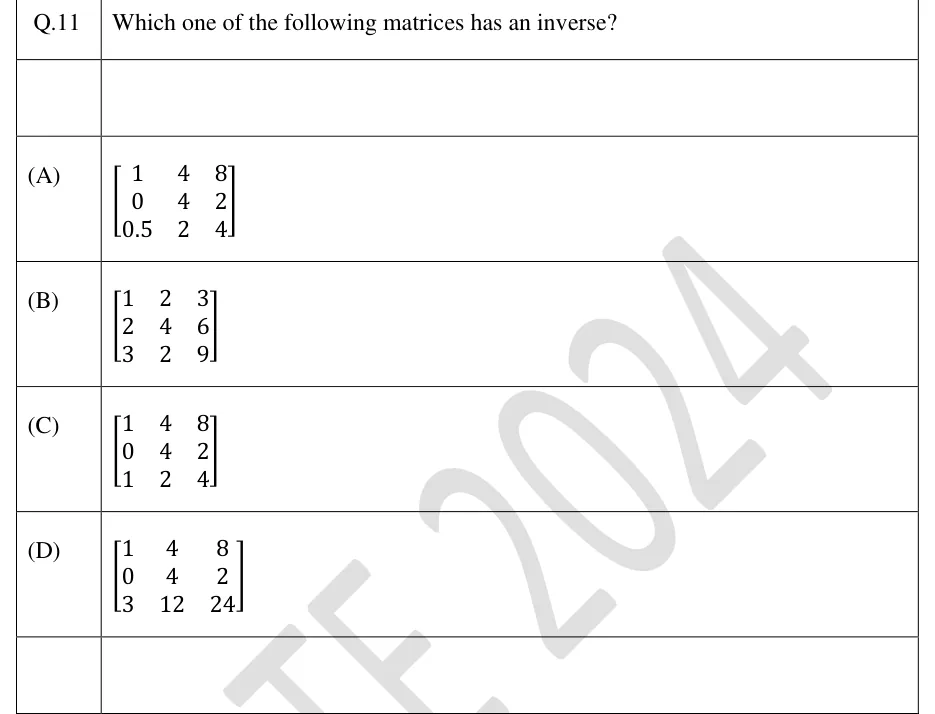
Which one of the following matrices has an inverse?
The sum of the eigenvalues of the matrix is ______ (rounded off to the nearest integer).
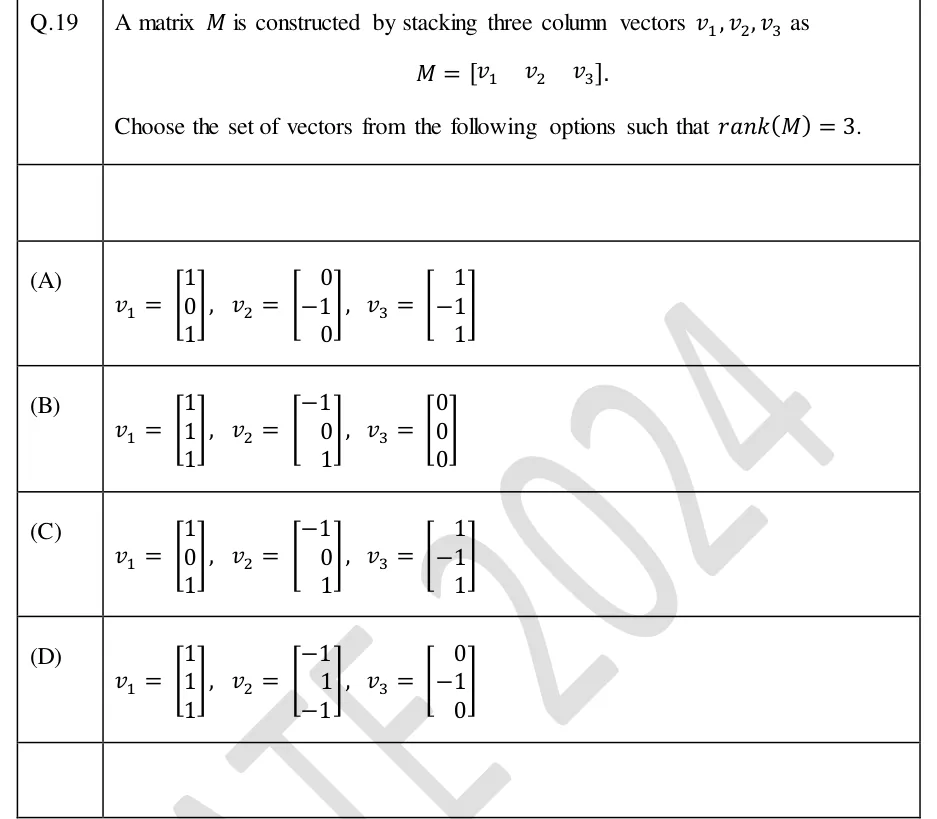
A matrix is constructed by stacking three column vectors as
Choose the set of vectors from the following options such that .
A matrix with all real elements has eigenvalues , , and . The value of is ________ (rounded off to nearest integer).
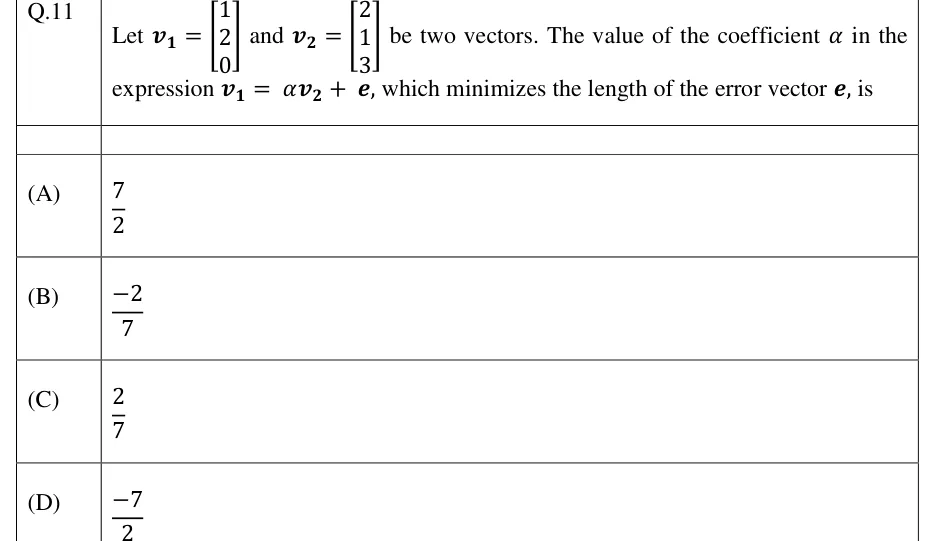
Let and be two vectors. The value of the coefficient in the expression , which minimizes the length of the error vector , is
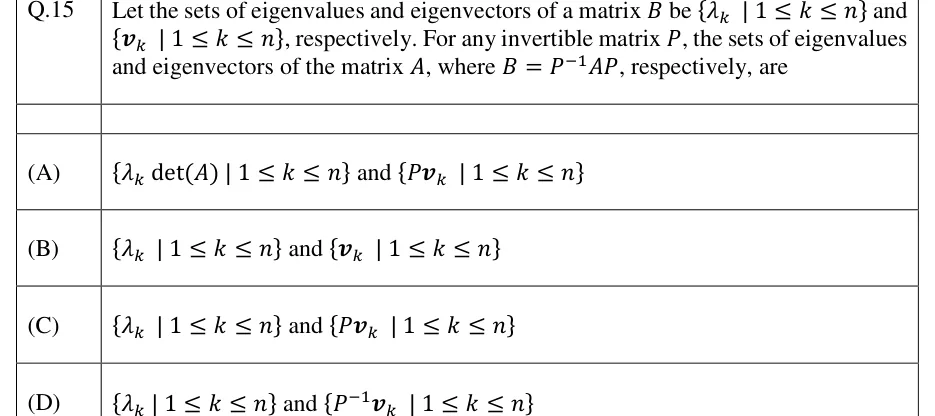
Let the sets of eigenvalues and eigenvectors of a matrix be and , respectively. For any invertible matrix , the sets of eigenvalues and eigenvectors of the matrix , where , respectively, are
and
and
and
and
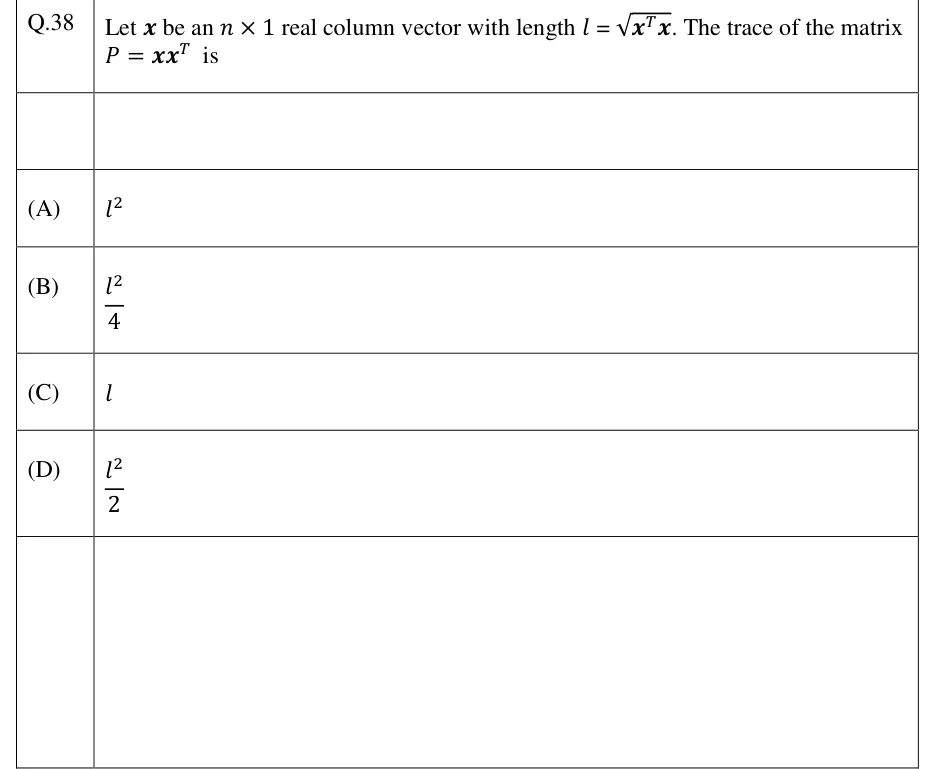
Let be an real column vector with length . The trace of the matrix is
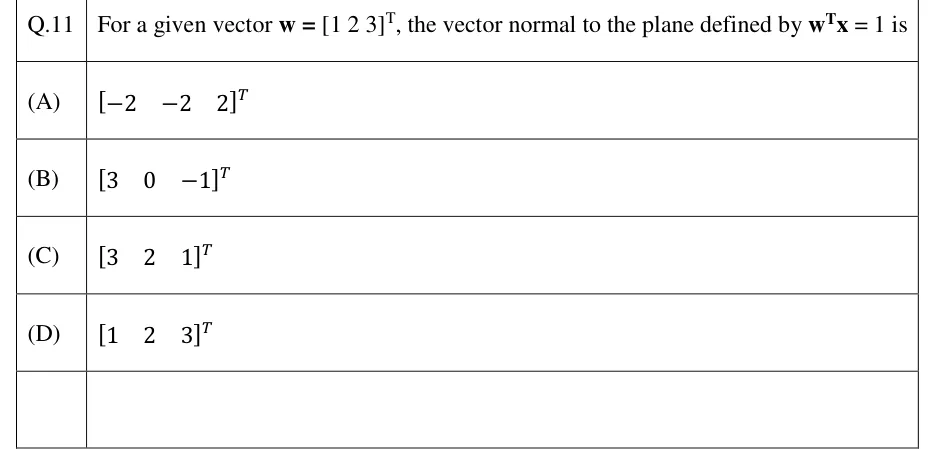
For a given vector , the vector normal to the plane defined by is
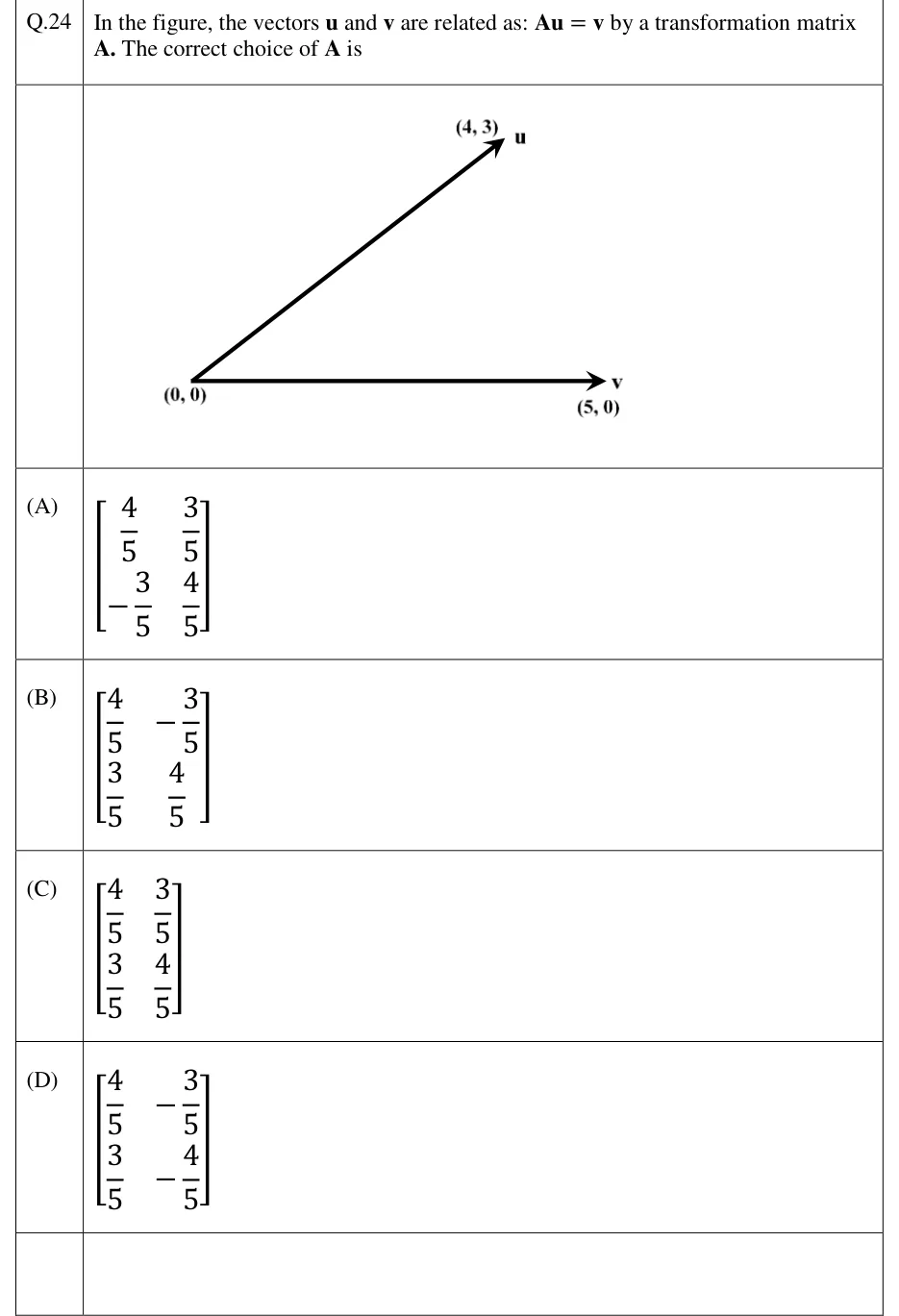
In the figure, the vectors and are related as: by a transformation matrix . The correct choice of is
 Tap to open full size
Two arrows drawn from a common tail at the origin, labelled (0, 0). Vector u runs from (0, 0) up and to the right to its head, labelled (4, 3), with the label u beside the arrowhead. Vector v runs horizontally to the right from (0, 0) to its head, labelled (5, 0), with the label v beside the arrowhead. No axes are drawn. Both vectors have length 5, and u lies above v at an angle of tan^-1(3/4) measured anticlockwise from v.
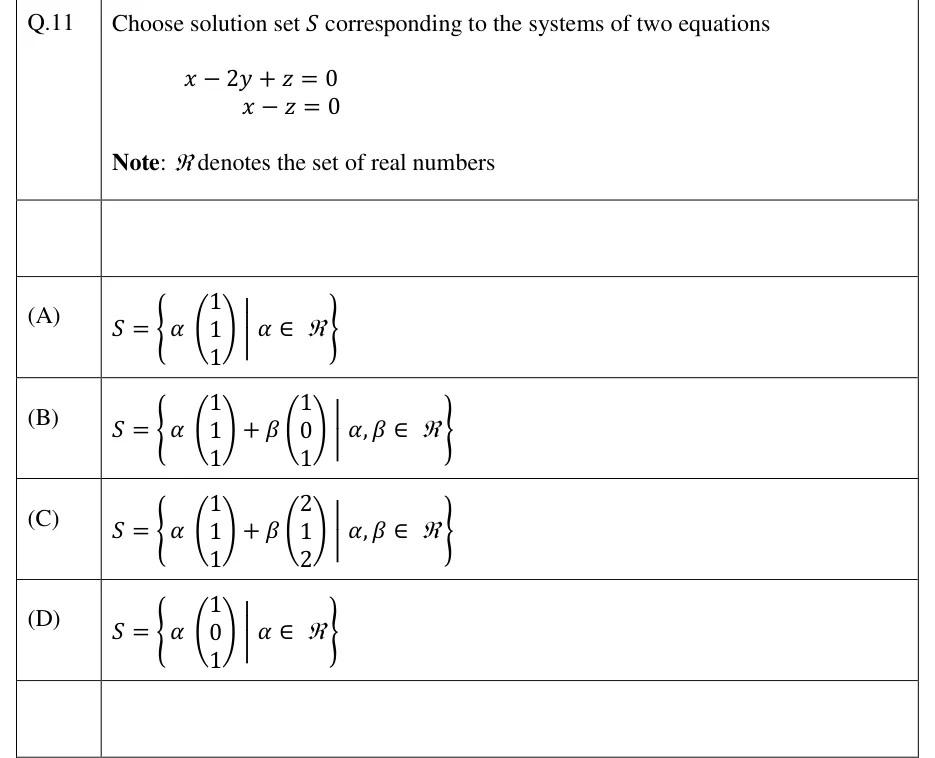
Choose solution set corresponding to the systems of two equations
Note: denotes the set of real numbers
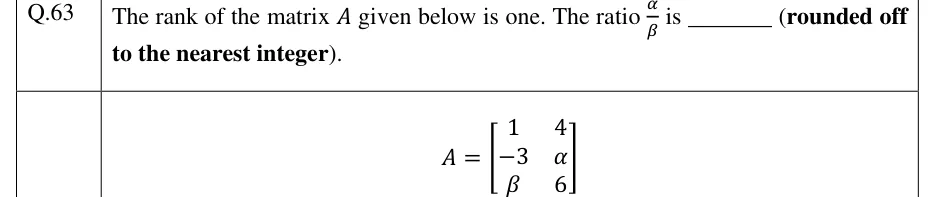
The rank of the matrix given below is one. The ratio is ________ (rounded off to the nearest integer).
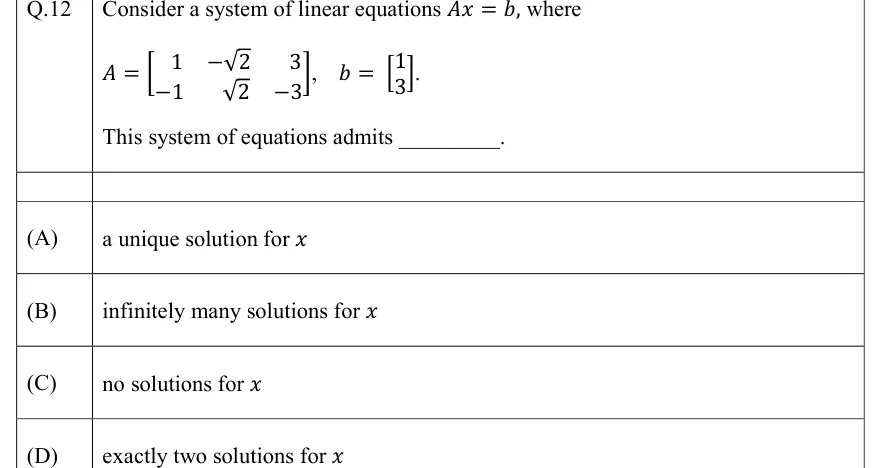
Consider a system of linear equations , where
This system of equations admits ________.
a unique solution for
infinitely many solutions for
no solutions for
exactly two solutions for
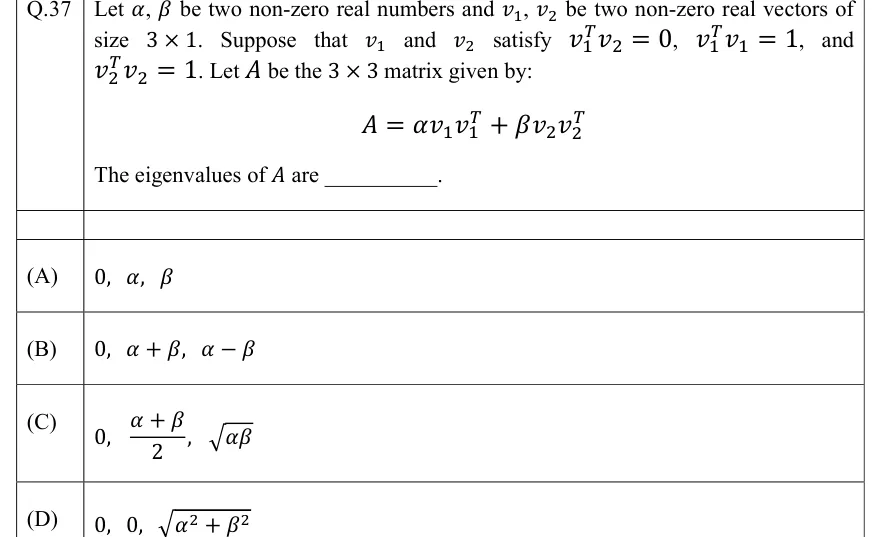
Let be two non-zero real numbers and be two non-zero real vectors of size . Suppose that and satisfy , , and . Let be the matrix given by:
The eigenvalues of are ________.
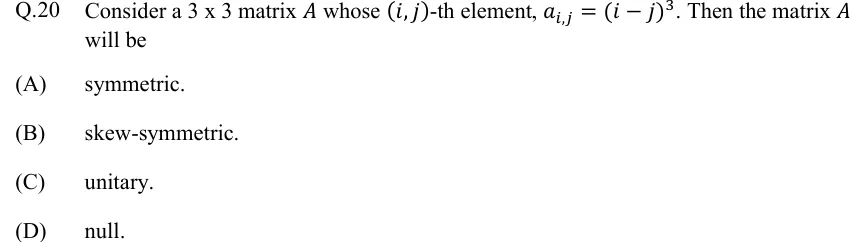
Consider a 3 x 3 matrix whose -th element, . Then the matrix will be
symmetric.
skew-symmetric.
unitary.
null.
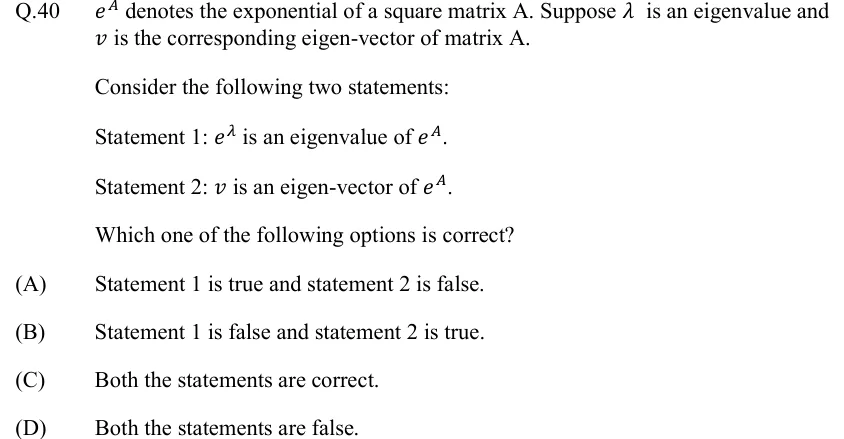
denotes the exponential of a square matrix A. Suppose is an eigenvalue and is the corresponding eigen-vector of matrix A.
Consider the following two statements:
Statement 1: is an eigenvalue of .
Statement 2: is an eigen-vector of .
Which one of the following options is correct?
Statement 1 is true and statement 2 is false.
Statement 1 is false and statement 2 is true.
Both the statements are correct.
Both the statements are false.
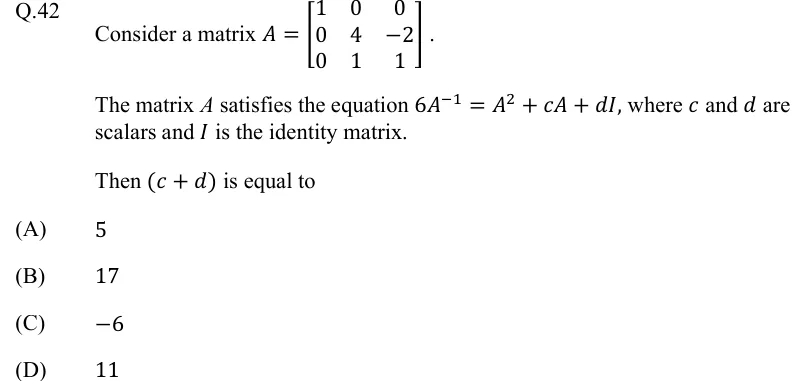
Consider a matrix .
The matrix satisfies the equation , where and are scalars and is the identity matrix.
Then is equal to
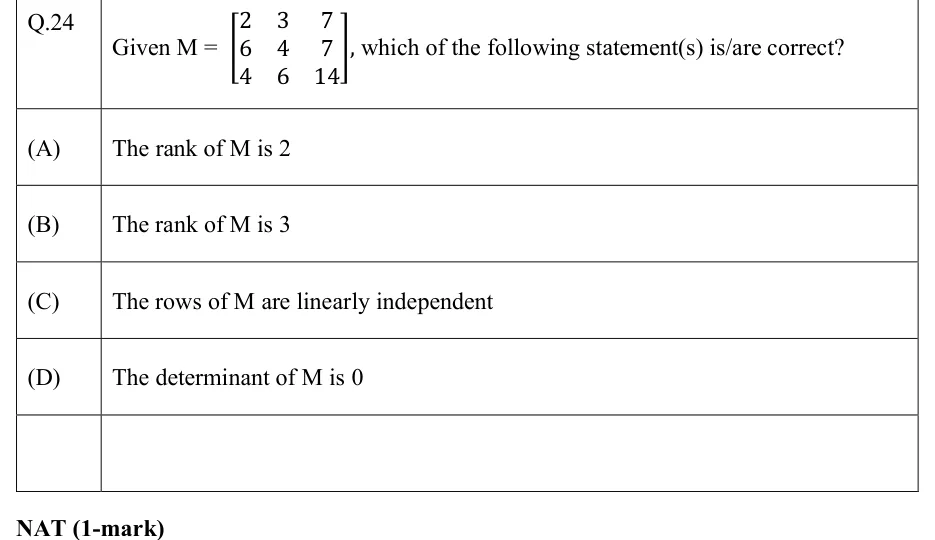
Given , which of the following statement(s) is/are correct?
The rank of M is 2
The rank of M is 3
The rows of M are linearly independent
The determinant of M is 0
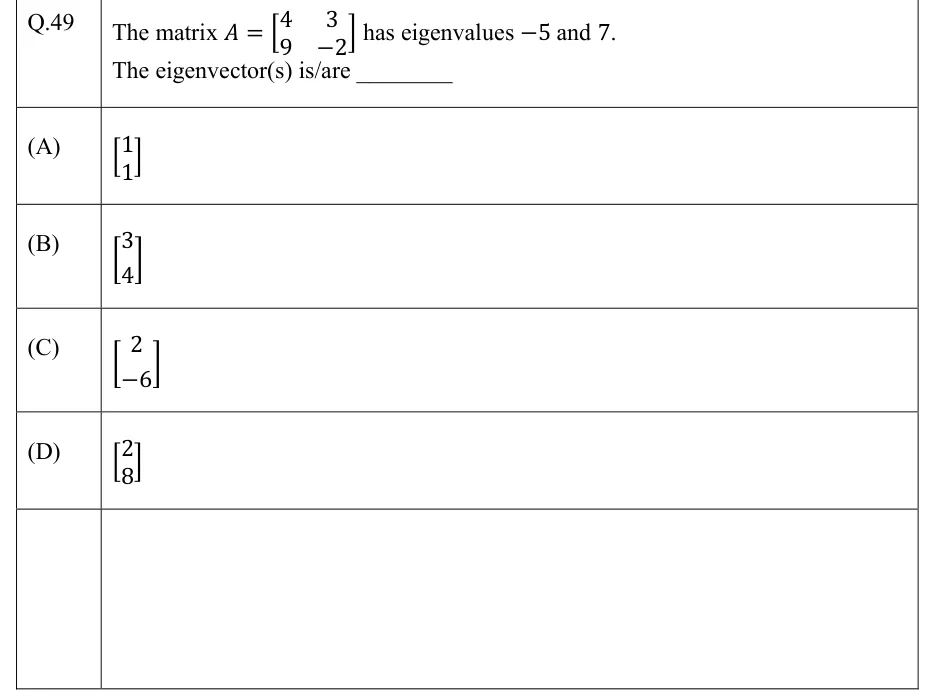
The matrix has eigenvalues and . The eigenvector(s) is/are ________
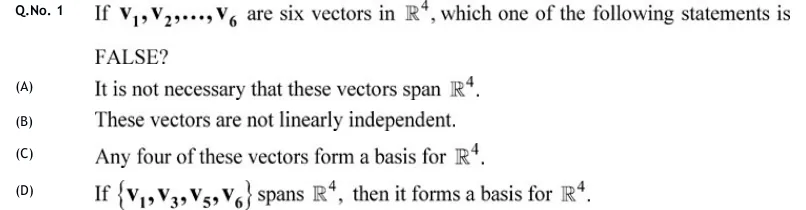
If are six vectors in , which one of the following statements is FALSE?
It is not necessary that these vectors span .
These vectors are not linearly independent.
Any four of these vectors form a basis for .
If spans , then it forms a basis for .
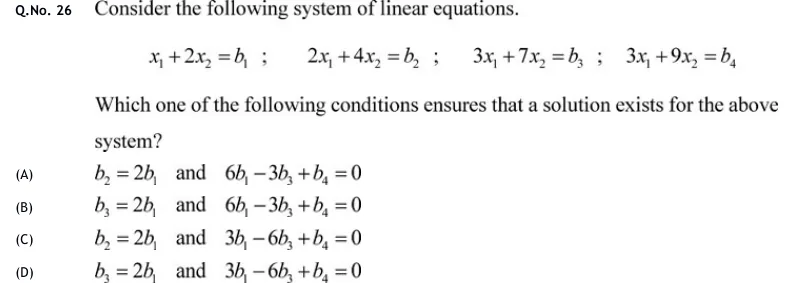
Consider the following system of linear equations.
Which one of the following conditions ensures that a solution exists for the above system?
and
and
and
and
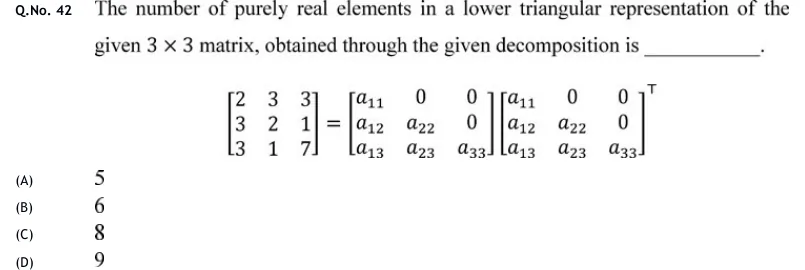
The number of purely real elements in a lower triangular representation of the given matrix, obtained through the given decomposition is ________.
5
6
8
9
Official answer: marks to all candidatesSource: Official answer key, GATE 2020 EE (IIT Delhi)
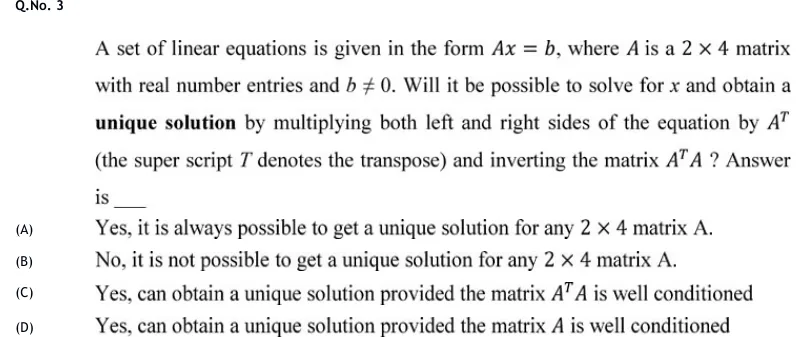
A set of linear equations is given in the form , where is a matrix with real number entries and . Will it be possible to solve for and obtain a unique solution by multiplying both left and right sides of the equation by (the super script denotes the transpose) and inverting the matrix ? Answer is ____
Yes, it is always possible to get a unique solution for any matrix A.
No, it is not possible to get a unique solution for any matrix A.
Yes, can obtain a unique solution provided the matrix is well conditioned
Yes, can obtain a unique solution provided the matrix is well conditioned
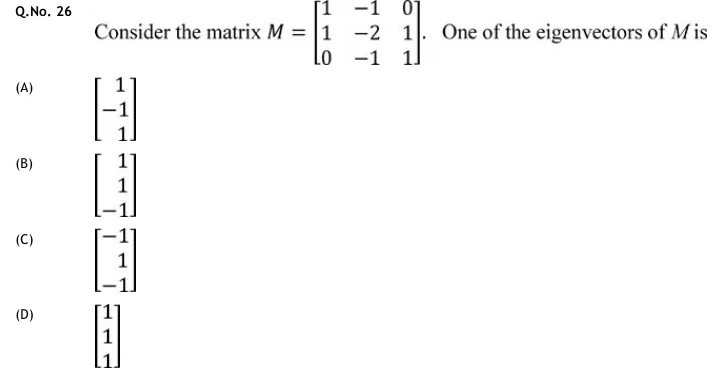
Consider the matrix . One of the eigenvectors of is
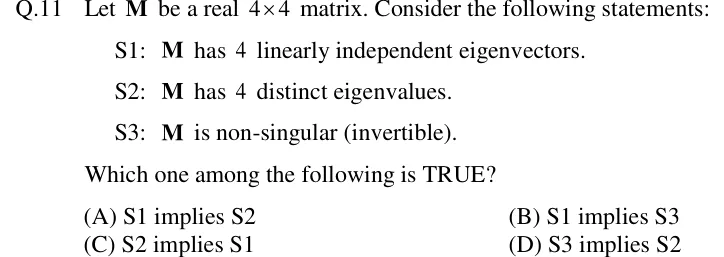
Let be a real matrix. Consider the following statements:
S1: has 4 linearly independent eigenvectors.
S2: has 4 distinct eigenvalues.
S3: is non-singular (invertible).
Which one among the following is TRUE?
S1 implies S2
S1 implies S3
S2 implies S1
S3 implies S2
Consider matrix and vector . The number of distinct real values of for which the equation has infinitely many solutions is ________.
Consider a non-singular square matrix . If and , the determinant of the matrix is ________ (up to 1 decimal place).
Let and , where is the identity matrix. The determinant of is ________ (up to 1 decimal place).
Let be a 3 by 3 matrix with real number entries. The matrix is such that . The eigen values of are
0, 0, 0
0,0,1
0,1,1
1,1,1
Consider the following system of linear equations:
Here and are the unknowns and is a real constant. The value of for which there are infinite number of solutions is
PRACTICE
A real matrix has eigenvalues , and . The determinant of is
Answer: (B)
.
for .
Check through eigenvalues: has eigenvalues , whose product is .
The homogeneous system , , has a non-trivial solution. The value of is ______.
Answer: (accepted range )
A square homogeneous system has a non-trivial solution exactly when its coefficient determinant is zero.
.
gives . Check: with , row 2 minus row 1 equals row 3, so the rows are dependent.
The quadratic form in the real variables is
positive definite
positive semi-definite but not positive definite
negative semi-definite
indefinite
Answer: (B)
Halve the cross-term coefficient: .
and , so the eigenvalues are and : none negative, one of them zero. Hence is positive semi-definite but not positive definite.
Directly: for every , and at , so (A) fails. rules out (C), and never takes a negative value, which rules out (D). The answer is (B).
Let . Which of the following statements is/are TRUE?
is diagonalisable
The geometric multiplicity of the eigenvalue is
The eigenvalues of are , and
Answer: (B), (C)
is upper triangular, so its eigenvalues are , and has AM .
has two non-zero, independent rows, so its rank is : (D) is false.
GM of is : (B) is true. Since GM AM, has only two independent eigenvectors and is not diagonalisable: (A) is false.
, and the eigenvalues of are the reciprocals : (C) is true.
For , the entry in row 1, column 2 of is ______.
Answer:
and , so and the eigenvalues are and .
By Cayley–Hamilton, , where at both eigenvalues: and .
Subtracting, , so and .
, and the (1, 2) entry is .
Check by diagonalisation: the (1, 2) entry of is , which is for .
is a real matrix of rank . Which of the following statements is/are TRUE?
The solution space of has dimension
has a solution for every in
The four rows of are linearly dependent
The matrix is invertible
Answer: (A), (C)
Rank-nullity with columns: nullity . (A) is true.
The columns of span a -dimensional subspace of , so some lies outside it; for that , and there is no solution. (B) is false.
Four rows but only three independent ones: the rows are dependent. (C) is true.
, so is singular. (D) is false.
OFFICIAL GATE 2027 SYLLABUS WORDING
Copied from the GATE 2027 syllabus; see all 2027 syllabi.
GATE EC
Vector space, basis, linear dependence and independence, matrix algebra, eigen values and eigen vectors, rank, solution of linear equations - existence and uniqueness
GATE EE
Matrix Algebra, Systems of linear equations, Eigen values, Eigen vectors
GATE IN
Matrix algebra, systems of linear equations, consistency and rank, eigenvalues and eigenvectors, tensors
Preparing in Kolkata? IAE Academy's course for GATE ECE, GATE EE or GATE IN.