
IAE Academy

GATE 2026 EE Q.55: solution and answer

GATE 2026 · EEQ.55 · 2 marks · MSQ

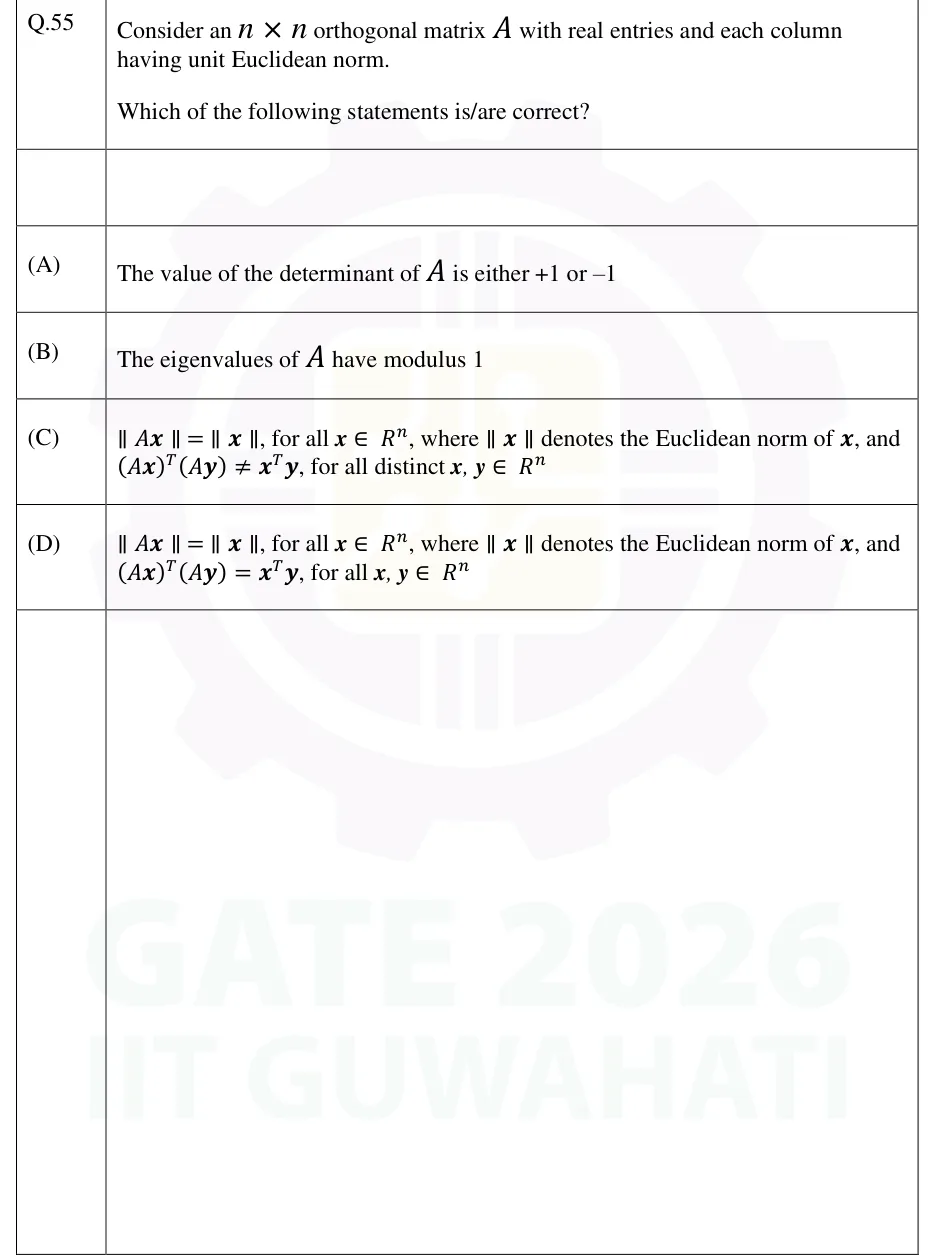
Consider an orthogonal matrix with real entries and each column having unit Euclidean norm.

Which of the following statements is/are correct?

  1. (A)

    The value of the determinant of is either or

  2. (B)

    The eigenvalues of have modulus 1

  3. (C)

    , for all , where denotes the Euclidean norm of , and , for all distinct
  4. (D)

    , for all , where denotes the Euclidean norm of , and , for all

See the question in the paper

Answer and solution

ANSWER

The correct options are (A), (B) and (D). For a real orthogonal matrix, , every eigenvalue has modulus 1, and preserves every length and every inner product. Option (C) is false because the equality holds for every pair of vectors, so it cannot fail for every distinct pair.

Official answer: A, B, DSource: Official answer key, GATE 2026 EE (IIT Guwahati)

  1. is a real orthogonal matrix, so . Because is square, this also gives . The condition that every column has unit Euclidean norm is already part of this: it is the diagonal of . Every part below follows from .

  2. (A) Determinant. Take determinants of and use : So (A) is correct.

  3. (B) Eigenvalues. Let with . The eigenvector can be complex, so write for its conjugate transpose. is real, so . Then and also Since , , so . For example, the rotation matrix has eigenvalues . They are complex, and each has modulus 1. So (B) is correct.

  4. Inner products are preserved. For any real vectors : Put to get , so .

  5. (D) Both parts of (D) are exactly what the previous step proved: for every , and for every pair. So (D) is correct.

  6. (C) The first part of (C) is true. The second part says for every pair of distinct vectors, but the previous step shows the two sides are equal for every pair. One concrete pair: , , and are distinct, and both sides equal . Any orthogonal has such pairs, for instance with any , where both sides are . The two parts of (C) are joined by "and", so (C) is false.

  7. The correct options are A, B and D.

KEY IDEA

Every property here follows from . Taking determinants gives . Writing shows that inner products are preserved, and so lengths are too. Applying the length result to a possibly complex eigenvector, using the conjugate transpose, gives .

WATCH OUT FOR

One mistake is to read (B) as saying the eigenvalues are and reject it because rotation matrices have complex eigenvalues. The option only claims modulus 1, and has modulus 1. Another is to accept (C) because its first half () is true, without noticing that its second half contradicts inner-product preservation. A third is to prove with in place of . That argument fails when the eigenvector is complex.

From the GATE 2026 EE paper. Every question of this paper · Download the full paper · All 46 Linear algebra questions, with notes

More Linear algebra questions