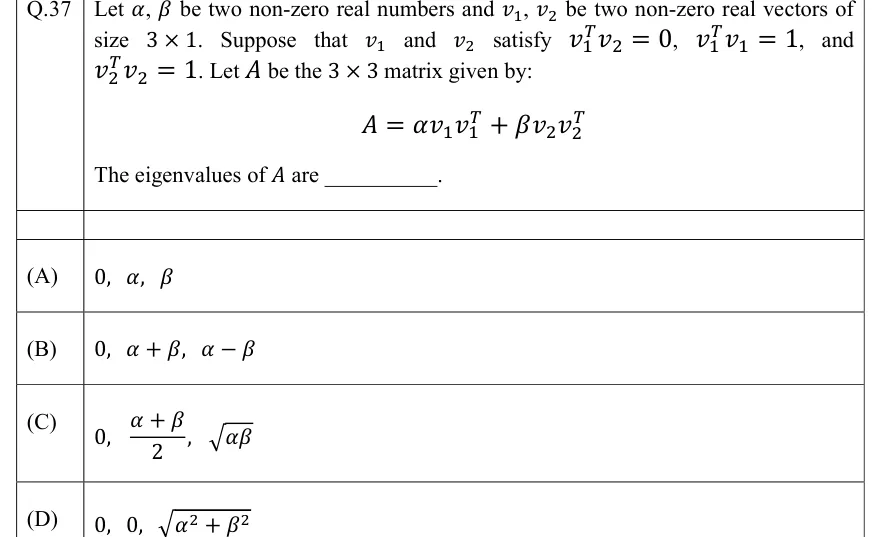
Let be two non-zero real numbers and be two non-zero real vectors of size . Suppose that and satisfy , , and . Let be the matrix given by:
The eigenvalues of are ________.
- (A)
- (B)
- (C)
- (D)

Let be two non-zero real numbers and be two non-zero real vectors of size . Suppose that and satisfy , , and . Let be the matrix given by:
The eigenvalues of are ________.
ANSWER
The eigenvalues of are , which is option (A).
Official answer: ASource: Official answer key, GATE 2022 EC (IIT Kharagpur)
The conditions , and say that are orthonormal vectors in .
Apply to . Matrix multiplication is associative, and , are scalars: So is an eigenvector with eigenvalue .
In the same way, So is an eigenvector with eigenvalue .
In , take a non-zero orthogonal to both and (for example , which is non-zero because are orthonormal). Then , so So is an eigenvector with eigenvalue .
The vectors are non-zero and mutually orthogonal, so they are linearly independent and form a basis of . A matrix with three independent eigenvectors has exactly those three eigenvalues (counted with multiplicity), so the eigenvalues of are , and .
Check with the trace: , which equals . Also is a sum of two rank-1 matrices, so . That makes , so one eigenvalue must be .
The eigenvalues of are : option (A).
KEY IDEA
and are orthonormal, so is a spectral decomposition. The matrix projects onto , so and . Any vector orthogonal to both is sent to , which gives the third eigenvalue . Checks: trace , and rank .
WATCH OUT FOR
Adding or combining and (options B, C, D) as if the two rank-1 terms mix. Because , each term acts only on its own direction, so the eigenvalues stay separate as and . Some students also forget the third eigenvalue. A matrix of rank at most 2 always has as an eigenvalue.
From the GATE 2022 EC paper. Every question of this paper · Download the full paper · All 46 Linear algebra questions, with notes