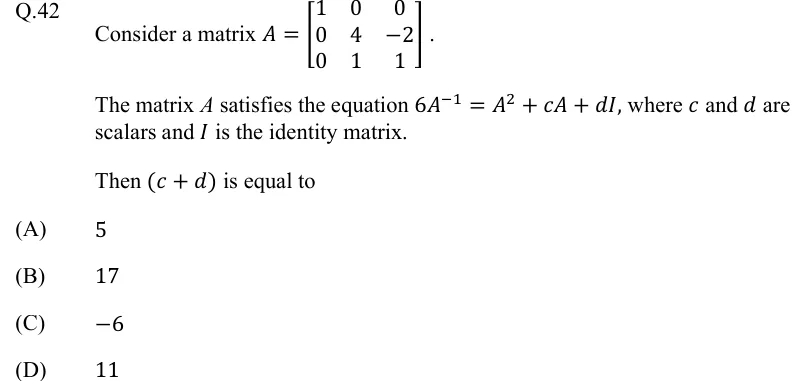
Consider a matrix .
The matrix satisfies the equation , where and are scalars and is the identity matrix.
Then is equal to
- (A)
- (B)
- (C)
- (D)

Consider a matrix .
The matrix satisfies the equation , where and are scalars and is the identity matrix.
Then is equal to
ANSWER
and , so . The answer is option (A).
Official answer: ASource: Official answer key, GATE 2022 EE (IIT Kharagpur)
is block diagonal. It is the entry plus the block , so .
For : and . So .
The characteristic equation is therefore , which expands to . (The overall sign of does not change the equation.)
Cayley-Hamilton theorem: every square matrix satisfies its own characteristic equation, so .
, so exists. Multiply the equation by to get , that is
Compare with to get and . These values are unique. If a second pair also worked, then . Since is not a scalar multiple of , this forces and .
, which is option (A).
KEY IDEA
By the Cayley-Hamilton theorem, satisfies its characteristic equation . Multiplying by gives as a quadratic in . Because is block diagonal, the characteristic polynomial is just times the block's polynomial, .
WATCH OUT FOR
Getting the sign of wrong: , not . With you get the wrong cubic and the wrong constant term, and a coefficient such as (option C) or (option D) looks like the answer. Those are the separate values of and , not their sum. Another slip is dropping the term when multiplying by , which loses the factor in front of .
From the GATE 2022 EE paper. Every question of this paper · Download the full paper · All 46 Linear algebra questions, with notes