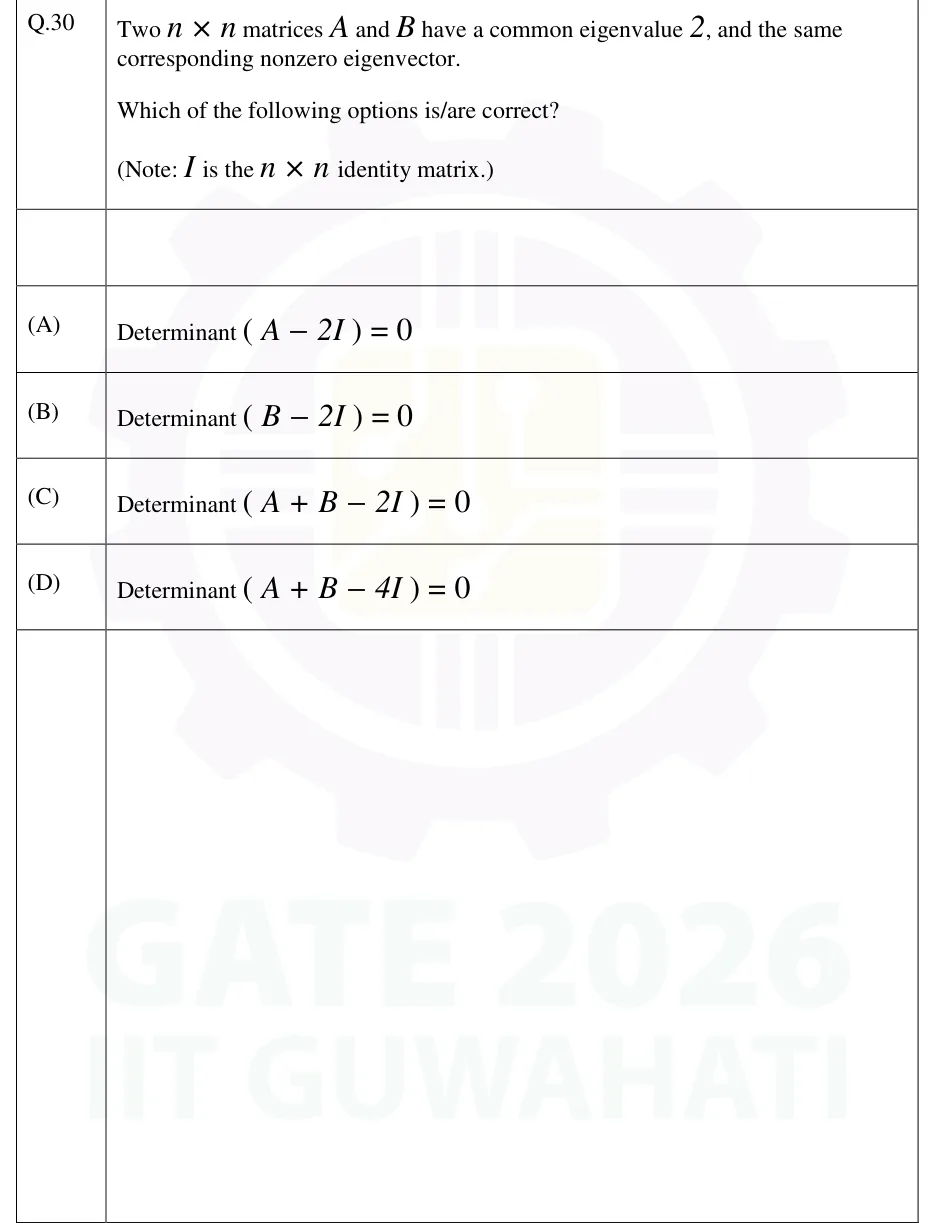
Two matrices and have a common eigenvalue , and the same corresponding nonzero eigenvector.
Which of the following options is/are correct?
(Note: is the identity matrix.)
- (A)
Determinant
- (B)
Determinant
- (C)
Determinant
- (D)
Determinant

Two matrices and have a common eigenvalue , and the same corresponding nonzero eigenvector.
Which of the following options is/are correct?
(Note: is the identity matrix.)
Determinant
Determinant
Determinant
Determinant
ANSWER
Options (A), (B) and (D) are correct: , and .
Official answer: A, B, DSource: Official answer key, GATE 2026 EE (IIT Guwahati)
Let be the common eigenvector. By the definition of an eigenpair, and .
Option (A): gives with . So has a nontrivial null space, which means it is singular, and . Correct.
Option (B): the same argument with gives with , so . Correct.
Because the eigenvector is the same for both matrices, the two eigen-equations can be added: So is an eigenvector of with eigenvalue .
Option (D): with , so is singular and . Correct.
Option (C): , so the shared eigenvector tells us nothing about whether is an eigenvalue of . Counter-example: satisfies the given data, but and . So (C) is not necessarily true.
Correct options: (A), (B) and (D).
KEY IDEA
is an eigenvalue of exactly when . If and share the eigenvector with eigenvalues and , then , so has eigenvalue (here ). Eigenvalues add only because the eigenvector is common.
WATCH OUT FOR
Ticking (C) because is an eigenvalue of both and , as if it must then be an eigenvalue of too. The shared eigenvector gives the eigenvalue , not . can be zero for some particular matrices (for example gives ), but it fails for , so (C) is not guaranteed. A second trap is assuming eigenvalues of are always sums of eigenvalues of and . That holds only for a shared eigenvector, which is given here.
From the GATE 2026 EE paper. Every question of this paper · Download the full paper · All 46 Linear algebra questions, with notes