
IAE Academy

GATE 2026 EE Q.57: solution and answer

GATE 2026 · EEQ.57 · 2 marks · NAT

The resistance values of the Wheatstone bridge shown are: , , . The battery voltage . The battery has an internal resistance of and the Galvanometer (G) has a resistance of .

[Figure]

The value of the resistance S for balanced condition is ________ (Answer in integer)
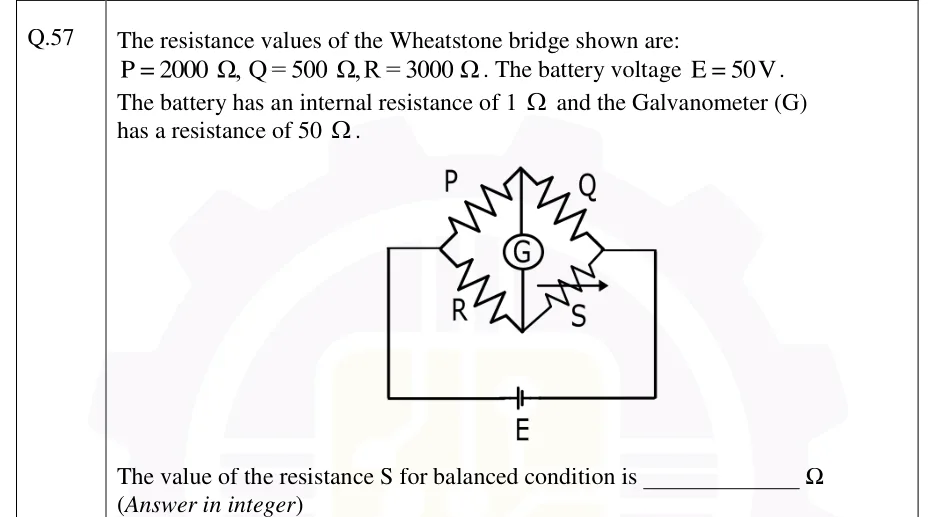
GATE 2026 EE question 57: A Wheatstone bridge drawn as a diamond with four nodes: left, top, right and bottom.Tap to open full size
Figure from the GATE 2026 EE paper. It is part of the question.
Figure description

A Wheatstone bridge drawn as a diamond with four nodes: left, top, right and bottom. Arm P joins the left node to the top node; arm Q joins the top node to the right node; arm R joins the left node to the bottom node; arm S, a variable resistor (drawn with an arrow through it), joins the bottom node to the right node. The galvanometer G is connected vertically between the top node and the bottom node. The battery E is connected between the left node and the right node by wires that run down from each side and meet at the battery at the bottom of the figure.

Answer and solution

ANSWER

The resistance S for balance is 750 Ω.

Official answer: 750Source: Official answer key, GATE 2026 EE (IIT Guwahati)

  1. Read the topology from the figure. P (left node to top node) and R (left node to bottom node) meet at the left supply node. Q (top node to right node) and the variable arm S (bottom node to right node) meet at the right supply node. G is connected between the top and bottom nodes, and the battery E is connected across the left and right nodes. So P is opposite S, and Q is opposite R.

  2. Balance condition. At balance G carries no current, so the same current flows through P and Q, and the same current flows through R and S. The top and bottom nodes are also at the same potential, so the drops from the left node are equal, , and so are the drops to the right node, . Dividing the first equation by the second gives

  3. Solve for the unknown arm:

  4. The battery voltage (), the battery's internal resistance () and the galvanometer resistance () do not enter the result. At balance no current flows through G, so its resistance has no effect. E and the source resistance only scale every current in the bridge by the same factor, so they cannot change the condition . These values matter only for the bridge's sensitivity or for the galvanometer current when the bridge is off balance.

  5. Hence .

KEY IDEA

A Wheatstone bridge is balanced when the products of opposite arms are equal. Here P is opposite S and Q is opposite R, so . This condition does not depend on the supply voltage, the source's internal resistance or the galvanometer's resistance.

WATCH OUT FOR

Pairing the wrong arms. Writing gives . Always find which arms sit opposite each other in the figure: they are the arms that share neither a supply node nor a galvanometer node. A second mistake is trying to use the 1 Ω internal resistance, the 50 Ω galvanometer resistance or E = 50 V. They are distractors, because no current flows through G at balance.

From the GATE 2026 EE paper. Every question of this paper · Download the full paper · All 14 Bridges questions, with notes

More Bridges questions