
IAE Academy

GATE 2018 IN Q.32: solution and answer

GATE 2018 · INQ.32 · 2 marks · MCQ

In the given circuit, the mesh currents , and are
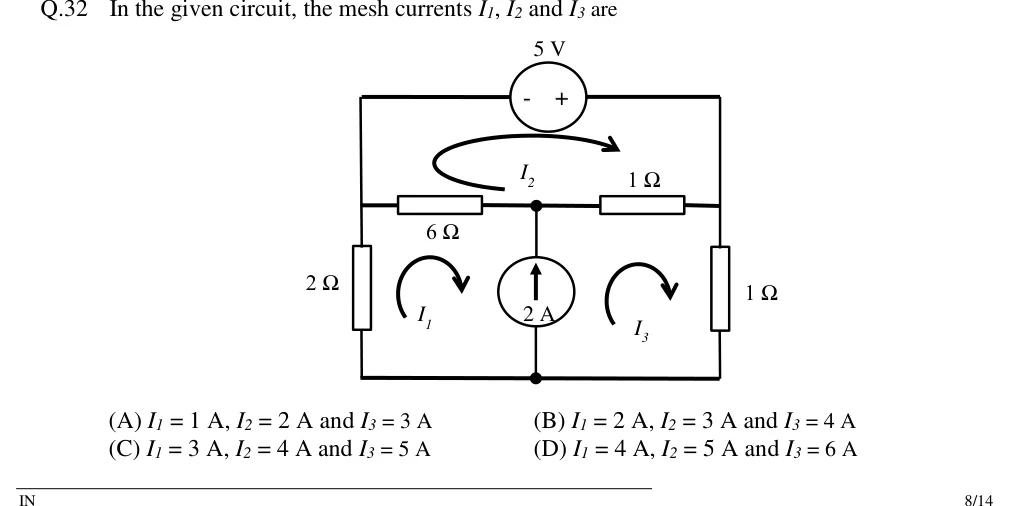
GATE 2018 IN question 32: A planar circuit with three meshes.Tap to open full size
Figure from the GATE 2018 IN paper. It is part of the question.
Figure description

A planar circuit with three meshes. Outer rectangle: the top wire runs from the top-left corner to the top-right corner through a 5 V independent voltage source, with its − terminal on the left and + on the right. Below the top wire is a middle horizontal branch joining left node L, middle node M and right node R: a 6 Ω resistor between L and M, and a 1 Ω resistor between M and R. The top-left corner is joined to L by a plain wire, and the top-right corner is joined to R by a plain wire. Below L, a 2 Ω resistor runs vertically from L to the bottom wire. Below R, a 1 Ω resistor runs vertically from R to the bottom wire. From M, a 2 A independent current source runs vertically down to bottom node B, with its arrow pointing up (from B towards M). The bottom wire joins the bottom of the 2 Ω resistor, B and the bottom of the right 1 Ω resistor. Mesh currents, all clockwise: I_2 in the top mesh (5 V source, 1 Ω, 6 Ω); I_1 in the lower-left mesh (2 Ω, 6 Ω, 2 A source); I_3 in the lower-right mesh (2 A source, horizontal 1 Ω, vertical 1 Ω).

  1. (A)

    A, A and A

  2. (B)

    A, A and A

  3. (C)

    A, A and A

  4. (D)

    A, A and A

Answer and solution

ANSWER

, and , which is option (A).

Official answer: ASource: Official answer key, GATE 2018 IN (IIT Guwahati)

  1. Current-source constraint. The 2 A source is the only element in the branch shared by meshes 1 and 3. With both meshes clockwise, flows up this branch and flows down it. The source forces 2 A upward, so

  2. KVL in mesh 2 (clockwise). Going left to right through the 5 V source takes us from − to +, which is a rise of 5 V. Along the bottom of mesh 2 we travel right to left. The leftward current in the 1 Ω is and the leftward current in the 6 Ω is :

  3. Supermesh of meshes 1 and 3. KVL cannot be written for mesh 1 or mesh 3 on its own, because the voltage across the current source is unknown. Instead, go clockwise round the outer boundary of the two meshes and leave out the source: up the 2 Ω (current ), right through the 6 Ω (current ), right through the 1 Ω (current ), down the right 1 Ω (current ), then back along the bottom wire, which has no elements:

  4. Substitute (1) into (2). Put into (2): , so and .

  5. Substitute into (3). .

  6. Back-substitute. and . Check in (2): . Check in (3): .

  7. Physical check with node voltages. Take the bottom wire as . The 2 Ω carries upward, so . The right 1 Ω carries downward, so . Then , which is exactly the source voltage, with + on the right. At node M, the 2 A from the source splits into 1 A leftward through the 6 Ω and 1 A rightward through the 1 Ω. Both branches give , so KCL and KVL hold everywhere. The answer is option (A).

  8. Why the supermesh equation decides it. All four options satisfy and , so equations (1) and (2) cannot separate them. Only (3) does. For example, option (B) gives .

KEY IDEA

When a current source is the only element in a branch shared by two meshes, it gives a constraint between their mesh currents, here . The KVL equation that replaces those two meshes goes round their combined outer boundary (the supermesh) and leaves out the source, because the voltage across the source is unknown.

WATCH OUT FOR

There are two common mistakes. The first is to write KVL round mesh 1 or mesh 3 alone as if the current source had zero voltage across it. The second is to test the options only against the source constraint. Every option satisfies , and every option also satisfies the mesh-2 equation, so only the supermesh equation picks out (A). Watch the sign of the 5 V source too: going clockwise in mesh 2 you meet − then +, which is a rise.

From the GATE 2018 IN paper. Every question of this paper · Download the full paper · All 25 Laws & node/mesh questions, with notes

More Laws & node/mesh questions