
IAE Academy

GATE 2026 EE Q.25: solution and answer

GATE 2026 · EEQ.25 · 1 mark · MCQ

Refer to the four circuits shown.

[Figure: four two-element loops]

Which one of the following options for , , , and makes all of them realizable?
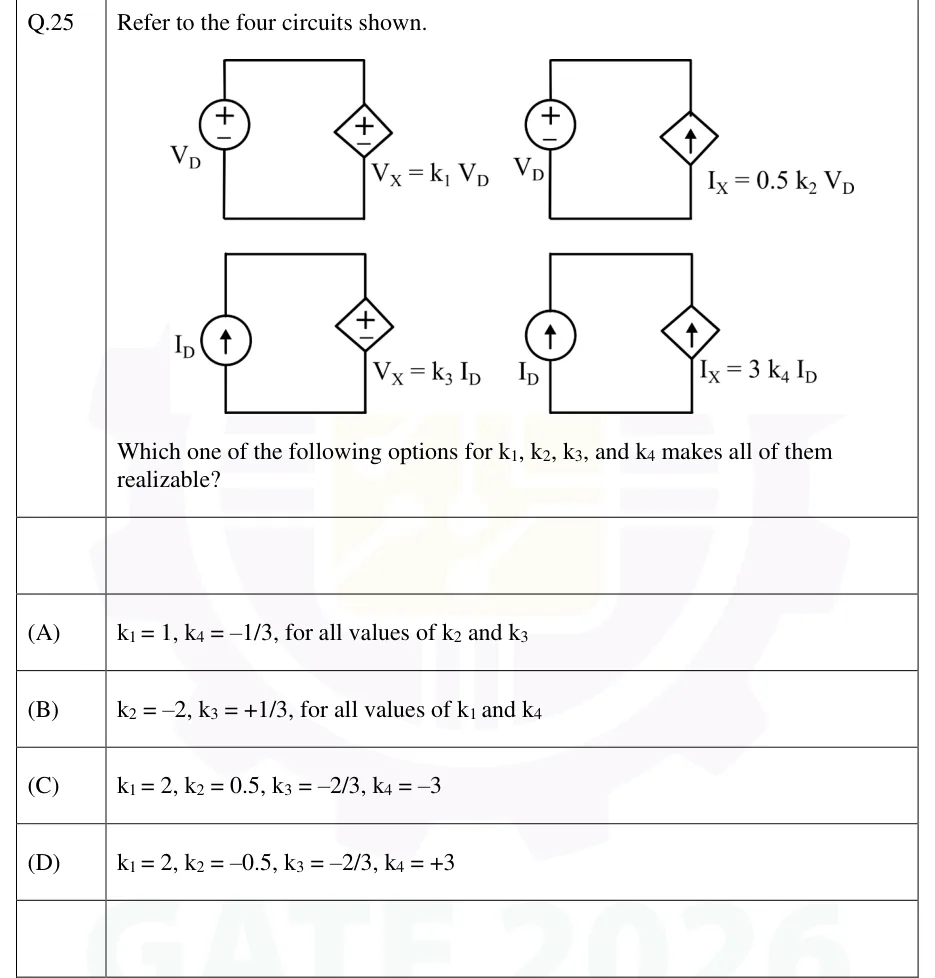
GATE 2026 EE question 25: Four separate circuits.Tap to open full size
Figure from the GATE 2026 EE paper. It is part of the question.
Figure description

Four separate circuits. Each is one closed loop with two elements, left and right, joined by a top wire and a bottom wire, so the two elements are in parallel (equivalently, in series around the single loop). (1) Top-left: on the left, an independent voltage source V_D (circle), + terminal at the top. On the right, a dependent voltage source (diamond), + terminal at the top, labelled V_X = k_1 V_D. (2) Top-right: on the left, an independent voltage source V_D (circle), + at the top. On the right, a dependent current source (diamond) with its arrow pointing up, labelled I_X = 0.5 k_2 V_D. (3) Bottom-left: on the left, an independent current source I_D (circle) with its arrow pointing up. On the right, a dependent voltage source (diamond), + at the top, labelled V_X = k_3 I_D. (4) Bottom-right: on the left, an independent current source I_D (circle) with its arrow pointing up. On the right, a dependent current source (diamond) with its arrow pointing up, labelled I_X = 3 k_4 I_D.

  1. (A)

    , , for all values of and

  2. (B)

    , , for all values of and

  3. (C)

    , , ,

  4. (D)

    , , ,

Answer and solution

ANSWER

(A) , , for all values of and .

Official answer: ASource: Official answer key, GATE 2026 EE (IIT Guwahati)

  1. Circuit 1 (two voltage sources in parallel). Both sources sit between the same top and bottom wires, so KVL around the loop needs them to give the same top-to-bottom voltage. Both have at the top, so , i.e. for every . That forces .

  2. Circuit 2 (voltage source in parallel with a current source). The voltage source fixes the voltage across the pair at , and the current source fixes the loop current at . An ideal voltage source carries whatever current flows through it, so KVL and KCL both hold for any value of . is unrestricted.

  3. Circuit 3 (current source and voltage source in one loop). The current source fixes the loop current at . The dependent voltage source passes that current while keeping its own voltage , and the current source takes up whatever terminal voltage KVL needs. Nothing conflicts, so is unrestricted.

  4. Circuit 4 (two current sources in series). A single loop carries only one current, so both sources must agree on it. points up on the left, which drives current clockwise around the loop. points up on the right, which drives it anticlockwise. Put the other way, KCL at the top node gives , so .

  5. Substituting : for every , so

  6. So all four circuits are realizable exactly when and , with and free. That is option (A). Options (C) and (D) have , which breaks circuit 1, and their values ( and ) break circuit 4 as well. Option (B) claims to work for all and , but any breaks circuit 1 and any breaks circuit 4.

KEY IDEA

Ideal voltage sources in parallel must have the same voltage (KVL), and ideal current sources in series must carry the same current (KCL). A voltage source paired with a current source, in either arrangement, can never conflict, so it puts no condition on its constant. Only circuits 1 and 4 constrain anything: and .

WATCH OUT FOR

Reading the two upward arrows in circuit 4 as "the same direction" and setting , which gives . Around the single loop, the two upward arrows actually drive current in opposite senses, so KCL at the top node needs . A second trap is thinking the voltage-source/current-source pairs (circuits 2 and 3) fix or . They don't: the voltage source takes any current, and the current source takes any voltage.

From the GATE 2026 EE paper. Every question of this paper · Download the full paper · All 25 Laws & node/mesh questions, with notes

More Laws & node/mesh questions