
IAE Academy

GATE 2025 EE Q.18: solution and answer

GATE 2025 · EEQ.18 · 1 mark · MCQ

The I-V characteristics of the element between the nodes X and Y is best depicted by
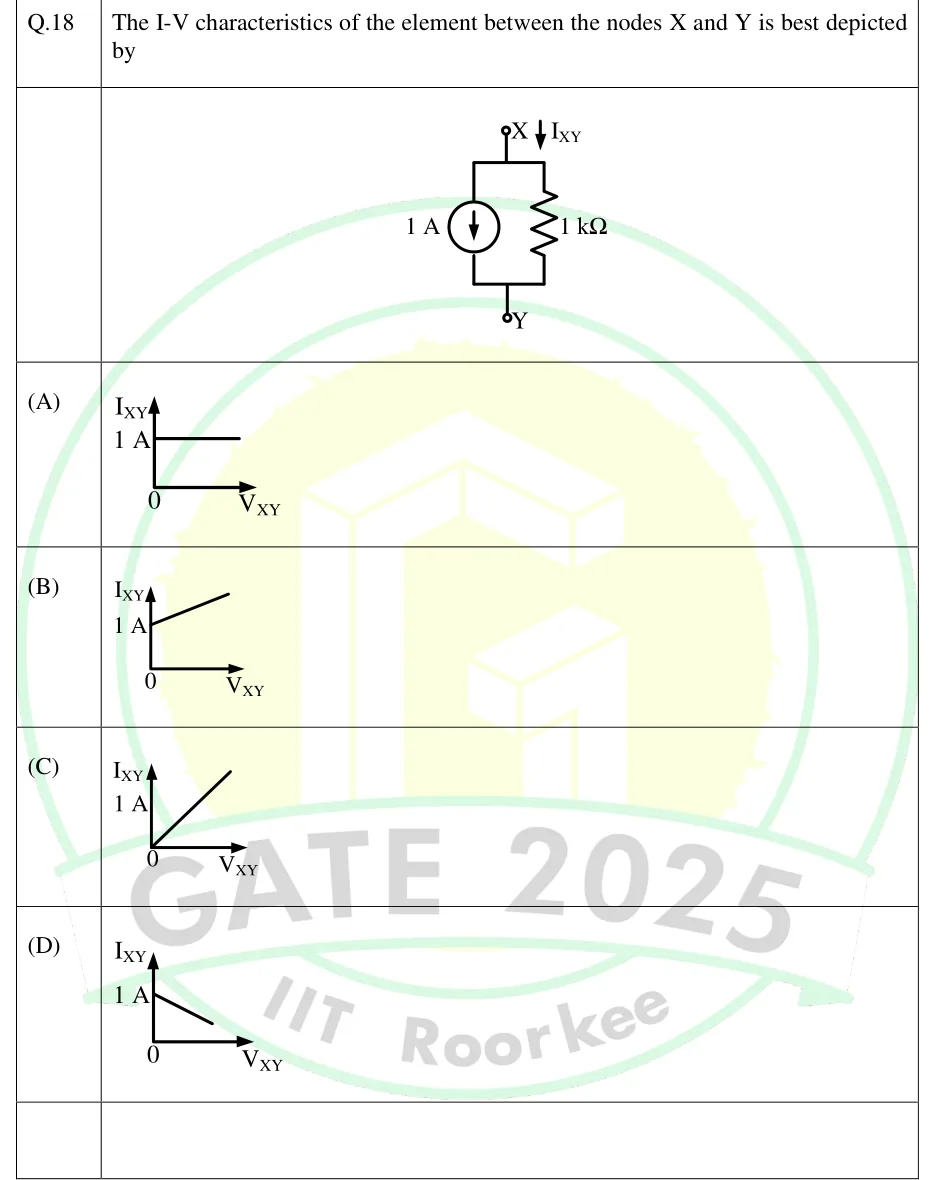
GATE 2025 EE question 18: Two-terminal element between terminal X (top) and terminal Y (bottom).Tap to open full size
Figure from the GATE 2025 EE paper. It is part of the question.
Figure description

Two-terminal element between terminal X (top) and terminal Y (bottom). A current I_XY is marked by an arrow pointing downward at terminal X, i.e. entering the element at X. Terminal X connects to a top node; terminal Y connects to a bottom node. Between the top and bottom nodes, two branches are in parallel: on the left an independent current source of 1 A whose arrow points downward (driving current from the top node through the source to the bottom node); on the right a 1 kΩ resistor. Each option is a sketch of I_XY (vertical axis) against V_XY (horizontal axis), origin marked 0, with the level 1 A marked on the I_XY axis. (A) horizontal line at I_XY = 1 A, starting at V_XY = 0. (B) straight line starting at 1 A on the I_XY axis and rising with positive slope as V_XY increases. (C) straight line through the origin with positive slope. (D) straight line starting at 1 A on the I_XY axis and falling with negative slope as V_XY increases.

  1. (A)

    Figure — horizontal line at I_XY = 1 A for V_XY ≥ 0 (zero slope)

  2. (B)

    Figure — straight line with intercept 1 A on the I_XY axis and positive slope

  3. (C)

    Figure — straight line through the origin with positive slope

  4. (D)

    Figure — straight line with intercept 1 A on the I_XY axis and negative slope

Answer and solution

ANSWER

(B): is a straight line with intercept and positive slope .

Official answer: BSource: Official answer key, GATE 2025 EE (IIT Roorkee)

  1. Take . The current enters the element at X (passive sign convention), and at the top node it divides between the two parallel branches.

  2. Current-source branch: the arrow points from the top node (X side) to the bottom node (Y side), so this branch carries exactly from X towards Y whatever the voltage across it.

  3. Resistor branch (Ohm's law): the current from X to Y through the resistor is .

  4. KCL at the top node:

  5. This is a straight line. At it gives (the intercept on the current axis), and its slope is .

  6. Only option (B) starts at and rises with . (A) has zero slope, which would need an open circuit in place of the resistor (an ideal current source alone). (C) has no source term, so it describes the resistor alone. (D) has a negative slope, which would need a negative resistance.

KEY IDEA

A current source in parallel with a resistor is a Norton source. KCL gives , so the I-V characteristic is a straight line: the source sets the intercept on the current axis and the conductance sets the slope. The source's arrow direction relative to decides the sign of the intercept.

WATCH OUT FOR

Picking (A) because the current source seems to fix the terminal current at 1 A. That is only true for a source in series with the resistor. Here the resistor is in parallel, so it draws an extra and the line slopes upwards. A second slip is misreading the source direction as opposing , which gives (intercept ). That matches no option and should send you back to check the sign.

From the GATE 2025 EE paper. Every question of this paper · Download the full paper · All 25 Laws & node/mesh questions, with notes

More Laws & node/mesh questions