
IAE Academy

GATE 2024 EE Q.12: solution and answer

GATE 2024 · EEQ.12 · 1 mark · MCQ

The number of junctions in the circuit is
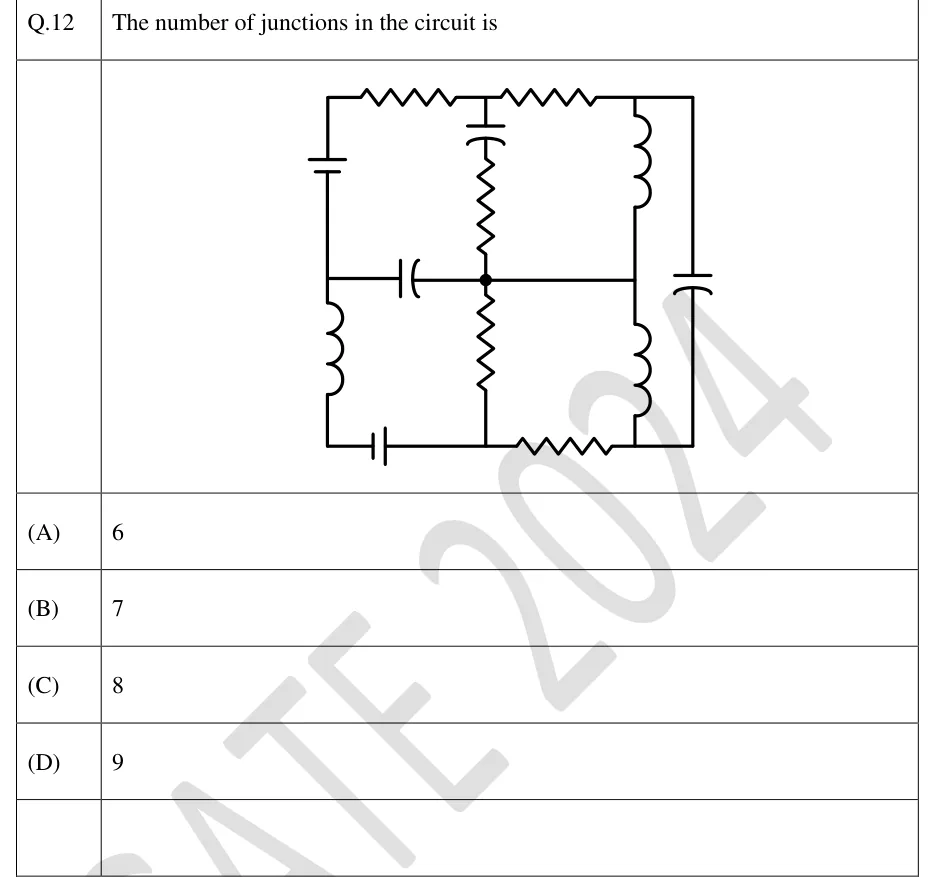
GATE 2024 EE question 12: A rectangular grid network with three vertical lines (left, middle, right-inner) plus an outer right vertical line, and…Tap to open full size
Figure from the GATE 2024 EE paper. It is part of the question.
Figure description

A rectangular grid network with three vertical lines (left, middle, right-inner) plus an outer right vertical line, and three horizontal levels (top, middle, bottom). Label the points: top row A (left corner), B (middle), T (right-inner), T' (outer right corner); middle row D (left), O (centre, the only point drawn with a solid dot), E (right-inner); bottom row F (left corner), G (middle), H (right-inner), H' (outer right corner). Elements: A-B resistor; B-T resistor; T-T' plain wire; A-D (left side, upper half) DC voltage source (battery); D-F (left side, lower half) inductor; F-G (bottom, left half) battery; G-H resistor; H-H' plain wire; B-O (middle vertical, upper half) a capacitor just below B in series with a resistor; O-G (middle vertical, lower half) resistor; D-O horizontal capacitor; O-E plain wire; T-E (right-inner vertical, upper half) inductor; E-H (right-inner vertical, lower half) inductor; T'-H' (outer right vertical) capacitor. Source polarities are not needed for the question. Element values are not given.

  1. (A)

    6

  2. (B)

    7

  3. (C)

    8

  4. (D)

    9

Answer and solution

ANSWER

The circuit has 6 junctions: B, {T, T'}, D, {O, E}, G and {H, H'}. Option (A).

Official answer: ASource: Official answer key, GATE 2024 EE (IISc Bengaluru)

  1. Definition. A junction (principal node) is a point where three or more circuit elements meet. All points joined only by ideal wire are one electrical node, so collapse every bare wire first.

  2. Collapse the ideal wires. Label the top row , the middle row and the bottom row . The bare wire from to makes the centre dot and the tee one node. The bare wires from to and from to merge those pairs in the same way.

  3. Count the elements at each candidate node, top and middle rows. has 2 resistors and 1 capacitor, so 3. has a resistor, an inductor and the outer capacitor, so 3. has the source, a capacitor and an inductor, so 3. has 2 resistors, 1 capacitor and 2 inductors, so 5.

  4. Bottom row. has the source and 2 resistors, so 3. has a resistor, an inductor and the outer capacitor, so 3.

  5. Discard the simple nodes. Corner (resistor and source), corner (inductor and source) and the point between the capacitor and the resistor in the upper middle branch each join only 2 elements. They are nodes but not junctions. With the six nodes above, the circuit has nodes in all.

  6. Count the junctions: , which is junctions. The answer is (A).

  7. Check with topology. The circuit has elements (5 resistors, 3 capacitors, 3 inductors, 2 sources) and nodes, so the number of independent loops is . Merging the series pairs leaves principal branches between the junctions, and again. That matches the 5 meshes visible in the drawing: four window panes plus the strip on the outer right.

KEY IDEA

A junction (principal node) is a point where three or more elements meet. First merge every set of points joined only by bare wire into one node, then count the elements at each node. Nodes with only two elements, such as corners and the midpoint of a series pair, are not junctions.

WATCH OUT FOR

There are two common mistakes. The first is counting the ends of a bare wire as separate junctions: O and E, T and T', H and H' are three pairs, and each pair is one node. The second is counting every node rather than only junctions. The circuit has 9 nodes, which is option (D), but A, F and the point between the capacitor and the resistor in the middle branch join only two elements each. A third slip is counting only the solid dot, since the drawing marks just one of the six junctions with a dot.

From the GATE 2024 EE paper. Every question of this paper · Download the full paper · All 25 Laws & node/mesh questions, with notes

More Laws & node/mesh questions