
IAE Academy

GATE 2026 EE Q.23: solution and answer

GATE 2026 · EEQ.23 · 1 mark · MCQ

A circuit with ideal elements is shown.

[Figure]

Which one of the following options correctly identifies all the linear elements in the circuit?
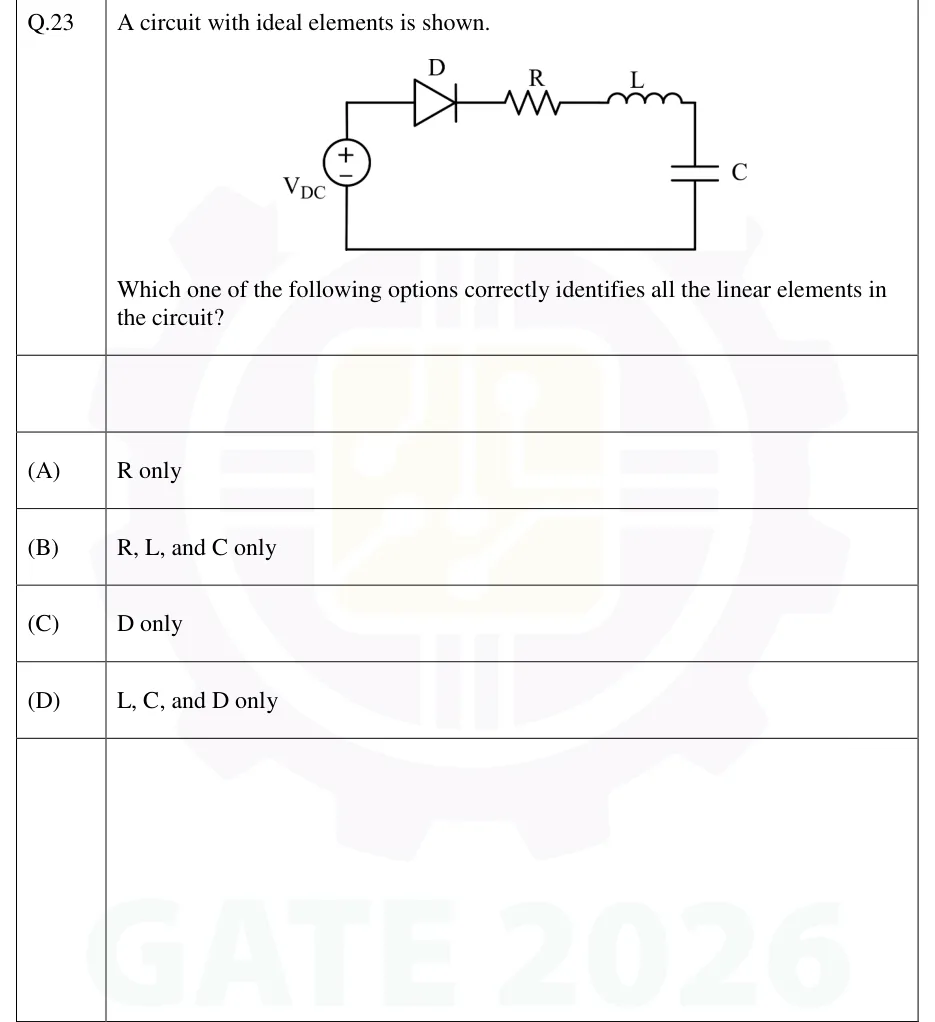
GATE 2026 EE question 23: A single series loop.Tap to open full size
Figure from the GATE 2026 EE paper. It is part of the question.
Figure description

A single series loop. On the left side sits a DC voltage source labelled V_DC, drawn as a circle with + at the top and − at the bottom. From the source's + terminal the wire goes up and then right along the top branch through, in order: a diode D (anode on the left, cathode on the right, so it conducts clockwise away from the + terminal), then a resistor R, then an inductor L. The wire then comes down the right side through a capacitor C and returns along the bottom wire to the source's − terminal. No element values are given.

  1. (A)

    R only

  2. (B)

    R, L, and C only

  3. (C)

    D only

  4. (D)

    L, C, and D only

Answer and solution

ANSWER

R, L and C are the linear elements. Each has a constant parameter, and its relation is either proportional () or proportional to a derivative (, ). The ideal diode's corner-shaped characteristic breaks homogeneity, so it is nonlinear. Option (B).

Official answer: BSource: Official answer key, GATE 2026 EE (IIT Guwahati)

  1. What a linear element is. A two-terminal element is linear when its – relation obeys superposition (additivity and homogeneity). If excitations and give responses and , then the excitation must give for every pair of real constants and , negative ones included.

  2. Resistor. Ohm's law, with constant, is a straight line through the origin of the – plane. So , and R is linear.

  3. Inductor. with constant. Differentiation is a linear operation: . So L is linear.

  4. Capacitor. with constant. The same argument applies: . So C is linear.

  5. Ideal diode. It conducts with for and blocks with for . Its – characteristic is two half-lines that meet at a corner at the origin, not a single straight line through the origin. To show homogeneity fails, take the allowed operating point and scale it by . That gives , and an ideal diode cannot carry reverse current, so that point is not on its characteristic. D is therefore nonlinear. It is piecewise linear, but piecewise linear is not linear. The Shockley model is nonlinear too.

  6. Conclusion. The linear elements in the circuit are R, L and C. The diode is the only nonlinear element. The answer is option (B).

KEY IDEA

Linearity belongs to each element, not to the circuit it sits in. An element is linear when its – relation obeys superposition. A constant-valued R, L or C does, because scaling and differentiation are both linear operations. An ideal diode's characteristic has a corner at the origin, so homogeneity fails and it is nonlinear.

WATCH OUT FOR

There are two common traps. (1) Calling L and C nonlinear because their relations contain derivatives, or because they store energy. Differentiation is a linear operation, so L and C with constant values are linear. (2) Calling the ideal diode linear because each of its two pieces is a straight line. Piecewise linear is not linear: scaling a forward-conducting point by gives a reverse current the diode cannot carry. The diode being in the loop, or the source being DC, does not change whether R, L or C are linear.

From the GATE 2026 EE paper. Every question of this paper · Download the full paper · All 25 Laws & node/mesh questions, with notes

More Laws & node/mesh questions