
IAE Academy

GATE 2024 EC Q.62: solution and answer

GATE 2024 · ECQ.62 · 2 marks · NAT

In the network shown below, maximum power is to be transferred to the load .

[Figure]

The value of (in ) is ________ .
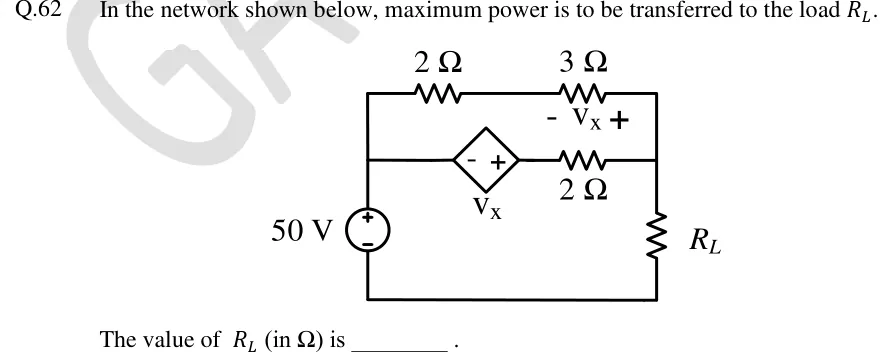
GATE 2024 EC question 62: A 50 V independent DC source sits in the left vertical branch, + terminal at the top.Tap to open full size
Figure from the GATE 2024 EC paper. It is part of the question.
Figure description

A 50 V independent DC source sits in the left vertical branch, + terminal at the top. Its top terminal connects to a left vertical wire, called node A here. Its bottom terminal connects to the bottom wire, which is the reference node. The right vertical wire is node B, and the load resistor R_L runs from node B down to the bottom wire. Two parallel branches connect node A to node B. (1) Top branch: a 2 Ω resistor in series with a 3 Ω resistor. The voltage across the 3 Ω resistor is labelled V_x, with - on the left end (the junction between the 2 Ω and the 3 Ω) and + on the right end (node B). (2) Middle branch: a dependent voltage source (diamond) of value V_x, with - on its left (node A side) and + on its right. It is in series with a 2 Ω resistor that goes to node B. The dependent source is controlled by V_x, the voltage across the 3 Ω resistor.

Answer and solution

ANSWER

For maximum power transfer, .

Official answer: 2.5Source: Official answer key, GATE 2024 EC (IISc Bengaluru)

  1. Maximum power transfer theorem: the load takes maximum power when , the Thevenin resistance seen from the terminals of . The circuit has a dependent source, so find from the terminal V–I relation, not by combining resistors.

  2. Take the bottom wire as the reference. Node A (the left vertical wire) is then at and node B (the right vertical wire) is at , the load voltage. Let .

  3. Top branch (2 Ω and 3 Ω in series): its current from A to B is . This current enters the 3 Ω at its left () end and leaves at its right () end, so the left end is the higher one and .

  4. Middle branch (KVL): the dependent source has on the node-A side, so its right terminal is at . The current through the 2 Ω towards B is

  5. KCL at node B: the current delivered to the load is

  6. Compare this with the Thevenin form . Open circuit () gives , and short circuit () gives , so

  7. Check with a test source: replace the 50 V source with a short, so node A is at 0, and apply at B. The top branch now carries from B to A, entering the 3 Ω at its end, so . The dependent source's right terminal is at , so the middle branch draws . Then and , which agrees.

  8. So . The maximum power would be , but the question does not ask for it.

KEY IDEA

For maximum power transfer, . When the network has a dependent source, find from the terminal V–I relation, as or with a test source. Here both branches from A to B carry , so the network behaves like in series with .

WATCH OUT FOR

One mistake is to kill the dependent source as if it were independent, which gives . Another is a sign error on : taking with current flowing towards the end makes the middle branch carry , which gives . is measured with at node B, so it is negative when current flows from A to B.

From the GATE 2024 EC paper. Every question of this paper · Download the full paper · All 16 Theorems questions, with notes

More Theorems questions