
IAE Academy

GATE 2023 IN Q.31: solution and answer

GATE 2023 · INQ.31 · 1 mark · NAT

In the circuit given, the Thevenin equivalent resistance across the terminals 'a' and 'b' is ________ (rounded off to one decimal place).
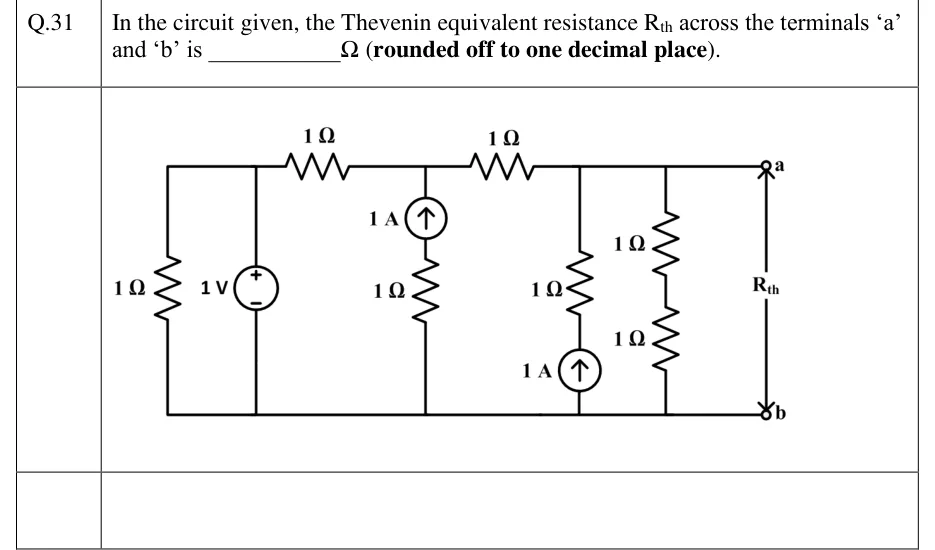
GATE 2023 IN question 31: Planar ladder circuit with a common bottom rail that is terminal b.Tap to open full size
Figure from the GATE 2023 IN paper. It is part of the question.
Figure description

Planar ladder circuit with a common bottom rail that is terminal b. Top node P (far left): a vertical 1 Ω resistor from P down to the bottom rail, and next to it an independent 1 V voltage source from P to the bottom rail, + terminal at the top (at P). A horizontal 1 Ω resistor on the top wire runs from P to node Q. From Q a vertical branch goes down to the bottom rail: a 1 A independent current source (arrow pointing up, toward Q) in series with a 1 Ω resistor below it. A second horizontal 1 Ω resistor on the top wire runs from Q to node R. The top wire continues from R to terminal a at the far right. From R to the bottom rail there are two vertical branches in parallel: (i) a 1 Ω resistor in series with a 1 A independent current source below it (arrow pointing up, toward R); (ii) two 1 Ω resistors in series. Terminals a (top right, on node R) and b (bottom right, on the bottom rail), with R_th marked between them.

Answer and solution

ANSWER

Official answer: 1.0Source: Official answer key, GATE 2023 IN (IIT Kanpur)

  1. Deactivate the independent sources. The circuit has no dependent sources, so is simply the resistance seen between a and b once the sources are switched off. Replace the source with a short circuit and each source with an open circuit.

  2. Left end: the shorted source joins the top-left node to the bottom rail (terminal b). The left now sits across a short, so it carries no current and drops out. The top-left node is at the same potential as b.

  3. Middle branch: the source is now an open, so its series carries no current and that branch drops out. The two top resistors are therefore in series, running from a to the top-left node, which is b: .

  4. Right side: the branch with in series with the second source is also an open, so it drops out too. The last branch is the two resistors in series, straight from a to b: .

  5. Combine the two paths in parallel across a-b:

KEY IDEA

With only independent sources present, is found by deactivating them: short every voltage source and open every current source. Any resistor in series with a current source then carries no current and drops out, and any resistor directly across a voltage source is shorted out.

WATCH OUT FOR

Keeping the resistors that sit in series with the sources in the network. Once a current source is opened, its whole branch carries no current, so those resistors do not count (keeping them gives about ). A second mistake is opening the source instead of shorting it. That leaves the left in the path and gives .

From the GATE 2023 IN paper. Every question of this paper · Download the full paper · All 16 Theorems questions, with notes

More Theorems questions