
IAE Academy

GATE 2020 EE Q.19: solution and answer

GATE 2020 · EEQ.19 · 1 mark · NAT

The Thevenin equivalent voltage, , in V (rounded off to 2 decimal places) of the network shown below, is ________
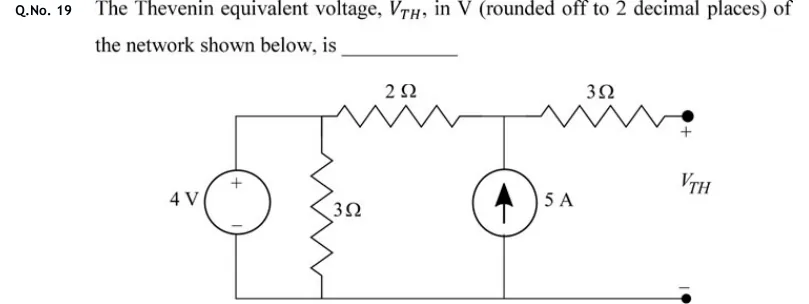
GATE 2020 EE question 19: The circuit has a common bottom (reference) rail and a top rail, reading left to right.Tap to open full size
Figure from the GATE 2020 EE paper. It is part of the question.
Figure description

The circuit has a common bottom (reference) rail and a top rail, reading left to right. Far left: an independent 4 V voltage source, + terminal at the top, connected between the top-left node (call it A) and the bottom rail. Right next to it, also between node A and the bottom rail, is a 3 Ω resistor, so it sits in parallel with the 4 V source. From node A a 2 Ω resistor runs along the top to node B. Between node B and the bottom rail is an independent 5 A current source whose arrow points upward, so it pushes current into node B. From node B a 3 Ω resistor runs along the top to an open terminal marked +. Directly below it, the bottom rail ends in an open terminal marked −. The open-circuit voltage between these two terminals is labelled V_TH.

Answer and solution

ANSWER

.

Official answer: 13.80 to 14.20Source: Official answer key, GATE 2020 EE (IIT Delhi)

  1. Open circuit at the output. Nothing is connected across the output terminals, so no current flows in the right-hand . With no current it drops no voltage, so , the voltage of the node where the , the current source and the output meet, measured from the bottom rail.

  2. Voltage source in parallel with a resistor. The left is connected directly across the ideal source. It draws current from the source but cannot change the source's terminal voltage, so whatever that resistor's value is.

  3. KCL at node B. The source pushes current into B. The output branch is open, so the only way out of B is through the to node A:

  4. Solve. .

  5. Result. . The sign is positive because the + output terminal connects to B through the current-free , and the − terminal is the bottom rail.

KEY IDEA

Only two facts are needed. An ideal voltage source fixes its node voltage no matter what resistor sits across it, and a resistor that carries no current (the open-circuited output ) drops no voltage. The whole therefore flows through the , so .

WATCH OUT FOR

Letting the left carry part of the (treating it as a divider with the , or using source transformation on it). It is directly across an ideal voltage source, so it has no effect on or . Another slip is to count a voltage drop across the output . With the terminals open it carries no current, so it drops nothing.

From the GATE 2020 EE paper. Every question of this paper · Download the full paper · All 16 Theorems questions, with notes

More Theorems questions