
IAE Academy

GATE 2018 IN Q.7: solution and answer

GATE 2018 · INQ.7 · 1 mark · MCQ

The Thevenin equivalent circuit representation across terminals p-q of the circuit shown in the figure is a
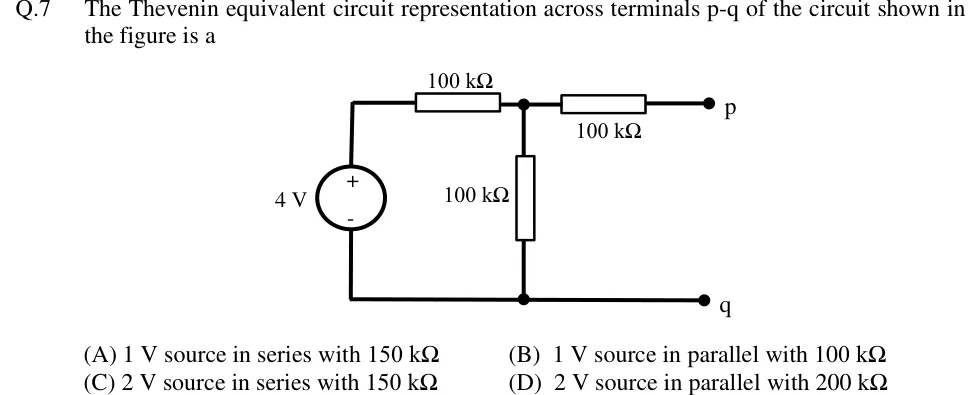
GATE 2018 IN question 7: A 4 V independent voltage source sits on the left, + terminal at the top and - terminal at the bottom.Tap to open full size
Figure from the GATE 2018 IN paper. It is part of the question.
Figure description

A 4 V independent voltage source sits on the left, + terminal at the top and - terminal at the bottom. From its + terminal the top wire runs through a 100 kΩ series resistor to a junction node. From that junction a vertical 100 kΩ resistor goes down to the bottom wire (the shunt branch). Also from the junction, a second 100 kΩ series resistor runs to the right to open terminal p. The bottom wire joins the source's - terminal, the lower end of the shunt 100 kΩ resistor, and open terminal q. Nothing is connected across p-q.

  1. (A)

    1 V source in series with 150 kΩ

  2. (B)

    1 V source in parallel with 100 kΩ

  3. (C)

    2 V source in series with 150 kΩ

  4. (D)

    2 V source in parallel with 200 kΩ

Answer and solution

ANSWER

The Thevenin equivalent across p-q is a 2 V source in series with 150 kΩ, option (C).

Official answer: CSource: Official answer key, GATE 2018 IN (IIT Guwahati)

  1. Open-circuit voltage. With p-q open, no current flows in the 100 kΩ resistor leading to p, so there is no voltage drop across it. is therefore the voltage across the shunt 100 kΩ resistor, with p positive with respect to q.

  2. Voltage divider. The 4 V source drives the first series 100 kΩ resistor and the shunt 100 kΩ resistor in series:

  3. Thevenin resistance. Set the independent 4 V source to zero, which means replacing it with a short circuit. Looking in from p-q, the first 100 kΩ resistor is now in parallel with the shunt 100 kΩ resistor:

  4. That 50 kΩ is in series with the 100 kΩ resistor leading to p:

  5. Form of the equivalent. A Thevenin equivalent is always an ideal voltage source in series with . A voltage source in parallel with a resistor, as in (B) and (D), behaves at its terminals like the bare source (), so neither of those can be right. The equivalent is a 2 V source in series with 150 kΩ, which is option (C).

KEY IDEA

is the open-circuit voltage. No current flows in the resistor leading to the open terminal, so it is just the divider voltage across the shunt resistor, . For , short the voltage source: . A Thevenin equivalent is always a source in series with a resistance.

WATCH OUT FOR

Three slips are common. (1) Treating the resistor leading to p as part of the divider, which gives or a similar wrong value, even though it carries no current when p-q is open. (2) Forgetting that same series resistor when finding , which gives 50 kΩ. (3) Opening the voltage source instead of shorting it, which gives and makes (D) look plausible. Separately, any option with a voltage source in parallel with a resistor has the wrong form for a Thevenin equivalent.

From the GATE 2018 IN paper. Every question of this paper · Download the full paper · All 16 Theorems questions, with notes

More Theorems questions