
IAE Academy

GATE 2026 EE Q.44: solution and answer

GATE 2026 · EEQ.44 · 2 marks · MCQ

The terminal voltage and current of a linear electrical network shown in Figure (a) are given in the table.

| Terminal voltage () | Terminal current () |
|---|---|
| 18 V | A |
| 30 V | 0.5 A |
| 36 V | 1.0 A |

The correct choice for the parameters (, ) of the Norton equivalent circuit shown in Figure (b) is:
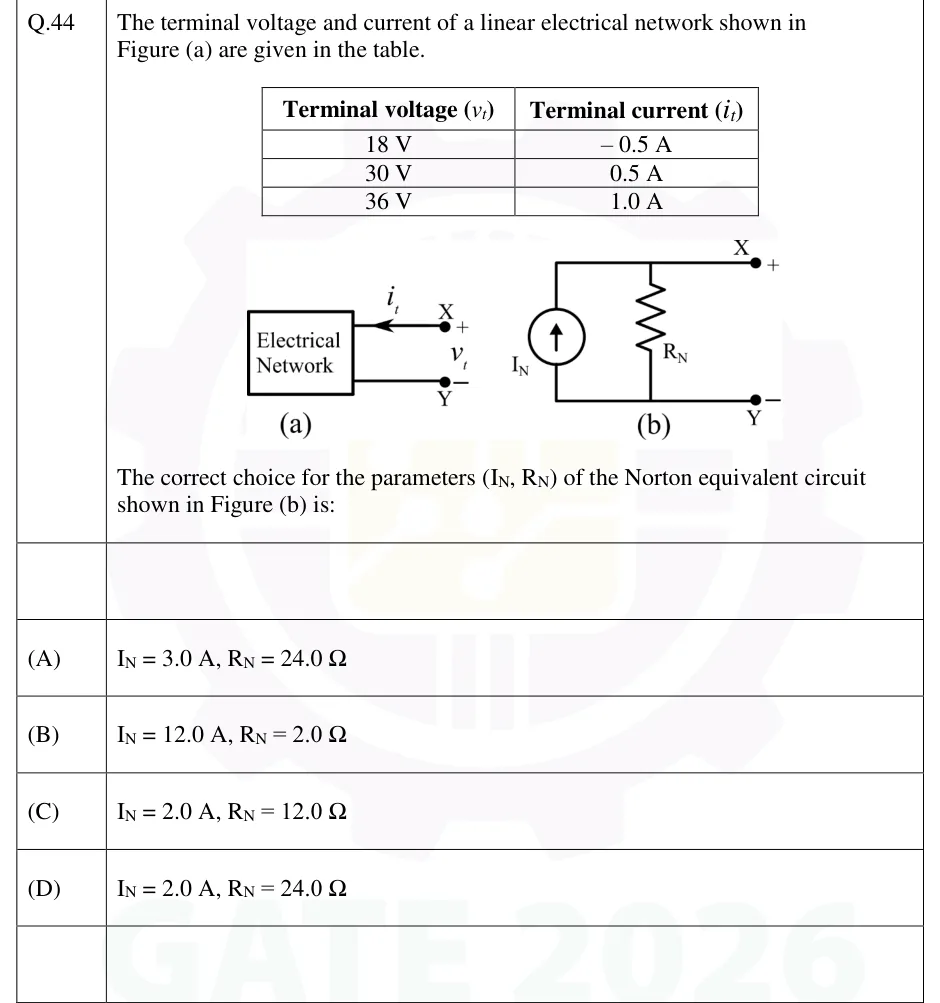
GATE 2026 EE question 44: Figure (a): a box labelled 'Electrical Network' with two terminals brought out to the right.Tap to open full size
Figure from the GATE 2026 EE paper. It is part of the question.
Figure description

Figure (a): a box labelled 'Electrical Network' with two terminals brought out to the right. The top terminal is X, marked +, and the bottom terminal is Y, marked −. The terminal voltage v_t is taken across X–Y (+ at X). The terminal current i_t is drawn on the top wire with its arrow pointing left, i.e. flowing from terminal X INTO the network. Figure (b): the Norton equivalent. An independent current source I_N with its arrow pointing upward (toward the top wire) is connected in parallel with a resistor R_N. The top wire goes to terminal X (+) and the bottom wire goes to terminal Y (−).

  1. (A)

    ,

  2. (B)

    ,

  3. (C)

    ,

  4. (D)

    ,

Answer and solution

ANSWER

, — option (C).

Official answer: CSource: Official answer key, GATE 2026 EE (IIT Guwahati)

  1. Terminal equation of a linear one-port. Seen from X–Y, any linear network behaves as a Thevenin source in series with . Here flows from X INTO the network, i.e. into its terminal (passive sign convention), so .

  2. Use two rows of the table. and . Subtracting the first from the second gives , so .

  3. Back-substitute. .

  4. Check with the third row. , which matches the table, so all three measurements lie on the same straight line and the parameters are consistent.

  5. Thevenin to Norton. and

  6. Check the polarity. In Figure (b) the source arrow points up toward X. On open circuit all of flows through , so , which agrees with . (KCL at X with leaving the Norton circuit toward the network gives , which reproduces 18 V, 30 V and 36 V.) So : option (C).

KEY IDEA

A linear one-port has a straight-line terminal characteristic (with entering the + terminal). Two measured points fix it: the slope is , the intercept at is the open-circuit voltage , and the Norton current is the short-circuit current . The third row serves as a check.

WATCH OUT FOR

Reading as leaving terminal X and writing . That gives , which is physically impossible and should tell you the sign is wrong. Two other slips: taking as the Norton resistance (that gives option D), or swapping the two values (that gives option B).

From the GATE 2026 EE paper. Every question of this paper · Download the full paper · All 16 Theorems questions, with notes

More Theorems questions