
IAE Academy

GATE 2018 EE Q.47: solution and answer

GATE 2018 · EEQ.47 · 2 marks · NAT

A three-phase load is connected to a three-phase balanced supply as shown in the figure. If , and (angles are considered positive in the anti-clockwise direction), the value of R for zero current in the neutral wire is ________ (up to 2 decimal places).
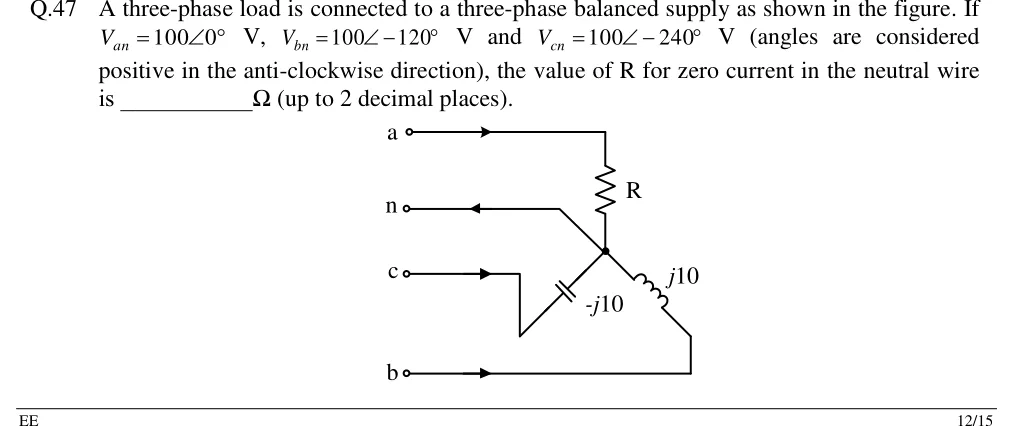
GATE 2018 EE question 47: Four supply terminals on the left, top to bottom: a, n, c, b.Tap to open full size
Figure from the GATE 2018 EE paper. It is part of the question.
Figure description

Four supply terminals on the left, top to bottom: a, n, c, b. The load is a star (Y) with one common star point (a solid dot). Line a: an arrow points right (into the load); the wire runs right, then down through a resistor R (vertical) to the star point. Neutral n: a wire from the star point runs up-left, then left to terminal n; its arrow points left (from load towards terminal n). Line c: an arrow points right; the wire runs right, down, then diagonally up-right through a capacitor labelled -j10 (ohms) to the star point. Line b: an arrow points right; the wire runs right, up, then diagonally up-left through an inductor labelled j10 (ohms) to the star point. So phase a has R, phase b has j10 (inductive) and phase c has -j10 (capacitive), all joined at the star point, which is tied to the supply neutral n.

Answer and solution

ANSWER

R = 10/√3 ≈ 5.77 Ω.

Official answer: 5.70 to 5.85Source: Official answer key, GATE 2018 EE (IIT Guwahati)

  1. Read the figure. The star point is tied to the supply neutral, so each branch has its own phase voltage across it. The branch impedances are , (inductor) and (capacitor).

  2. KCL at the star point gives . For zero neutral current this sum must be .

  3. Phase b current: .

  4. Phase c current: .

  5. Add them. The imaginary parts cancel because :

  6. So must be . That current is in phase with , so a pure (positive) resistor can carry it: .

KEY IDEA

When the star point is tied to the neutral, each branch current is its own phase voltage divided by its own impedance, and the neutral carries their phasor sum. The j10 and -j10 branches each draw 10 A. Their quadrature parts cancel and leave a real current of . Phase a must therefore draw , which is in phase with , so a resistor can supply it: .

WATCH OUT FOR

The usual slip is swapping the reactances between phases, i.e. putting the capacitor on b and the inductor on c. Then , which needs . A negative value like this shows the phase assignment is wrong, but candidates often just enter its magnitude without noticing. Other slips are forgetting that dividing by adds to the angle, and using line voltages () when a neutral-connected star has phase voltages across its branches.

From the GATE 2018 EE paper. Every question of this paper · Download the full paper · All 11 Three-phase (EE) questions, with notes

More Three-phase (EE) questions