
IAE Academy

GATE 2024 EE Q.50: solution and answer

GATE 2024 · EEQ.50 · 2 marks · NAT

In the circuit shown, and . It is supplied by a three phase 400 V source with the phase sequence being R-Y-B. Assume the watt meters and to be ideal. The magnitude of the difference between the readings of and in watts is ________ (rounded off to 2 decimal places).
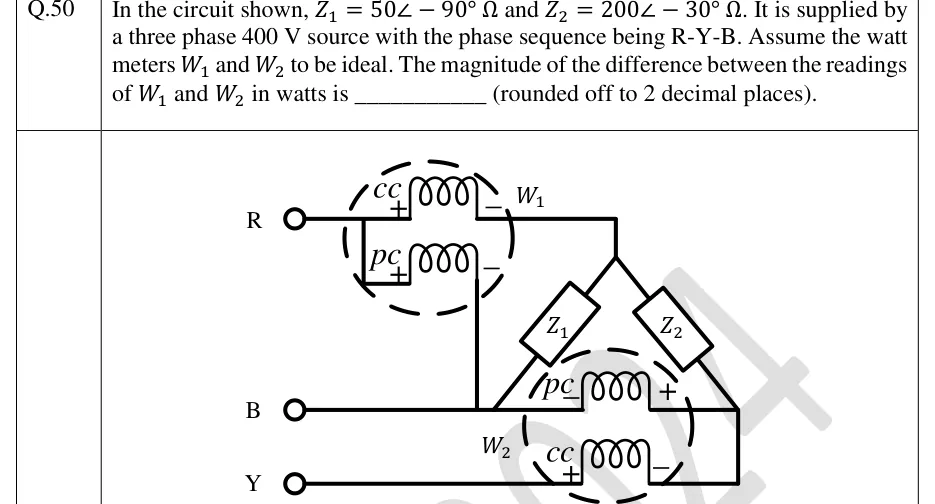
GATE 2024 EE question 50: Three supply terminals on the left, top to bottom: R, B, Y (B is drawn in the middle, Y at the bottom).Tap to open full size
Figure from the GATE 2024 EE paper. It is part of the question.
Figure description

Three supply terminals on the left, top to bottom: R, B, Y (B is drawn in the middle, Y at the bottom). Wattmeter W1: its current coil (cc) is in series with line R, '+' end on the source side and '-' end on the load side; its pressure coil (pc) has its '+' end tied to line R on the source side of the cc and its '-' end taken down by a vertical wire to line B. Beyond W1 the R line goes right and down to the top vertex of a triangle-shaped load. Left side of the triangle: Z1, from the top (R) vertex down to the bottom-left vertex, which sits on line B. Right side of the triangle: Z2, from the top (R) vertex down to the bottom-right vertex. The bottom side of the triangle is NOT an impedance: it is the pressure coil of wattmeter W2, with its '-' end at the bottom-left vertex (line B) and its '+' end at the bottom-right vertex. Line Y passes through the current coil of W2 ('+' end on the source side, '-' end on the load side) and then goes right and up to the bottom-right vertex. So Z1 is connected between R and B, Z2 between R and Y, W1 reads with cc in R and pc across R-B, and W2 reads with cc in Y and pc across Y-B (B is the common line of the two-wattmeter connection).

Answer and solution

ANSWER

, because and .

Official answer: 692 to 693Source: Official answer key, GATE 2024 EE (IISc Bengaluru)

  1. Read the figure. is connected between lines R and B, and between lines R and Y. The bottom side of the triangle is not a load. It is the pressure coil of . An ideal pressure coil draws no current, so no load current flows between Y and B. has its current coil in line R and its pressure coil across R–B, with on R. has its current coil in line Y and its pressure coil across Y–B, with on Y. This is the two-wattmeter method with B as the common line.

  2. Line voltages (rms), RYB sequence. The 400 V is the line-to-line rms value. Take . Then and . Reversing these gives and .

  3. Line currents by KCL at the load nodes. The current in from R to B is , and the current in from R to Y is . So Only takes current from line Y:

  4. Wattmeter reading. . Here is the voltage from the end to the end of the pressure coil, and is the current entering the end of the current coil. For a current , .

  5. . Check: leads by exactly , so .

  6. . This agrees with from the current found above.

  7. Check against total power. is purely capacitive, so it takes no real power. has the full 400 V line voltage across it, so . In a three-wire system the two readings must add up to the total power, and they do: .

  8. Answer. . (Had the sequence been R-B-Y, the two readings would simply swap, to and . The magnitude of the difference would be the same.)

KEY IDEA

First find where the load actually is. The third side of the "delta" is a wattmeter pressure coil, which carries no current, so the load is only (R–B) and (R–Y). Then get each reading from , taking the pressure-coil voltage from its end to its end and the current entering the end of the current coil. is at exactly to , so and the whole taken by shows on .

WATCH OUT FOR

Treating the bottom side of the triangle as a third load impedance, or assuming the load is balanced and using . That formula holds only for a balanced load, and this load is not balanced: nothing is connected between Y and B, and and differ. Two other slips are common. One is using a phase voltage of V across the delta-connected impedances instead of the 400 V line voltage. The other is dropping the part of , which leaves correct but only by luck and gets the current in line R wrong.

From the GATE 2024 EE paper. Every question of this paper · Download the full paper · All 11 Three-phase (EE) questions, with notes

More Three-phase (EE) questions