
IAE Academy

GATE 2022 EE Q.34: solution and answer

GATE 2022 · EEQ.34 · 1 mark · NAT

Two balanced three-phase loads, as shown in the figure, are connected to a V, three-phase, 50 Hz main supply. Given and . The ammeter reading, in amperes, is ________. (round off to nearest integer)
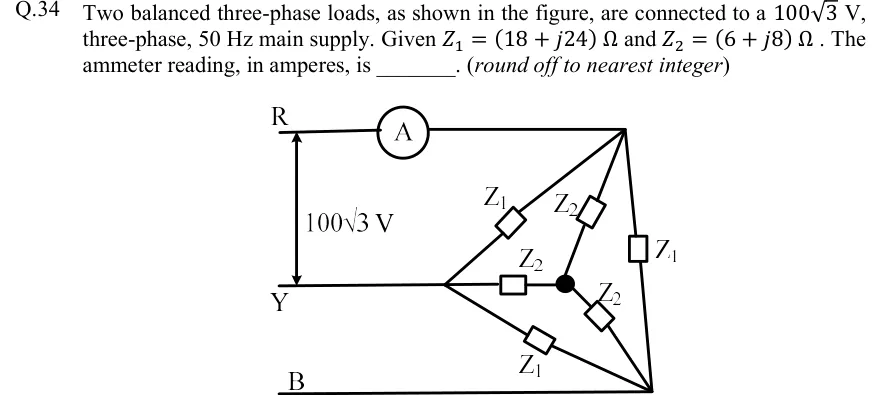
GATE 2022 EE question 34: Three supply lines R (top), Y (middle) and B (bottom);Tap to open full size
Figure from the GATE 2022 EE paper. It is part of the question.
Figure description

Three supply lines R (top), Y (middle) and B (bottom); the line voltage between R and Y is marked 100 √ 3 V with a double-headed arrow. Line R passes through an ammeter A and ends at a top-right load node. Line Y ends at a left load node. Line B ends at a bottom-right load node. Delta load: Z_1 between the Y node and the R node (upper diagonal), Z_1 between the R node and the B node (vertical right side), and Z_1 between the Y node and the B node (lower diagonal). Star load: a floating star point (solid dot, not connected to any neutral) inside the triangle, with Z_2 from the R node to the dot, Z_2 from the Y node to the dot (horizontal), and Z_2 from the dot to the B node. The ammeter therefore reads the total line current in R drawn by both loads.

Answer and solution

ANSWER

The ammeter reads 20 A.

Official answer: 20Source: Official answer key, GATE 2022 EE (IIT Kharagpur)

  1. Phase voltage of the supply (balanced, star-equivalent): . The ammeter sits in line R ahead of both loads, so it reads the total line current drawn by the delta load and the star load together.

  2. Delta-to-star conversion of the balanced delta: .

  3. Both loads are balanced, so the star point of the load and the equivalent star point of the converted delta are both at the supply neutral potential. The per-phase impedances are therefore in parallel:

  4. Line current:

  5. Check by treating the loads separately. Star load: per line. Delta load: each sees the full line voltage, so its phase current is , and its line current is . Both line currents lag the R phase voltage by the same angle (for the delta, lags by , the line current lags by , and leads by ), so they are in phase and add directly: .

KEY IDEA

Replace the balanced delta by its star equivalent (). Two balanced star loads fed from the same supply have their star points at neutral potential, so the per-phase impedances are in parallel. Here , so the per-phase impedance is , , and the line current is .

WATCH OUT FOR

Three errors are common here. (1) Leaving out the factor of 3 in the delta-to-star conversion, or dividing the delta's phase current by instead of multiplying by it. Either slip gives the wrong delta line current. (2) Applying the line voltage V across a star impedance, which gives 17.3 A per branch. (3) Reporting the current of only one load (10 A). Adding the two line-current magnitudes arithmetically is valid here only because both loads have the same impedance angle, . In general the currents must be added as phasors.

From the GATE 2022 EE paper. Every question of this paper · Download the full paper · All 11 Three-phase (EE) questions, with notes

More Three-phase (EE) questions