
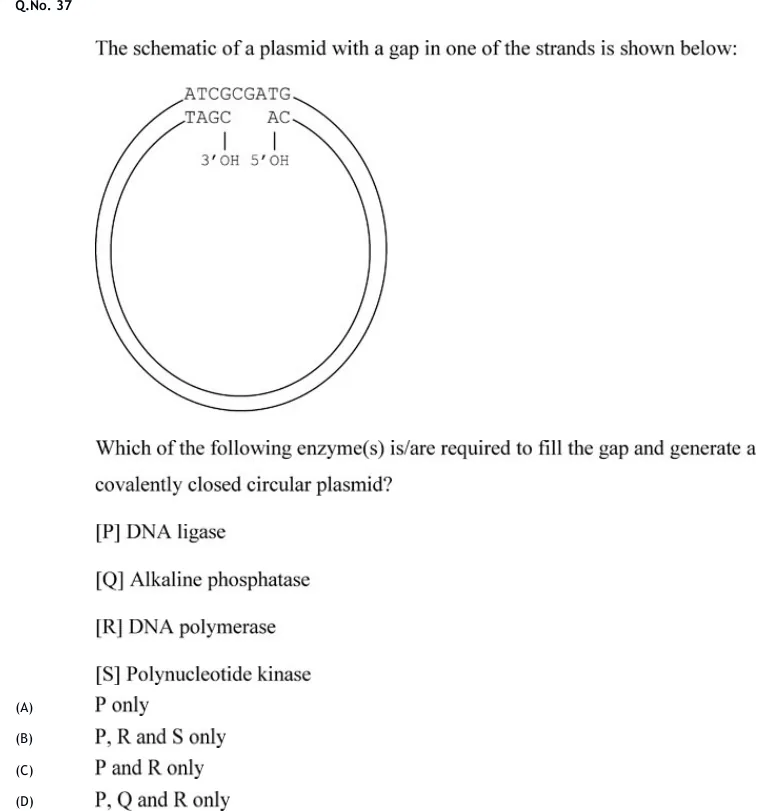
The schematic of a plasmid with a gap in one of the strands is shown below: [circular double-stranded plasmid diagram]. Top strand (continuous, outer): 5'-ATCGCGATG-3'. Bottom strand (broken, shown below it): left fragment 'TAGC' ending in a vertical line down to '3'OH', then a gap, then right fragment 'AC' with a vertical line down to '5'OH'. So the bottom strand is interrupted: one piece ends 3'-OH (after TAGC), and the next piece begins 5'-OH (before AC), with several bases of the complementary strand missing between them (a gap), opposite the continuous top strand ATCGCGATG. Which of the following enzyme(s) is/are required to fill the gap and generate a covalently closed circular plasmid? [P] DNA ligase [Q] Alkaline phosphatase [R] DNA polymerase [S] Polynucleotide kinase
 Tap to open full size
Figure description
A circular plasmid drawn as two concentric circles (double-stranded DNA, most of the circle shown as plain double lines representing the rest of the plasmid). At one point on the circle, the sequence is spelled out: the outer/top strand reads 5'-ATCGCGATG-3' continuously (no break). Directly below it, aligned by base-pairing, the bottom strand is shown broken into two fragments with a gap between them: the left fragment reads 'TAGC' and has a line dropping down to the label '3'OH' (marking its 3' terminus); after a gap of missing bases, the right fragment reads 'AC' and has a line dropping down to the label '5'OH' (marking its 5' terminus, explicitly written as 5'-OH rather than 5'-phosphate). This depicts a plasmid strand with both a gap (missing nucleotides) and, once the gap is filled, a nick whose 5' end lacks a phosphate group.
- (A)
P only
- (B)
P, R and S only
- (C)
P and R only
- (D)
P, Q and R only