IAE Academy

GATE 2020 BT Q.9: solution and answer

GATE 2020 · BTQ.9 · 1 mark · MCQ

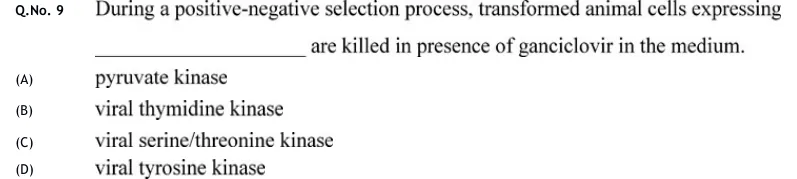
During a positive-negative selection process, transformed animal cells expressing ________ are killed in presence of ganciclovir in the medium.

  1. (A)

    pyruvate kinase

  2. (B)

    viral thymidine kinase

  3. (C)

    viral serine/threonine kinase

  4. (D)

    viral tyrosine kinase

See the question in the paper

Answer and solution

ANSWER

GATE BT 2020 Q.9: The correct answer is (B) viral thymidine kinase.

Official answer: BSource: Official answer key, GATE 2020 BT (IIT Delhi)

  1. Positive-negative selection is a gene-targeting strategy used to enrich for homologous recombinants over random (non-homologous) integrants.

  2. The targeting vector carries a positive selectable marker (e.g., neo) inside the region of homology, and a negative selectable marker — HSV (viral) thymidine kinase — placed outside/flanking the homology arms.

  3. In true homologous recombination, only the homologous segment integrates; the flanking viral-tk cassette is excluded and lost, so homologous recombinants do NOT express viral thymidine kinase.

  4. In random, non-homologous integration, the whole linear construct (including the flanking tk gene) typically integrates intact, so these cells DO express viral thymidine kinase.

  5. Viral (HSV) thymidine kinase, unlike mammalian cellular thymidine kinase, efficiently phosphorylates the nucleoside analogue ganciclovir to ganciclovir monophosphate; host kinases then convert it to the triphosphate.

  6. Ganciclovir triphosphate is incorporated into replicating DNA, causing chain termination/DNA damage that kills the cell — so only cells expressing viral thymidine kinase (the random integrants) are killed by ganciclovir, letting homologous recombinants survive.

  7. Option (A) pyruvate kinase is a glycolytic enzyme unrelated to nucleoside phosphorylation or ganciclovir activation — incorrect.

  8. Options (C) viral serine/threonine kinase and (D) viral tyrosine kinase are protein kinases acting on protein substrates in signal transduction, not nucleoside kinases, and cannot activate ganciclovir — incorrect.

  9. Only (B) viral thymidine kinase has the substrate specificity to convert ganciclovir into its cytotoxic, DNA-incorporating form, making it the enzyme whose expression marks cells for killing in positive-negative selection. Final answer: (B).

KEY IDEA

Positive-negative selection in gene targeting places a negative marker (HSV/viral thymidine kinase) flanking the homology arms; homologous recombinants lose it (survive ganciclovir), while random integrants retain and express it, and viral (but not mammalian) thymidine kinase efficiently phosphorylates ganciclovir into a DNA-damaging, cytotoxic form, killing the randomly integrated cells.

WATCH OUT FOR

Confusing this with simple positive selection (e.g., neo/G418 resistance) or assuming any kinase can activate ganciclovir; only viral (HSV) thymidine kinase has the substrate specificity to phosphorylate this nucleoside analogue — mammalian thymidine kinase and unrelated protein kinases (serine/threonine, tyrosine kinases) cannot.

From the GATE 2020 BT paper. Every question of this paper · Download the full paper · All 5 Libraries & cloning questions, with notes

More Libraries & cloning questions