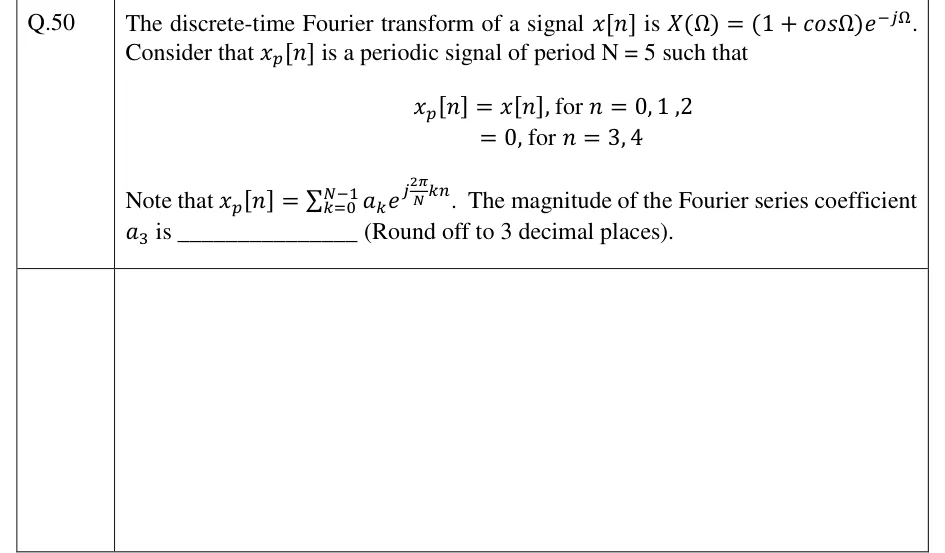
The discrete-time Fourier transform of a signal is . Consider that is a periodic signal of period such that
Note that . The magnitude of the Fourier series coefficient is ________ (Round off to 3 decimal places).

The discrete-time Fourier transform of a signal is . Consider that is a periodic signal of period such that
Note that . The magnitude of the Fourier series coefficient is ________ (Round off to 3 decimal places).
ANSWER
.
Official answer: 0.037 to 0.039Source: Official answer key, GATE 2023 EE (IIT Kanpur)
Expand the DTFT into exponentials (Euler).
Read off by comparing with . , , , and for every other . So lies entirely inside , and one period of () is exactly followed by the zeros at .
DTFS coefficients are samples of the DTFT. With the synthesis form given in the question, the analysis equation is . Since one period equals and is zero outside that period, the sum is the DTFT evaluated at :
Evaluate at , .
Take the magnitude. Since and , . Here , so
Check by direct summation (optional). , whose magnitude is , giving again.
Round to 3 decimal places: .
KEY IDEA
When one period of a periodic signal is a finite-length signal padded with zeros, its DTFS coefficients are the DTFT of sampled at equally spaced frequencies and divided by : . Here fits inside , so nothing overlaps (no time-domain aliasing) and .
WATCH OUT FOR
Forgetting the factor, which gives instead of . Another mistake is using (the angle is in the third quadrant, so its cosine is negative), which gives . Students also sometimes sample at or instead of .
From the GATE 2023 EE paper. Every question of this paper · Download the full paper · All 11 DTFT & DFT questions, with notes