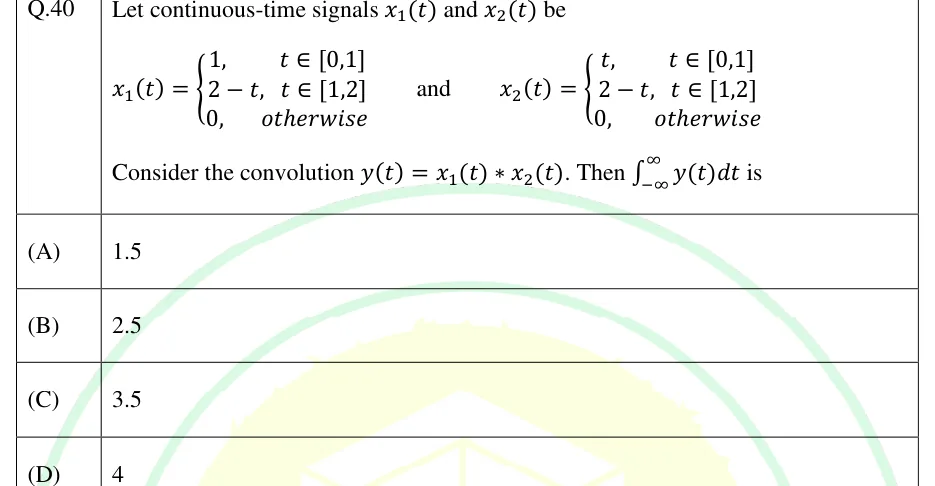
Let continuous-time signals and be
Consider the convolution . Then is
- (A)
1.5
- (B)
2.5
- (C)
3.5
- (D)
4

Let continuous-time signals and be
Consider the convolution . Then is
1.5
2.5
3.5
4
ANSWER
The area under equals (area of ) times (area of ), which is , so the answer is option (A).
Official answer: ASource: Official answer key, GATE 2025 EE (IIT Roorkee)
Area property of convolution: if , then This is , because . Directly: . Swapping the order of integration is valid here because both signals are bounded and last only a finite time.
Area of : a unit rectangle on followed by a ramp falling from 1 to 0 on :
Area of : a triangle with base and peak 1 at :
Multiply the areas: The answer is option (A).
KEY IDEA
The area under a convolution is the product of the areas of the two signals, , which is the same statement as . So you never need to work out itself.
WATCH OUT FOR
Adding the two areas instead of multiplying them: is exactly option (B). A second trap is counting only the rectangle part of and taking its area as 1, which drops the triangle of area on . Working out the full piecewise convolution also reaches 1.5, but it takes much longer and leaves more room for algebra slips.
From the GATE 2025 EE paper. Every question of this paper · Download the full paper · All 31 LTI & convolution questions, with notes