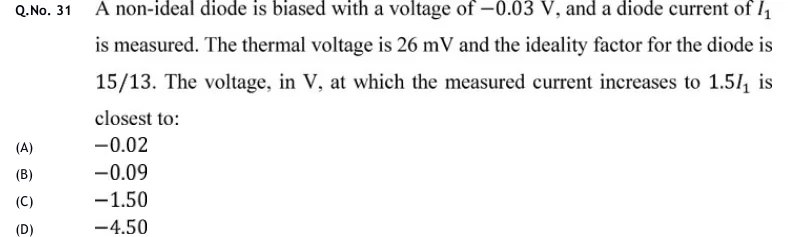
A non-ideal diode is biased with a voltage of , and a diode current of is measured. The thermal voltage is and the ideality factor for the diode is . The voltage, in V, at which the measured current increases to is closest to:
- (A)
- (B)
- (C)
- (D)

A non-ideal diode is biased with a voltage of , and a diode current of is measured. The thermal voltage is and the ideality factor for the diode is . The voltage, in V, at which the measured current increases to is closest to:
ANSWER
With , . Setting gives , so . The answer is option (B).
Official answer: BSource: Official answer key, GATE 2020 EE (IIT Delhi)
Use the Shockley diode equation with ideality factor : . The bias is only about one below zero, so the term is not negligible and must be kept.
Effective thermal voltage: .
At : , so (a reverse current).
Required current: . Set .
Solve: , so .
Hence , which is option (B). Check that a solution exists: in reverse bias the current magnitude can only approach , and is still less than .
KEY IDEA
At a reverse bias of only about one , keep the full Shockley equation . The reverse current saturates toward , so raising its magnitude by 50% (from to ) takes a lot more reverse voltage, and ends up about three times the original bias.
WATCH OUT FOR
Dropping the term and writing . That approximation holds only for forward bias well above . Using it here gives , which is distractor (A). It moves the voltage toward zero even though the reverse current is supposed to grow. A second slip is using without multiplying by the ideality factor.
From the GATE 2020 EE paper. Every question of this paper · Download the full paper · All 25 Diode circuits questions, with notes